

Lean FIRE vs Fat FIRE is not simply a choice between spending $30,000 and $100,000 a year. They are two different risk systems. Lean FIRE can fail when a non-negotiable cost such as healthcare, rent, or a bad first decade overwhelms a thin buffer. Fat FIRE usually has more room to cut spending, but it can fail through tax friction, required distributions, and a lifestyle that quietly becomes too expensive to reduce.
At a 4% withdrawal rate, $30,000 of annual spending suggests a $750,000 portfolio, while $100,000 suggests $2.5 million. Those numbers describe the size of the portfolios. They do not describe what can break each plan.
Annual spending and FIRE number by withdrawal rate
Your basic FIRE number is annual portfolio-funded spending divided by your starting withdrawal rate. A lower rate requires more savings but creates more room for a long retirement, weak early returns, and unexpected expenses.
| Annual spending | FIRE number at 4% | FIRE number at 3.5% | FIRE number at 3.25% |
|---|---|---|---|
| $30,000 | $750,000 | $857,143 | $923,077 |
| $40,000 | $1,000,000 | $1,142,857 | $1,230,769 |
| $100,000 | $2,500,000 | $2,857,143 | $3,076,923 |
| $150,000 | $3,750,000 | $4,285,714 | $4,615,385 |
Use the FIRE Number Calculator to replace these example budgets with your own spending, income, and withdrawal rate. The label matters less than whether your number includes every cost your portfolio must actually fund.
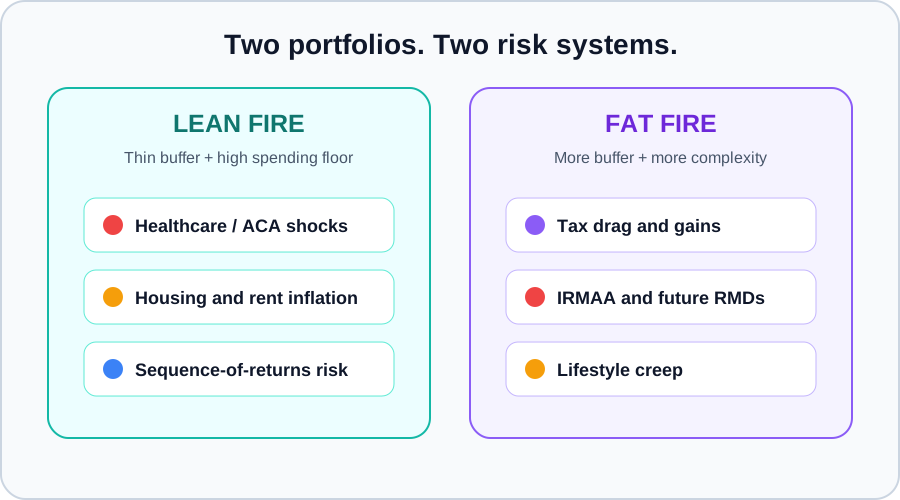
Lean FIRE and Fat FIRE are informal labels
No regulator or research body sets an official Lean FIRE or Fat FIRE threshold. The labels are useful shorthand from the FIRE community. Lean FIRE commonly means a low-cost plan near $25,000 to $40,000 of annual spending. Fat FIRE commonly means a high-comfort plan starting around $100,000 and potentially reaching far higher. Between regular and Fat FIRE, Chubby FIRE describes a comfortable plan with more margin but usually less tax complexity. For how all of these fit together, see the full map of FIRE types.
Geography and household structure can make those ranges misleading. A paid-off home in a low-cost area can make $40,000 comfortable for one household. Rent, children, or chronic healthcare needs can make the same budget unworkable for another. What matters is not whether your spending looks lean or fat to someone else. It is how much of that spending is fixed, how volatile it is, and which levers remain when conditions change.
Lean FIRE risk: a high spending floor and few levers
Lean FIRE works by keeping the portfolio-funded budget small. That can shorten the path to financial independence dramatically. But once housing, food, transportation, insurance, and healthcare consume most of the budget, there may be little optional spending left to cut. The plan is efficient, but concentrated. Our guide to calculating a durable Lean FIRE number shows how that spending floor changes the target.
Healthcare can overwhelm a thin buffer
Before Medicare eligibility, Marketplace insurance can be one of the largest and least predictable costs in Lean FIRE. For 2026, the enhanced premium tax credits that had been available during the pandemic era ended on December 31, 2025. HealthCare.gov says the pandemic-era additional savings ended on December 31, 2025, so 2026 Marketplace savings are generally less generous. For Lean FIRE, that makes income planning more important because premium credits depend on household size and estimated income.
That creates a strange Lean FIRE constraint: spending and income are not the same thing. You might spend $40,000 while creating more taxable income through a Roth conversion or capital gain. Crossing an income threshold can raise premiums even though your lifestyle did not change. Our ACA subsidies for FIRE guide explains how to track MAGI separately from cash flow.
Housing determines how lean Lean FIRE can be
Housing is often the biggest difference between a durable Lean FIRE plan and a brittle one. A paid-off home removes rent or a mortgage payment, but not property tax, insurance, or maintenance. A renter keeps flexibility to move, but remains exposed to rent increases indefinitely. The guide to Lean FIRE housing risk compares the spending floors of a renter and paid-off homeowner on the same $40,000 budget.
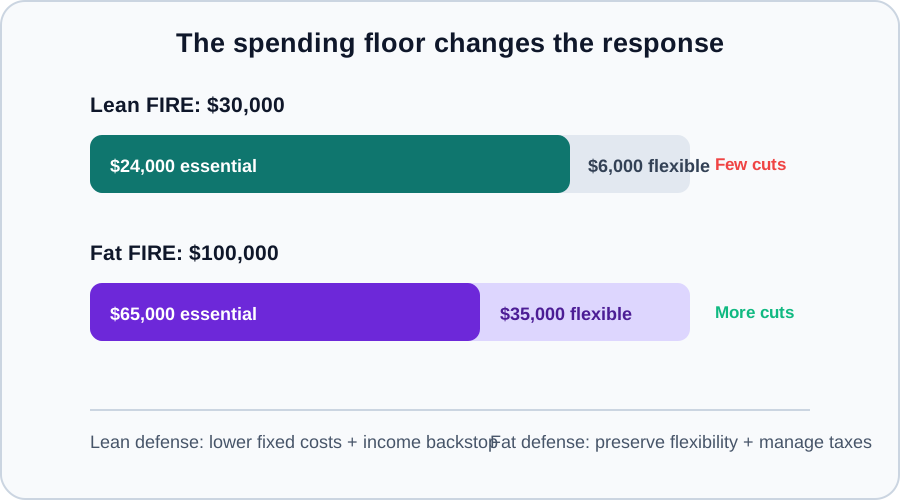
The practical test is simple: after paying housing and healthcare, how much of the annual budget remains? A $30,000 plan with $24,000 of essential costs has only $6,000 available for emergencies and cuts. A $100,000 plan with $65,000 of essential costs can remove $35,000 without immediately threatening the basics.
Sequence risk hits a rigid budget harder
Imagine a Lean FIRE household begins with $750,000 and withdraws $30,000, or 4%. If the portfolio falls 30% early, the balance drops to roughly $525,000 before considering that year's withdrawal. The same $30,000 is now about 5.7% of the reduced portfolio.
A market decline is not unique to Lean FIRE. The problem is the response. Cutting travel is easier than cutting rent, medication, or groceries. Review the evidence behind the 4% rule for long retirements and compare rates with the Safe Withdrawal Rate tool.
How to make a Lean FIRE plan more durable
- Lower the fixed spending floor, especially housing, before leaving full-time work.
- Consider a 3.25% to 3.5% starting rate when the budget has little room to flex.
- Keep a realistic backstop such as part-time income, geographic flexibility, or a return to work.
- Track healthcare MAGI and cash spending as two separate numbers.
Fat FIRE risk: friction, complexity, and drift
Fat FIRE starts with a larger portfolio and a higher-comfort lifestyle. It usually has a stronger defense against emergencies and bad markets because more spending is discretionary. Its danger is that a large portfolio creates more moving parts, while comfort spending can gradually become fixed spending.
Large balances create tax friction
A Fat FIRE household may hold millions across taxable brokerage, traditional retirement, and Roth accounts. That creates valuable choices, but also tax drag from dividends and realized gains, ordinary income from traditional withdrawals, and coordination problems between accounts.
The tax system can reward careful timing. For example, the IRS explains that some long-term capital gains can fall in a 0% federal bracket. But gains, dividends, and conversions still affect taxable income and may collide with other thresholds. A large portfolio does not remove risk; it changes the risk into a planning problem.
RMDs and IRMAA can arrive later
Large traditional IRA and 401(k) balances can eventually force taxable withdrawals. RMD starting ages depend on birth year. The IRS says required minimum distributions generally begin at age 73 for many current retirees. Under SECURE 2.0, the applicable age rises to 75 for people born on or after January 1, 1960. If those balances grow untouched for decades, future required distributions can be much larger than the household needs for spending.
Higher income can also trigger Medicare's income-related monthly adjustment amount, known as IRMAA. For 2026, CMS sets the first Part B IRMAA threshold above $109,000 for single filers and $218,000 for joint filers. The surcharge uses income from two years earlier, so a large gain or conversion can affect Medicare premiums later.
The low-income years after work but before RMDs can be useful for planned conversions. The Roth conversion ladder guide explains how those conversions can improve account access and reduce future pre-tax balances. Our guide to Fat FIRE tax planning maps how conversions, gains, RMDs, and IRMAA interact across retirement.
Lifestyle creep can quietly raise the spending floor
Fat FIRE is resilient when a meaningful share of spending remains optional. It becomes more fragile when multiple homes, private-school tuition, club dues, luxury vehicles, or recurring family support become commitments. A $150,000 lifestyle with $50,000 of flexible spending is safer than a $120,000 lifestyle with almost nothing that can be paused.
The defense is not permanent austerity. It is defining a core lifestyle and a comfort layer, then measuring both. That keeps a strong year in the market from silently rewriting the minimum lifestyle the portfolio must support forever.
Lean FIRE vs Fat FIRE after a 30% market drop
| Plan | Starting position | After a 30% drop | Most realistic response |
|---|---|---|---|
| Lean FIRE | $750,000 portfolio; $30,000 spending | Approx. $525,000; planned spending equals about 5.7% | Add income, pause inflation raises, or change location |
| Fat FIRE | $3,000,000 portfolio; $100,000 spending | Approx. $2,100,000; planned spending equals about 4.8% | Cut travel and upgrades; review gains and conversions |
Neither outcome is automatic. The Fat FIRE household takes a larger dollar loss, while the Lean FIRE household has fewer painless responses. This is not a story about Fat FIRE being safe and Lean FIRE being unsafe; it is about matching your recovery plan to the way your own plan would actually break. This simplified comparison ignores the exact timing of withdrawals and taxes so the difference in available responses stays clear.
Which FIRE style fits your plan?
Before choosing a label, answer five questions with actual dollars:
- How much of annual spending is essential and difficult to cut?
- Can housing and healthcare rise without breaking the plan?
- Could part-time work or relocation realistically cover a bad first decade?
- How much money sits in taxable, traditional, and Roth accounts?
- Can you manage conversions, capital gains, RMDs, and Medicare thresholds over time?
Lean FIRE tends to fit households with a genuinely low spending floor, flexible geography, and a credible income backstop. Fat FIRE tends to fit households that value a higher comfort level and are willing to manage more tax and account complexity. Many durable plans sit between the labels.
Common Lean FIRE vs Fat FIRE mistakes
Treating a spending range as a definition
A $40,000 renter with high medical costs may carry more risk than a $60,000 homeowner with a paid-off house and flexible work. Classify the plan by its vulnerabilities, not internet thresholds.
Assuming more money removes planning risk
A larger portfolio creates more margin, but it can also create larger taxable events, future required distributions, and a lifestyle that expands faster than the original plan.
Using one withdrawal rate without testing flexibility
A 4% plan with flexible spending and future income may be more resilient than a rigid 3.5% plan. Test both the number and your response to a poor market.
Lean FIRE vs Fat FIRE FAQ
Is Lean FIRE riskier than Fat FIRE?
Lean FIRE usually has less financial margin and fewer expenses to cut, so healthcare, housing, and early market losses can be more dangerous. Fat FIRE has more cushion but faces greater tax complexity and lifestyle-inflation risk.
How much do you need for Lean FIRE?
At $30,000 of annual portfolio-funded spending, the basic target is $750,000 at 4%, $857,143 at 3.5%, or $923,077 at 3.25%. Your real target must also include taxes, healthcare, and irregular expenses.
How much do you need for Fat FIRE?
At $100,000 of annual spending, the basic target is $2.5 million at 4%, about $2.86 million at 3.5%, or about $3.08 million at 3.25%. Higher spending requires proportionally more.
Can you move from Lean FIRE to Fat FIRE?
Yes. Continuing part-time work, allowing the portfolio to grow, or reducing major fixed costs can move a household between FIRE styles. The labels describe a plan, not a permanent identity.
What to read next
The bottom line
Lean FIRE and Fat FIRE both exchange earned income for portfolio dependence, but they demand different defenses. Lean FIRE needs protection against shocks that hit a high spending floor. Fat FIRE needs protection against taxes, complexity, and a comfort layer that becomes impossible to cut.
Build the plan around its weakest system. For Lean FIRE, create more buffer and a credible income backstop. For Fat FIRE, create tax flexibility and keep optional spending optional. The better plan is the one whose failure modes you can see and manage.
This article is educational and does not constitute tax, legal, healthcare, or financial advice. Withdrawal rates are planning assumptions, not guarantees. Tax and benefit rules can change, and individual costs vary.