

Slow FIRE is financial independence on a gentler savings rate — roughly 15–25% of your pay instead of the 50–70% often associated with aggressive FIRE. These are community ranges, not official thresholds. The trade is simple: you keep more of your money for the life you're living now, and you reach independence later. Save 20% from a zero start and you're about 37 years from full financial independence; push to 50% and it's closer to 17 years. Slow FIRE picks the slower lane on purpose — but it is still a real, portfolio-based path to independence, not a watered-down one.
The catch is that "slower" only works if you keep investing consistently. A slow plan that quietly stops contributing isn't Slow FIRE — it's just spending. This guide covers what Slow FIRE actually is, how your savings rate sets your timeline, where Coast FIRE fits, and the few things that quietly break a slow plan.
What is Slow FIRE?
Slow FIRE (often called Slow FI) means pursuing financial independence at a deliberately relaxed pace, with a lower savings rate and a longer timeline, so you can enjoy more of your life today instead of deferring everything to a future quit date. The term "Slow FI" was coined by Jessica and Corey at The Fioneers, who describe it as using the incremental financial freedom you gain along the way to "live happier and healthier lives, do better work, and build strong relationships" — rather than grinding to an all-or-nothing finish line.
It solves a real problem: burnout and deprivation. A 50–70% savings rate works for a single high earner with cheap rent, but it's out of reach (or just miserable) for people with kids, a mortgage, or a normal cost of living. Slow FIRE makes independence accessible to them — and, importantly, you're still investing toward a portfolio that can fund spending one day. That is what separates it from simply "not doing FIRE." If you eventually want a larger FIRE target with more comfort and margin, see Chubby FIRE.
Slow FIRE vs. aggressive FIRE
| Dimension | Slow FIRE | Aggressive FIRE |
|---|---|---|
| Savings rate | ~15–25% of pay | ~50–70% of pay |
| Timeline to full FI | Decades (often ~20–37 years) | ~10–17 years |
| Lifestyle today | More balance and spending now | Heavy frugality and deferral |
| Burnout risk | Lower — pace is sustainable | Higher — intensity is the point |
| Margin for error | Thinner buffers; consistency matters more | Larger surplus absorbs surprises |
The honest tradeoff sits in that last row. A slower saver builds thinner buffers against a market downturn, a job loss, or a planning miscalculation — so for Slow FIRE, consistency matters even more than for the aggressive version. The aggressive saver can absorb a bad year inside a fat surplus; the slow saver needs the habit to never break.
How your savings rate sets the timeline
The most important idea in all of FIRE comes from Mr. Money Mustache's "Shockingly Simple Math Behind Early Retirement": your savings rate — the share of take-home pay you invest — drives how long you take to reach independence, far more than your raw income. The reason is that saving more does double duty: it builds the portfolio faster and proves you can live on less, which lowers the number you need.
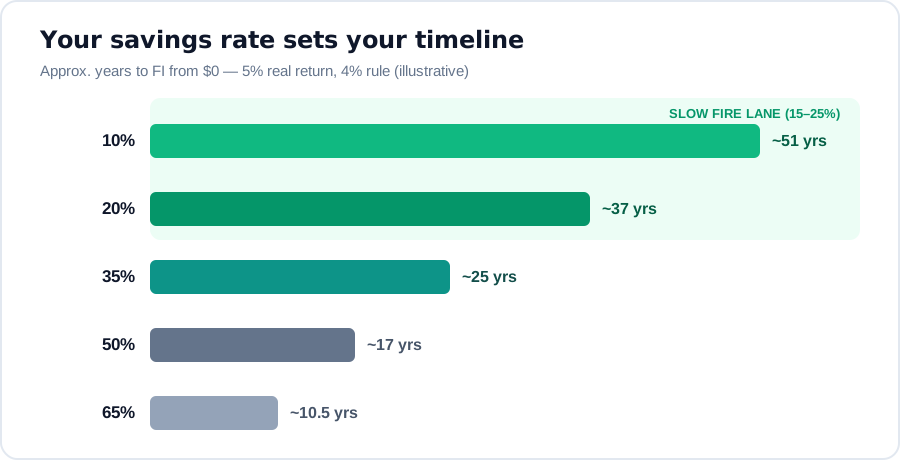
Here is the approximate time to full FI from a zero balance, assuming a conservative 5% real return and the 4% rule (25× annual spending):
| Savings rate | Approx. years to FI (from $0) | What it realistically buys |
|---|---|---|
| 10% | ~51 years | Optionality and a future downshift, not early retirement |
| 15% | ~43 years | Traditional-age retirement plus flexibility |
| 20% | ~37 years | The sustainable Slow FIRE middle |
| 25% | ~32 years | Coast FIRE early; real choices in your 40s |
| 35% | ~25 years | Genuine early retirement in your 50s |
| 50% | ~17 years | Classic aggressive FIRE |
| 65% | ~10.5 years | Extreme, single-high-earner FIRE |
These are illustrative, not predictions: they assume no starting balance, steady real returns, and constant spending, and real life varies on all three. The 5% real figure is deliberately conservative compared with the ~7% real often quoted for US stocks.
Why a lower rate still builds real optionality
At 10%, full retirement at 40 is off the table on that rate alone — about 51 years from zero. But 10% is far from pointless. It still funds an emergency fund, crosses Coast FIRE over time, and pays for flexibility like a future career break or a lower-stress job. A 20% rate lands you near traditional retirement timing if you start in your late 20s — but Coast FIRE often arrives a decade or two sooner, unlocking a downshift well before the finish line. Optionality compounds even when "retirement" is still decades away.
Is Slow FIRE real financial independence?
Yes — and this is the key distinction. Slow FIRE is portfolio-based. You are building invested assets that will eventually fund your spending through withdrawals, which is the definition of financial independence. That makes it fundamentally different from a mini-retirement, which spends down a cash pile and ends when the money runs out.
The condition is consistency. Slow FIRE relies on the same compounding engine as every other FIRE path, just over a longer runway — and that engine only works if you keep feeding it. Run your own contribution and growth assumptions through a compound interest calculator and you'll see how much of the final balance comes from growth versus contributions on a multi-decade horizon. Stop investing halfway and you don't get "most of Slow FIRE" — you break the part doing the heavy lifting.
How Slow FIRE pairs with Coast FIRE
Coast FIRE is the natural first milestone of a Slow FIRE plan. It's the point where your invested balance is large enough that compound growth alone — with zero new contributions — will reach your full FIRE number by traditional retirement age. After that, you only need to earn enough to cover today's bills.
For a 30-year-old targeting a $1,250,000 portfolio (a $50,000-a-year retirement at the 4% rule), retiring at 65 with a 7% return and 3% inflation — about a 3.9% real return — the Coast FIRE number is roughly $329,000 invested today. Hit that, and a Slow FIRE saver can ease off the savings pedal, redirect cash to current life, or switch to lighter work. See what Coast FIRE is for the full worked example and a number-by-age table. To see how that milestone compares with part-time-income and full-portfolio paths, jump to Regular FIRE vs Coast FIRE vs Barista FIRE.
What can quietly break a Slow FIRE plan
Because the buffers are thinner, the failure modes are subtle. These are the three that matter most, and they overlap with the biggest FIRE planning mistakes.
Lifestyle inflation
This is a common way a Slow FIRE plan breaks. When "save less, live more" slides into "save nothing, spend everything," the slow path becomes the never path. Worse, lifestyle creep is double trouble: it lowers your savings rate and raises your future FIRE number, because you now need 25× a bigger budget. As raises arrive, push them toward investing before lifestyle absorbs them.
Housing cost
Housing is often a household's largest expense and one of the biggest levers on both your savings rate and your FIRE number. A budget that ignores rent or mortgage drift makes every projection wrong. Keeping housing in check is often what makes a 20% savings rate possible at all.
Stopping investing too early
Slow FIRE and Coast FIRE both require consistent investing. Cutting it short — to fund a purchase, or because the goal feels distant — breaks the compounding the whole plan relies on. The first dollars invested are the most powerful because they compound the longest, so a gap early in the plan is the most expensive kind.
Healthcare and account access before 65 and 59½
Whenever your slow plan finally lets you stop working before 65, two government rules decide whether it holds together.
Healthcare before Medicare. Medicare eligibility generally begins at 65, so an earlier exit means self-funding coverage, often through the ACA marketplace. For 2026, the enhanced premium tax credits from the American Rescue Plan expired at the end of 2025, and the 400%-of-poverty "subsidy cliff" returned under current law — above that income, you can lose the premium tax credit entirely. Congress has actively debated extensions, so verify the current law before you rely on it. Either way, managing ACA MAGI and the other subsidy inputs becomes a core part of the plan; see the 2026 ACA subsidy cliff for FIRE.
Account access before 59½. Withdrawing from a 401(k) or traditional IRA before age 59½ generally triggers a 10% early-withdrawal penalty plus ordinary income tax (IRS Topic No. 558). FIRE savers bridge that gap with a Roth conversion ladder, a taxable brokerage account, or the Rule of 55 — not by paying the penalty.
Who Slow FIRE fits — and who it doesn't
| Slow FIRE fits you if… | Slow FIRE doesn't fit if… |
|---|---|
| You dislike extreme frugality but want long-term security | You hate your job and want out fast |
| You have kids, a mortgage, or higher living costs | You won't invest consistently for decades |
| You can automate a steady 15–25% and leave it alone | You need to retire in ~10 years no matter what |
If your real problem is a specific job you can't stand, a slow path keeps you in it longer — a mini-retirement or a job change may fit better. Slow FIRE is for people who want balance now and eventual freedom, and are willing to trade speed for both.
Slow FIRE FAQ
What savings rate counts as Slow FIRE?
There's no official threshold, but Slow FIRE typically means roughly 15–25% of take-home pay, versus the 50–70% associated with aggressive FIRE. The defining feature is choosing a sustainable pace on purpose, not the exact percentage.
Is Slow FIRE just saving normally?
Not quite. A normal saver may have no target; Slow FIRE is deliberate financial independence with a known FIRE number, consistent investing, and milestones like Coast FIRE — just on a longer runway with more life along the way.
Can I reach financial independence saving only 20%?
Yes, eventually. At a 20% rate from a zero start, full FI is roughly 37 years away under a 5% real return and the 4% rule — close to traditional retirement timing if you start young — and Coast FIRE arrives much sooner. The numbers are illustrative, so test your own.
How is Slow FIRE different from Coast FIRE?
Slow FIRE is the overall strategy (lower savings rate, longer timeline). Coast FIRE is a milestone within it: the point where you've invested enough that you can stop contributing and let compounding finish the job by retirement age.
What's the biggest risk with Slow FIRE?
Lifestyle inflation quietly absorbing the slower savings, so "slow" becomes "never." Because buffers are thinner than in aggressive FIRE, staying consistent and keeping housing costs in check matter more.
What to read next
All timelines and dollar figures assume steady real returns, the 4% rule, and constant spending; they are illustrative planning tools, not predictions. Tax, ACA, and contribution rules change yearly — verify current figures with IRS.gov and HealthCare.gov. This article is educational and does not constitute financial advice.