

The 4% rule is still a useful starting point, but it is not automatically safe for FIRE. It was built around a roughly 30-year retirement. If you retire in your 40s and need your portfolio to last 50 years or more, a fixed 4% withdrawal leaves much less room for bad markets, high inflation, taxes, fees, and surprise expenses.
For a long early retirement, a starting rate around 3.25% to 3.75% is a more cautious planning range when spending must stay steady. Starting near 4% can still be reasonable when you keep investment costs low, can reduce optional spending after bad years, and expect future income such as Social Security or part-time work.
What the choice means in real dollars
Say you expect to spend $60,000 a year after leaving full-time work. Your target changes sharply depending on the withdrawal rate:
| Starting withdrawal rate | Portfolio needed | Extra savings versus 4% |
|---|---|---|
| 4.0% | $1,500,000 | — |
| 3.75% | $1,600,000 | $100,000 |
| 3.5% | $1,714,000 | $214,000 |
| 3.25% | $1,846,000 | $346,000 |
The lower rate is not free: it may require several more years of saving. But you do not have to choose only between working longer and taking more risk. Cutting annual spending from $60,000 to $55,000 lowers a 3.5% target from about $1.71 million to $1.57 million. Part-time income can reduce it further.
What the 4% rule actually assumes
The classic rule starts with 4% of your original portfolio, then raises that dollar amount with inflation every year. With $1.5 million, you withdraw $60,000 in year one. If inflation is 3%, year two rises to $61,800 even if the market fell.
That approach came from historical US market tests and was designed around a retirement of about 30 years. It assumes a diversified stock-and-bond portfolio and asks whether money remains at the end. It does not promise a smooth ride, account for every tax and fee, or guarantee success in the future.
If you want the basic formula first, read our 4% rule explainer, and the FIRE number formula for how the chosen rate turns into the target portfolio. The important question here is whether those assumptions fit an early retirement.
Why FIRE changes the answer
A 50-year retirement is not a 30-year retirement
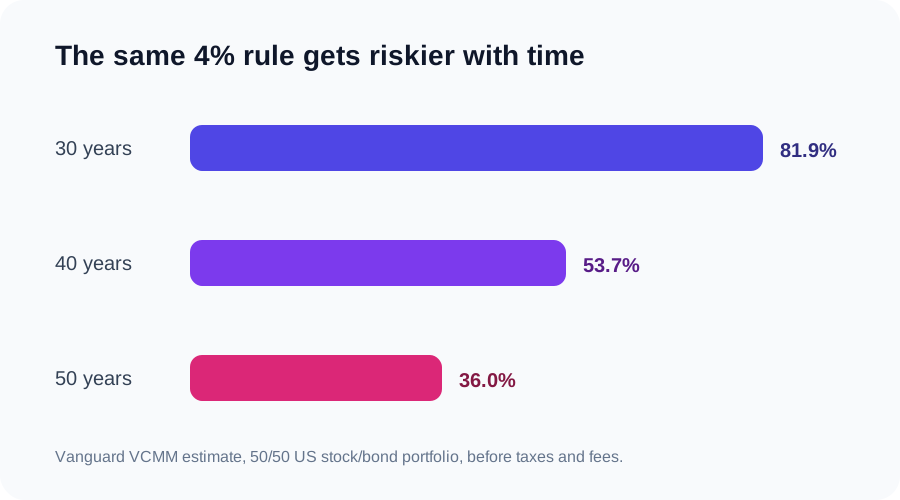
Time is the biggest issue. Vanguard's FIRE guidance explains why a rule built around a 30-year retirement needs adjustment for a retirement lasting 50 years or more. Its 50/50 US stock-and-bond model using a fixed 4% inflation-adjusted withdrawal estimated that success fell from 81.9% over 30 years to 53.7% over 40 years and 36.0% over 50 years, before taxes and fees.
Those figures are model estimates, not a forecast for your portfolio. Still, the lesson is practical: retiring at 40 with the same rule used by someone retiring at 65 is a major assumption, not a small adjustment.
Bad returns early in retirement hurt more
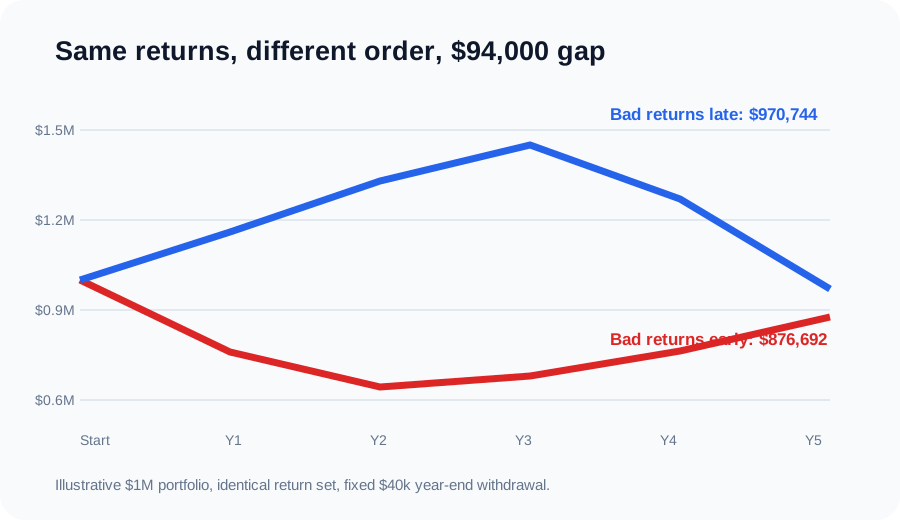
Two investors can earn similar average returns and get very different outcomes because the order of returns matters. If your portfolio drops early, withdrawals force you to sell more shares while prices are low. Fewer shares remain to benefit from the recovery. This is sequence of returns risk, and it is one of the most dangerous risks in an early retirement's first decade.
Imagine your $1.5 million portfolio falls 25% to $1.125 million near the start of retirement. Your planned $60,000 withdrawal is no longer 4% of the remaining balance. It is about 5.3%. Continuing to increase that withdrawal with inflation can make recovery difficult.
Inflation, fees, and taxes quietly raise the pressure
High inflation early in retirement is especially painful because the classic rule raises withdrawals while the portfolio may already be struggling. Fees also compound against you for decades. Vanguard's same 50-year model showed sharply worse outcomes as annual costs increased.
Taxes create another gap between the number in a calculator and cash available to spend. A $60,000 lifestyle may require withdrawals above $60,000 when much of the money comes from a traditional 401(k) or IRA. Healthcare before age 65 can also be a large and uneven cost, so include it explicitly using our healthcare before Medicare guide.
What current retirement research says
Recent research has not made the 4% rule useless. It has made the answer more conditional.Morningstar's 2025 retirement-income research for 2026 retirees estimated a 3.9% starting rate for fixed, inflation-adjusted spending over 30 years with a 90% success target. That is close to 4%, but it still addresses a conventional 30-year retirement, not a 50-year FIRE plan.
The same research found that flexible spending methods could support higher starting withdrawals because retirees agreed to cut spending when markets disappointed. Separate Vanguard research found that modest adjustments during difficult early years greatly improved outcomes. The useful takeaway is simple: flexibility has financial value.
How to make a 4% FIRE plan more resilient
Separate needs from wants
Build a core budget for housing, food, insurance, and healthcare. Then identify travel, upgrades, gifts, and other spending you could pause after a bad market year. A household spending $60,000 with $15,000 of flexible expenses has more room than one with $60,000 of fixed bills.
Use simple spending guardrails
You do not need a complicated formula. Review the plan once a year. After a poor market year, skip the inflation raise or reduce optional spending. After strong years, allow a measured increase. The goal is to avoid blindly increasing withdrawals while your portfolio is under stress.
Plan for income bridges
Even modest income changes the math. If part-time work covers $15,000 of a $60,000 budget, the portfolio initially needs to provide only $45,000. That can make Barista FIRE a safer bridge instead of an all-or-nothing retirement date.
Later, Social Security can reduce the amount your investments must supply. Our Social Security bridge guide explains how portfolio withdrawals and delayed benefits can work together.
Keep costs low and diversify
Long retirements magnify small annual costs. Use the 4% rule on the money that can actually support spending after investment fees and taxes, not an idealized gross portfolio. A diversified portfolio also gives you more than one source to rebalance or sell when one market is struggling.
Choose a rate that fits your actual plan
A withdrawal rate is not a personality test. Choosing 3.5% does not make you cautious, and choosing 4% does not make you reckless. The right starting point depends on what the portfolio must do and what you are willing to change. Just watch that chasing an ever-lower rate does not turn into one more year syndrome, where each added year of work buys less and less extra safety.
| Your situation | A practical starting approach | What to verify |
|---|---|---|
| Retiring near 65 with flexible travel spending | Test around 4% | 30-year horizon, Social Security, healthcare, and taxes |
| Retiring in your early 50s | Compare 3.5% to 4% | 40-year horizon and ability to skip inflation raises |
| Retiring in your 30s or 40s with fixed expenses | Start testing around 3.25% to 3.5% | 50-year horizon, large spending shocks, and future income |
| Leaving full-time work but earning part-time income | Model Barista FIRE separately | How long the income lasts and whether it includes healthcare |
Also run a bad-start scenario before declaring yourself financially independent. Assume stocks fall during your first year, inflation stays uncomfortable, and one major expense arrives earlier than expected. Then ask what you would actually do. Could you earn $10,000 for a year, delay a car purchase, or cut travel? A plan with clear responses is more useful than one that only works when every average assumption arrives on schedule.
Recheck the plan annually using your current portfolio and expected spending. You do not need to react to every market headline. You do need to notice when a $60,000 withdrawal has become an unusually large share of the remaining portfolio. That is the moment to adjust, not after several years of hoping the original percentage will rescue the plan.
Common mistakes when using the 4% rule
- Calling 4% guaranteed. It is a planning rule based on assumptions, not a promise.
- Ignoring retirement length. A plan beginning at 40 needs more margin than one beginning at 65.
- Using current spending without adjustments. Add taxes, healthcare, home repairs, and irregular costs.
- Refusing to change spending. Small early cuts can be more effective than waiting until the portfolio is badly damaged.
- Counting income twice. Do not subtract Social Security or part-time income from expenses and also add it again elsewhere in the plan.
- Chasing the perfect rate. A reasonable rate plus an annual review is stronger than a precise-looking number you never revisit.
Calculate your FIRE plan with more than one rate
Do not run only a 4% scenario. Compare 4%, 3.75%, 3.5%, and 3.25%, then decide how much flexibility you are willing to trade for an earlier retirement date.
You can also use the Coast FIRE Calculator to see when compounding may finish the job, or the Barista FIRE Calculator to model part-time income before full financial independence.
Frequently asked questions
Is the 4% rule safe for 50 years?
It should not be treated as reliably safe for 50 years when withdrawals stay fixed and inflation-adjusted. A 50-year horizon gives poor returns, inflation, and costs much more time to damage the plan. Many FIRE households use a lower rate or flexible spending.
What withdrawal rate should FIRE investors use?
There is no universal rate. For a 40- to 50-year plan with mostly fixed spending, 3.25% to 3.75% is a cautious starting range. A rate near 4% becomes more reasonable when spending is flexible and future income will reduce portfolio withdrawals. For a worked example of how the target changes at the longest horizons, see how much you need to retire at 45.
Does the 4% rule include taxes?
Not automatically. Your planned withdrawal must cover taxes as well as spending. Account type and withdrawal order determine how much of each dollar remains available.
Does Social Security change the 4% rule?
Yes. Once Social Security begins, your portfolio may need to fund a smaller spending gap. Model the years before and after benefits separately instead of assuming the same withdrawal forever.
Should I use 3.5% instead of 4%?
A 3.5% rate provides more margin but requires about 28.6 times annual spending instead of 25 times. It can be a sensible baseline for early retirees who want steady spending, but it is still not a guarantee.
The bottom line
The 4% rule is still useful because it turns retirement spending into a clear target. But for FIRE, it works best as a starting scenario rather than a set-and-forget rule. Longer horizons make early market losses, inflation, costs, and rigid spending more dangerous.
Build your plan around a range of withdrawal rates, keep optional spending flexible, and include future income and major costs. The safest useful plan is not necessarily the one with the lowest rate. It is the one you can monitor and adjust before small problems become large ones. The amount of flexibility you have also depends on your FIRE style; our Lean FIRE vs Fat FIRE comparison explains why a thin essential-spending budget and a larger discretionary budget fail differently.
What to read next
This article is educational and does not constitute financial advice. Research findings and modeled success rates depend on their assumptions and do not predict future results.