

The main types of FIRE all run on one formula. Lean, Regular, Chubby, Fat, Coast, and Barista FIRE differ mostly in two numbers: how much you plan to spend each year, and whether you keep earning income. Take your annual spending, divide by your withdrawal rate, and you have the portfolio target. At a 4% rate, $50,000 of spending means a $1,250,000 portfolio. The labels just describe where you sit on that scale — and how you get there.
That means you do not have to pick a tribe. You pick a spending level you can live on and a plan for covering it: a full portfolio (Lean, Regular, Chubby, Fat), or a portfolio plus ongoing income (Coast, Barista). This guide explains all six, shows the rough numbers behind each, and helps you choose based on your own budget rather than an internet definition.
The types of FIRE at a glance
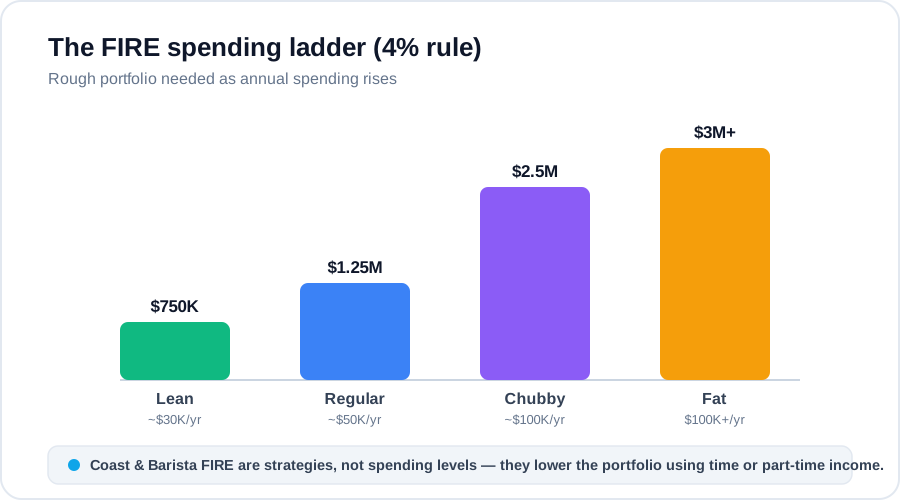
Four of these labels — Lean, Regular, Chubby, and Fat — describe a spending level and assume your portfolio covers everything. Two of them — Coast and Barista — describe a strategy that lets you stop saving or keep working part-time. The portfolio targets below use a 4% withdrawal rate and are illustrative starting points, not forecasts.
| FIRE type | Typical annual spending | Rough portfolio at 4% | Still earning income? |
|---|---|---|---|
| Lean FIRE | $25,000–$40,000 | $625,000–$1,000,000 | No |
| Regular FIRE | ~$50,000 | ~$1,250,000 | No |
| Chubby FIRE | $80,000–$150,000 | $2,000,000–$3,750,000 | No |
| Fat FIRE | $100,000+ | $2,500,000+ | No |
| Coast FIRE | Today's bills (any level) | Front-load, then $0 new saving | Yes, to cover current spending |
| Barista FIRE | Part covered by work | Smaller; part-time income fills the gap | Yes, part-time |
Use the FIRE hub to run any of these with your own spending and withdrawal rate. The label matters less than whether your number includes every cost the portfolio must actually fund — especially healthcare and taxes.
The one formula behind every type
Every FIRE type starts from the same calculation:
At a 4% withdrawal rate, dividing by 0.04 is the same as multiplying by 25, which is why FIRE is often described as "25× your spending." The FIRE number formula explains why, and our guide to the 4% rule covers where that 4% comes from — and why many early retirees use 3.5% or 3.25% for a 40- to 50-year retirement.
The four spending-based types simply move the spending input up or down. Coast and Barista change the strategy instead: Coast FIRE front-loads the portfolio early and lets compounding finish the job, while Barista FIRE subtracts part-time income from spending before dividing.
Lean, Regular, Chubby, and Fat FIRE: the spending ladder
These four are the same idea at different budgets. None of them are official categories — no regulator or research body sets a Lean or Fat threshold. They are useful community shorthand, and the boundaries blur.
Lean FIRE: a low-cost, efficient plan
Lean FIRE commonly means roughly $25,000 to $40,000 of annual spending, or a $625,000 to $1,000,000 portfolio at 4%. The appeal is speed: a smaller number arrives years sooner. The catch is fragility — once housing, food, and healthcare consume most of a thin budget, there is little left to cut in a bad year. Our guide to a durable Lean FIRE number shows how the spending floor changes the real target.
Regular FIRE: the standard 25× target
Regular (or "traditional") FIRE is the baseline most people picture: around $50,000 of spending and a $1,250,000 portfolio at 4%, with the portfolio covering everything and no required ongoing work. It is the reference point the other types adjust from.
Chubby FIRE: comfort with less complexity
Chubby FIRE sits between Regular and Fat — commonly $80,000 to $150,000 of spending, or a $2 million to $3.75 million portfolio. It buys real margin and comfort without the full tax complexity of a very large portfolio. See Chubby FIRE explained for the middle-path math.
Fat FIRE: high comfort, more moving parts
Fat FIRE usually starts around $100,000 of annual spending — a $2.5 million-plus portfolio — and can go far higher. More money means more cushion against bad markets, but also more tax friction: large pre-tax balances, required distributions, and Medicare surcharges later. The comparison of Lean FIRE vs Fat FIRE treats these as two different risk systems, and Fat FIRE tax planning maps where the friction comes from.
Coast FIRE: stop saving, keep working for now
Coast FIRE is the moment your invested balance is large enough to grow into your full FIRE number on its own, with no further contributions. You still work to pay today's bills, but every retirement dollar is already invested. For a $1.25 million goal at age 65, a 30-year-old needs about $329,000 invested today, assuming a 7% return and 3% inflation (about a 3.9% real return). At 25 it is about $272,000; at 40 it is about $482,000 — time, not contribution size, is the lever. Full details are in what is Coast FIRE.
Barista FIRE: part-time income shrinks the number
Barista FIRE keeps part-time or lower-stress work that covers part of your spending, so the portfolio covers less. Spend $50,000 and earn $20,000 part-time, and the portfolio only has to fund $30,000 — about $750,000 at 4% instead of $1,250,000. Every $1,000 of reliable annual income removes $25,000 from the target. The name comes from part-time jobs that historically offered health benefits; see what is Barista FIRE for the full breakdown.
Healthcare and taxes differ by type
Two FIRE plans with the same portfolio can face very different risks, because the type shapes your exposure to the two costs that break early-retirement budgets: healthcare before 65 and taxes after.
Lean and Barista FIRE live closest to the healthcare cliff. Before Medicare eligibility at 65, Marketplace insurance is often the largest unpredictable cost. For 2026, the enhanced premium tax credits from the pandemic era have ended — HealthCare.gov confirms the additional savings ended on December 31, 2025, so 2026 subsidies are generally less generous and income planning matters more. A Barista FIRE job with employer coverage can sidestep that math entirely, which is often worth more than the wage itself.
Fat FIRE carries the heaviest tax tail. Large traditional 401(k) and IRA balances eventually force taxable withdrawals. The IRS sets required minimum distributions to generally begin at age 73 for many current retirees (rising to 75 for people born in 1960 or later). Those forced distributions can also push income past Medicare's surcharge thresholds: for 2026, CMS sets the first Part B IRMAA threshold above $109,000 for single filers and $218,000 for joint filers. That is why bigger FIRE plans need more tax planning, not less.
Which type of FIRE fits you?
Answer four questions with real dollars before choosing a label:
- What annual spending can you genuinely live on, including healthcare and taxes? That sets Lean vs Regular vs Chubby vs Fat.
- Do you want to stop working entirely, or keep some income? Income points you toward Coast or Barista.
- How many years until you want the portfolio to stand on its own?
- How much of your spending is fixed and hard to cut if markets fall early?
| If your goal is… | Look first at |
|---|---|
| The fastest exit on a low budget | Lean FIRE |
| A comfortable lifestyle with margin | Chubby or Fat FIRE |
| Stop saving but keep your current job for now | Coast FIRE |
| Leave the career but keep flexible part-time income | Barista FIRE |
Common mistakes with FIRE types
Treating the label as a rule
A $40,000 renter with high medical costs may carry more risk than a $60,000 homeowner with a paid-off house. Classify your plan by its vulnerabilities, not by which spending bucket it lands in.
Forgetting Coast and Barista still need income
Neither Coast nor Barista FIRE means you have stopped relying on a paycheck. Coast FIRE still needs income for today's bills; Barista FIRE still needs reliable part-time income. Lose that income and the plan changes.
Copying someone else's number
The same dollar target can be safe for one household and brittle for another. Geography, housing, health, and account mix change the answer more than the label does. Review the biggest FIRE planning mistakes before locking in a plan that only works if everything goes right.
Types of FIRE FAQ
What are the main types of FIRE?
The most common types are Lean FIRE (low spending), Regular FIRE (standard 25× target), Chubby FIRE (comfortable middle), Fat FIRE (high spending), Coast FIRE (stop saving, keep working), and Barista FIRE (part-time income covers part of spending). They share the same underlying formula.
What is the difference between Coast and Barista FIRE?
Coast FIRE means your invested balance is large enough to grow into retirement on its own, so you stop saving but keep working to cover current bills without touching the portfolio. Barista FIRE means you leave full-time work and use part-time income to cover part of your spending while the portfolio covers the rest. See Coast FIRE vs Barista FIRE for the direct comparison.
Which type of FIRE is easiest to reach?
Coast and Barista FIRE usually require the smallest portfolio because you keep some income. Lean FIRE requires the smallest full portfolio because spending is low. Fat FIRE requires the most. Easier to reach is not the same as safer — lower targets often rely on continued income or a thin spending buffer.
Can you switch FIRE types over time?
Yes. Many people Coast for a few years, shift to Barista FIRE when they leave a career, then reach Regular or Fat FIRE as the portfolio grows. The labels describe a plan at a moment in time, not a permanent identity. You can also vary the pace — a Slow FIRE plan reaches the same numbers on a lower savings rate — or take a mini-retirement as a funded break without changing the destination.
What to read next
The bottom line
The types of FIRE are not six different goals — they are six positions on one equation. Pick the spending level you can sustain, decide whether you want ongoing income, and the formula gives you the target. Then pressure-test it against the costs that actually break plans: healthcare before 65 and taxes after.
Choose the path whose failure modes you can see and manage, not the one with the most appealing name. The best FIRE type is simply the one that fits your real budget, your tolerance for work, and your willingness to plan around taxes and healthcare.
This article is educational and does not constitute tax, legal, healthcare, or financial advice. Withdrawal rates and portfolio targets are planning assumptions, not guarantees. Tax, healthcare, and benefit rules can change, and individual costs vary.