

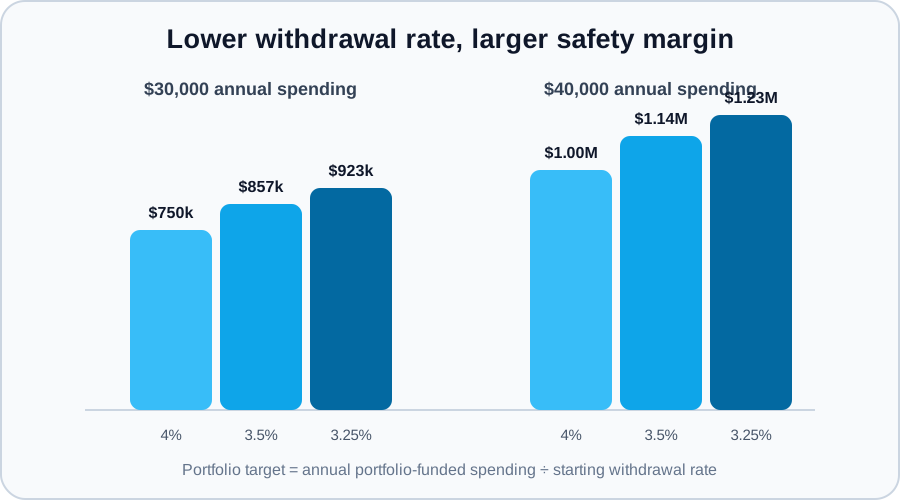
A lean FIRE number starts at $750,000 if your portfolio must fund $30,000 a year and you use a 4% withdrawal rate. But that is the mathematical minimum, not automatically enough. Because a Lean FIRE budget is mostly housing, healthcare, food, and transportation, you often need a larger margin of safety than someone with more optional spending.
For a long early retirement, testing 3.5% and 3.25% raises that same $30,000 target to $857,143 and $923,077. The right number is the smallest portfolio that can fund your spending floor through bad markets, inflation, and expensive surprises without requiring cuts you cannot actually make.
Lean FIRE number by annual spending
| Annual spending | At 4% | At 3.5% | At 3.25% |
|---|---|---|---|
| $30,000 | $750,000 | $857,143 | $923,077 |
| $35,000 | $875,000 | $1,000,000 | $1,076,923 |
| $40,000 | $1,000,000 | $1,142,857 | $1,230,769 |
| $50,000 | $1,250,000 | $1,428,571 | $1,538,462 |
The formula is annual portfolio-funded spending divided by your withdrawal rate. Use the FIRE Number Calculator to replace the examples with your own expenses and rate. These figures assume the portfolio funds the full budget; they do not yet subtract future income or add one-time reserves.
The Lean FIRE risk profile
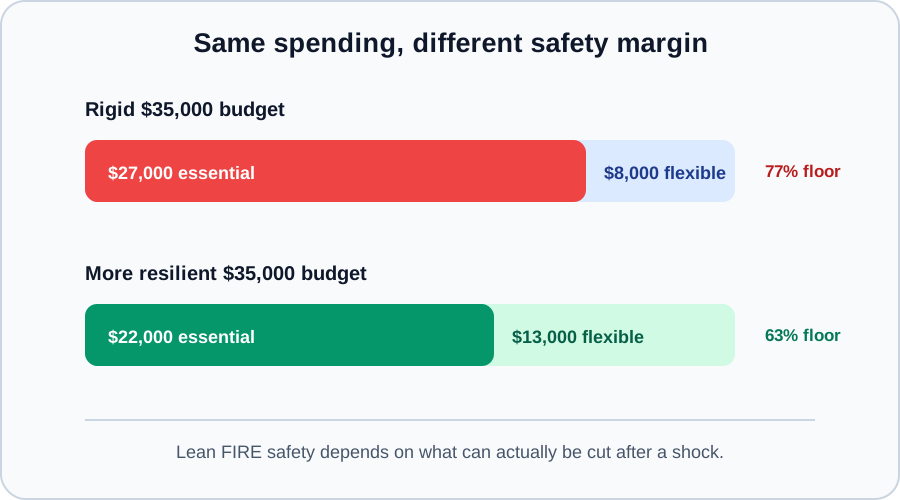
Lean FIRE is not merely regular FIRE with a smaller portfolio. As explained in our Lean FIRE vs Fat FIRE comparison, its risk profile is different because most spending is non-discretionary. If $27,000 of a $35,000 budget pays for essentials, only $8,000 can be reduced when markets fall or costs rise. A larger-budget retiree may be able to pause expensive travel or upgrades without touching the basics.
This is the key question: how much of your budget is a spending floor? Add housing, basic food, healthcare, insurance, utilities, essential transportation, taxes, and minimum family obligations. Then separate travel, dining, upgrades, gifts, and optional hobbies. A Lean FIRE plan with a low floor can be durable. A plan where nearly every dollar is essential needs more portfolio margin or another backstop.
Healthcare and ACA costs can move the number
Healthcare before Medicare can break an otherwise careful Lean FIRE budget. Marketplace premiums depend on age, location, household size, plan, and income. For 2026, HealthCare.gov says the additional pandemic-era premium savings ended on December 31, 2025, and qualifying households will likely pay more than they did in 2025.
Your spending and your ACA income are also different numbers. You might spend $35,000 while realizing more income through capital gains or a Roth conversion. The same HealthCare.gov guidance states that the premium tax credit depends on household size and estimated income, so a tax move can raise insurance costs without changing your lifestyle.
Build the plan with a realistic gross premium, deductible, and out-of-pocket reserve before assuming subsidies. Then read the guides to health insurance before Medicare and ACA subsidies for FIRE to model the bridge and MAGI separately.
Housing risk determines how lean you can go
Housing is usually the most powerful Lean FIRE lever because it is both large and difficult to cut quickly. The Bureau of Labor Statistics reported that shelter represented 35.625% of the CPI market basket in December 2025. A renter remains exposed to future rent increases. A paid-off homeowner removes rent or a mortgage payment, but still needs room for property tax, insurance, maintenance, and major repairs.
Do not call a budget lean because the mortgage will be gone someday. Model the exact year it ends and the costs that remain afterward. If rent consumes $18,000 of a $35,000 budget, your plan has far less room than a $35,000 budget with $7,000 of annual property tax, insurance, and maintenance. See the full Lean FIRE housing cost comparison to stress-test a renter, mortgage, and paid-off-home scenario.
Sequence risk is harder when spending cannot flex
Sequence-of-returns risk means poor returns early in retirement can cause lasting damage because you sell investments while the portfolio is down. Start with $750,000 and withdraw $30,000, and the planned rate is 4%. After a 30% market drop, the balance is roughly $525,000 before accounting for withdrawals; the same $30,000 now equals about 5.7% of the reduced portfolio.
The market decline is not unique to Lean FIRE. The limited response is. You can pause a vacation, but you cannot casually pause rent, medication, or groceries. That is why a 3.25%–3.5% rate can be a useful Lean FIRE stress test, especially for retirement horizons much longer than 30 years. Read whether the 4% rule is still safe for FIRE for the evidence and tradeoffs behind lower starting rates.
Inflation attacks the spending floor first
Inflation does not arrive as one clean percentage on your budget. Rent, insurance, healthcare, food, and transportation can rise at different speeds. If those categories are already most of your spending, inflation reaches the part of the budget you are least able to cut.
Keep two Lean FIRE budgets: a current lifestyle budget and a protected floor. The protected floor should include irregular essentials such as replacing a car, dental work, appliance replacement, and home repairs. Turning a $6,000 repair into a surprise does not make it disappear from the long-term math.
How much margin does Lean FIRE need?
There is no universal percentage because the needed margin depends on your risks. A paid-off home, low healthcare exposure, flexible location, and reliable part-time income can make a smaller portfolio more resilient. Rent, dependents, health conditions, and a rigid budget push the number higher.
| Plan characteristic | Why it matters | Useful response |
|---|---|---|
| Most spending is essential | Few cuts are available after a market decline | Test 3.25%–3.5% and add an emergency reserve |
| Rent continues indefinitely | The largest cost remains exposed to inflation | Model higher-rent scenarios or preserve relocation flexibility |
| Retirement begins before 65 | Healthcare and ACA income rules can change annual costs | Price coverage before subsidies and track MAGI |
| Part-time work is realistic | Income reduces withdrawals during bad markets | Model the Barista FIRE backstop |
One practical approach is to calculate three numbers: the 4% baseline, the 3.5% target, and the 3.25% high-margin target. Then ask what would let you retire at each level. At $40,000 of spending, those targets are $1,000,000, $1,142,857, and $1,230,769. The extra $230,769 between 4% and 3.25% buys margin, but a credible income backstop may provide similar protection without requiring you to wait for the full difference.
Common Lean FIRE number mistakes
Using last year's spending without adjustments
A working-year budget may omit private health insurance, daytime utilities, travel, or taxes on withdrawals. Rebuild the budget for retirement instead of copying one total from a banking app.
Treating all spending as flexible
A plan is not flexible merely because you promise to spend less after a crash. Identify the exact dollars you would cut and confirm that the protected spending floor still works.
Counting part-time income forever
Part-time work is a strong backstop, but health, caregiving, or the labor market can remove it. Use the Barista FIRE Calculator to test the income, then stress-test at least one year with no earnings.
Review the biggest FIRE planning mistakes if your number only works when every assumption goes right.
Lean FIRE number FAQ
What is a good Lean FIRE number?
A good Lean FIRE number covers your full spending floor with room for irregular costs and bad early returns. For $35,000 of annual spending, that is $875,000 at 4%, $1,000,000 at 3.5%, or $1,076,923 at 3.25%.
Is $1 million enough for Lean FIRE?
$1 million supports $40,000 in first-year withdrawals at 4% or $35,000 at 3.5%. Whether it is enough depends on how much of that budget is essential, your retirement length, healthcare, housing, taxes, and available backstops.
Is Lean FIRE realistic?
Lean FIRE can be realistic when the low spending is proven over time, housing is stable, healthcare is priced, and you have a response to bad markets. It is fragile when the budget works only if every expense stays low and nothing unexpected happens.
Should Lean FIRE use the 4% rule?
The 4% rule is a useful baseline, not a guarantee. Lean FIRE households with long horizons and little discretionary spending should also test 3.5%, 3.25%, flexible withdrawals, and part-time income.
What to read next
The bottom line
Your Lean FIRE number is not enough merely because annual spending divided by 4% produces a reachable target. It is enough when the plan can protect the non-negotiable spending floor through healthcare changes, housing costs, inflation, and a bad first decade.
Start with the 4% number, test 3.5% and 3.25%, and name the backstop you would actually use. A durable Lean FIRE plan is not the one with the smallest number. It is the one that stays workable when life refuses to remain lean.
This article is educational and does not constitute tax, healthcare, or financial advice. Withdrawal rates are planning assumptions, not guarantees. Costs, markets, tax rules, and benefit rules can change.