

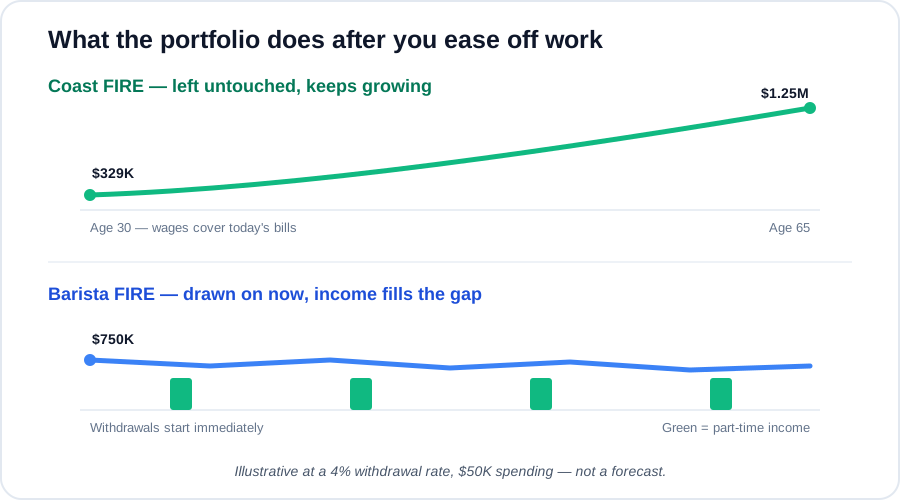
Coast FIRE and Barista FIRE both let you ease off work without a full portfolio — but the key difference is what your portfolio is doing. With Coast FIRE, you have already invested enough that compounding alone will reach your full FIRE number, so you stop saving and leave the portfolio untouched while a job covers today's bills. With Barista FIRE, you start drawing on the portfolio now, and part-time income covers the rest of your spending. Coast protects the portfolio; Barista taps it early.
That single distinction changes how much you need and how each plan can fail. A 30-year-old chasing a $1.25 million goal reaches Coast FIRE at about $329,000 invested today. A Barista FIRE plan covering $30,000 of a $50,000 budget from the portfolio needs about $750,000. This guide compares the two so you can pick the right one — or sequence both.
Coast FIRE vs Barista FIRE at a glance
| Coast FIRE | Barista FIRE | |
|---|---|---|
| Core idea | Invested enough that compounding reaches the goal | Part-time income covers part of spending |
| Portfolio role | Left untouched to grow | Drawn on now to fill the income gap |
| Still saving? | No | Usually no |
| Work needed | Enough to cover all current expenses | Part-time, to cover part of expenses |
| Example number | ~$329,000 invested at age 30 | ~$750,000 (with $20k side income) |
| Main risk | Touching the money or stopping work too early | Losing the part-time income or its benefits |
The numbers above assume $50,000 of annual spending and a 4% withdrawal rate, and are illustrative starting points rather than forecasts. Both fit inside the broader map of FIRE types, where Coast and Barista are the two strategies that let you stop saving the full amount. If you want the definitions first, start with what Coast FIRE is and what Barista FIRE is.
How Coast FIRE works
Coast FIRE is the point where your invested balance, left alone, will compound into your full FIRE number by your target retirement age — no new contributions required. You still need a job, but only to cover current living costs, not to add to retirement savings. For a $1.25 million goal at 65, a 30-year-old needs about $329,000 invested today, assuming a 7% return and 3% inflation (about a 3.9% real return). Hit it at 25 and the number is about $272,000; wait until 40 and it is about $482,000.
The leverage is time, and the discipline is leaving the money alone. Withdraw $50,000 at 35 and you lose not just $50,000 but everything it would have compounded to by 65. The full present-value math is in what is Coast FIRE.
How Barista FIRE works
Barista FIRE replaces a full-time career with part-time or lower-stress work that covers part of your spending. The portfolio covers the rest, starting now. Subtract the side income before dividing: spend $50,000 and earn $20,000 part-time, and the portfolio only has to fund $30,000 — about $750,000 at 4%. Every $1,000 of reliable annual income removes $25,000 from the target. The full method is in what is Barista FIRE.
Unlike Coast FIRE, Barista FIRE draws on the portfolio immediately, so sequence-of-returns risk is live from day one — though smaller withdrawals soften it. The income has to be reliable, because the portfolio was sized assuming it keeps coming.
The real difference is what the portfolio does
Both paths keep you working in some form, so the headline difference is not "work vs no work." It is whether you are still protecting the portfolio or already spending it.
- Coast FIRE keeps the portfolio invested and untouched. You need enough earned income to cover every current expense, but the portfolio compounds at full strength.
- Barista FIRE starts withdrawals now. You can work less because the portfolio is bigger and helps cover spending, but it is no longer growing untouched.
That is why a Coast plan typically needs a much smaller balance than a Barista plan at the same age: the Coast portfolio still has years of untouched compounding ahead, while the Barista portfolio has to be large enough to sustain withdrawals today.
Healthcare can tip the decision
For early retirees, health insurance before age 65 — when Medicare.gov says most people become eligible for Medicare — is often the deciding factor, and it favors Barista FIRE when the part-time job carries benefits. For 2026, the enhanced premium tax credits from the pandemic era have ended; HealthCare.gov confirms the additional savings ended on December 31, 2025. A Barista FIRE job that includes employer coverage can be worth far more than its wage, because it sidesteps Marketplace costs entirely.
A Coast FIRE worker usually still has a full-time job with its own benefits, so healthcare is less of an immediate concern — until they stop working. Either way, price the coverage explicitly using our guide to health insurance before Medicare.
Can you combine Coast and Barista FIRE?
Yes — and many people do, in sequence. A natural arc is to reach Coast FIRE in your 30s while still in a career, then downshift to Barista FIRE later: by then the portfolio has compounded, so a modest part-time income is enough to bridge to full retirement. The two are not rivals so much as consecutive stages. The full sequence sits inside the Regular vs Coast vs Barista comparison.
Common Coast vs Barista mistakes
Treating Coast FIRE as quitting work
Coast FIRE only stops retirement saving. You still need income for current bills. Mistaking it for full retirement leaves a hole where this year's rent and groceries were supposed to be.
Overcounting Barista income
Barista FIRE numbers fall apart if the side income is seasonal, optimistic, or hard to replace. Use conservative, after-tax income, and keep a cash buffer so a job gap does not force selling shares in a down market.
Ignoring what breaks each plan
Coast FIRE fails if you raid the portfolio or have to stop working before it matures. Barista FIRE fails if the income or its benefits disappear. Match your backup plan to your own failure mode — the wider FIRE planning mistakes apply to both.
Coast FIRE vs Barista FIRE FAQ
Which one needs less money?
Coast FIRE usually needs a smaller balance today because the portfolio keeps compounding untouched for years and your job covers all current costs. Barista FIRE needs a larger portfolio because you start withdrawing from it now, even though part-time income covers part of spending.
Can you move from Coast FIRE to Barista FIRE?
Yes. Reaching Coast FIRE first and shifting to Barista FIRE later is a common path: the portfolio has more time to grow before you begin drawing on it, which lowers the income you need in the Barista years.
Is Barista FIRE riskier than Coast FIRE?
They carry different risks. Barista FIRE faces sequence-of-returns risk immediately because withdrawals start now, plus income risk if the part-time work ends. Coast FIRE avoids early withdrawals but depends on keeping full income until the portfolio matures.
Do both assume the 4% rule?
The example numbers use 4%, but the rate is a planning choice. A longer retirement or a rigid budget may call for 3.5% or 3.25%; reliable ongoing income may support a higher rate. See the 4% rule explained.
What to read next
The bottom line
Coast FIRE and Barista FIRE both let you work less without a full portfolio, but they sit on opposite sides of one line: Coast FIRE protects the portfolio and lets compounding finish the job, while Barista FIRE starts spending it and leans on part-time income to cover the rest.
Choose Coast FIRE if you can keep covering your bills and want to maximize untouched growth. Choose Barista FIRE if you want to leave the career now and have reliable part-time income — ideally with benefits. And if your situation allows, do both in sequence: Coast first, Barista later.
This article is educational and does not constitute tax, legal, healthcare, or financial advice. Withdrawal rates and portfolio targets are planning assumptions, not guarantees. Tax, healthcare, and benefit rules can change, and individual costs vary.