
Fat FIRE tax planning is the work of controlling when a large portfolio creates taxable income. At a 3% starting withdrawal rate, a $4 million portfolio supports $120,000 of first-year withdrawals before taxes, fees, and healthcare costs. But the withdrawal rate alone does not show dividends in taxable accounts, Roth conversions, future required minimum distributions, or Medicare IRMAA surcharges.
More money gives you more margin, but it also creates more tax friction. The goal is not to pay zero tax every year. It is to avoid wasting low-tax years now and then being forced into unnecessarily high-income years later.
The Fat FIRE tax risk profile
Fat FIRE usually has a stronger defense against market declines than Lean FIRE because more spending is optional. Travel, upgrades, and luxury purchases can be paused. The less obvious weakness is that income can appear even when you do not need more cash.
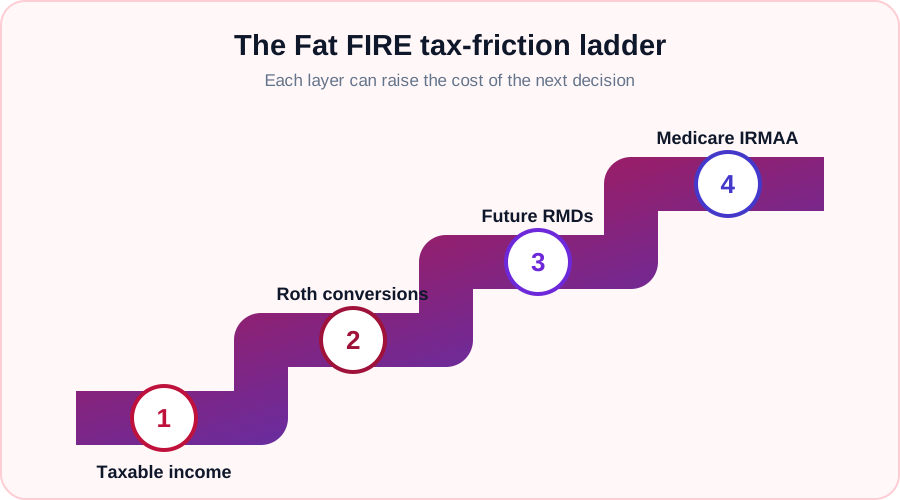
A taxable account distributes dividends. A traditional IRA eventually creates required withdrawals. A Roth conversion intentionally creates ordinary income. Selling appreciated investments realizes gains. Those events can stack on top of one another and move a household through this tax-friction ladder:
Our Lean FIRE vs Fat FIRE comparison explains why this is a different risk system, not simply a bigger version of the same plan. Fat FIRE has more levers, but using them well requires a year-by-year tax map. Households that want more margin without making tax complexity the center of retirement may prefer the Chubby FIRE middle path.
Start with a three-bucket system
The foundation of Fat FIRE tax planning is holding meaningful assets across three tax buckets. Each bucket gives you a different way to fund spending and control taxable income.
| Bucket | How withdrawals are generally taxed | Main planning use | Main risk |
|---|---|---|---|
| Taxable brokerage | Cost basis returns tax-free; realized gains and distributions may be taxable | Early-retirement spending, gain harvesting, and flexibility | Annual tax drag and large embedded gains |
| Traditional IRA / 401(k) | Withdrawals and conversions are generally ordinary income | Fill lower brackets during gap years | Future RMDs reduce control |
| Roth IRA / Roth 401(k) | Qualified withdrawals are generally federal-income-tax-free | Fund large expenses without raising taxable income | Using scarce Roth dollars too early |
These are general federal rules, and the details depend on your situation; IRS Publication 590-B covers how traditional and Roth IRA distributions are taxed, including the conditions for a qualified tax-free Roth withdrawal.
Imagine two couples with the same $4 million net worth. One holds nearly everything in a traditional 401(k). The other has $1.5 million taxable, $1.5 million traditional, and $1 million Roth. The second couple can choose which bucket supplies the next dollar. The first couple has fewer choices and may face much larger mandatory taxable income later.
This is why the best account is not always the one with the largest immediate deduction. The guide to 401(k) vs Roth IRA for FIRE explains how taxable, traditional, and Roth balances serve different parts of an early retirement.
The 0% long-term capital gains bracket is valuable, but easy to misunderstand
For tax year 2026, the IRS sets the maximum 0% long-term capital-gains amount at $49,450 for single filers and $98,900 for married couples filing jointly. These are taxable-income thresholds, not the amount of gains you may always realize tax-free.
Ordinary taxable income fills the bracket first. If a married couple has $60,000 of taxable ordinary income, only about $38,900 remains before reaching the 2026 0% threshold. Realizing $60,000 of long-term gains would push the top portion into the 15% capital-gains bracket. Qualified dividends also use space in the preferential-rate brackets.
Low-income years can still create a powerful tax-gain-harvesting opportunity: sell an appreciated investment, realize gains inside the 0% bracket, and reinvest to raise cost basis. But a 0% federal capital-gains rate does not mean the gain is invisible. It can still affect state taxes, ACA income before 65, and Medicare IRMAA later.
Use the Roth conversion gap years deliberately
The years after your final high-income paycheck and before Social Security or RMDs begin can be the most valuable tax-planning years of retirement. Your spending may remain high while taxable income falls, especially when a taxable account returns cost basis alongside gains.
A planned Roth conversion fills part of that income gap. You pay ordinary income tax now, reduce the traditional balance that can produce future RMDs, and create more Roth money for later years. The point is not to convert as much as possible. It is to compare the marginal cost today with the likely marginal cost later.
For example, converting an extra $80,000 may fit comfortably into your chosen federal tax bracket. But the same conversion could reduce an ACA premium tax credit before 65 or create an IRMAA surcharge after 65. Read the Roth conversion ladder guide for the five-year access rules and conversion mechanics.
RMDs can turn deferred tax into forced tax
Tax deferral is valuable, but it is not tax elimination. Traditional balances can compound for decades and later create required minimum distributions even when you do not need the cash. The IRS states that Roth accounts do not require lifetime withdrawals for the original owner, while traditional retirement accounts are generally subject to RMD rules.
Under current IRS guidance, RMD timing depends on account type and current law. The IRS currently says many original account holders generally begin RMDs at age 73. A large pre-tax balance can therefore grow untouched for years, then produce ordinary income that stacks with Social Security, dividends, and realized gains.
The practical defense is to project the traditional balance at RMD age before deciding conversions are too expensive today. A year with a visible tax bill can still be the cheaper choice if it prevents a much larger forced-income problem later.
Medicare IRMAA makes income timing matter two years early
IRMAA is an income-related surcharge on Medicare Part B and Part D. For 2026, CMS sets the standard Part B premium at $202.90 per month and the first IRMAA threshold above $109,000 for single filers or $218,000 for joint filers.
Crossing that first threshold adds $81.20 per month for Part B and $14.50 per month for Part D in 2026. For a married couple, that is about $2,297 a year in combined surcharges before considering the underlying Part D plan premiums. The surcharge applies by tier, so one more dollar of income can move the full amount into effect.
Medicare generally uses tax-return information from two years earlier to determine IRMAA. That means a large 2024 gain or conversion can affect 2026 premiums. It also means the final years before Medicare enrollment already belong in the plan. ACA planning before 65 and IRMAA planning after 65 use different thresholds and timing rules.
Tax drag and lifestyle inflation quietly raise the required portfolio
Tax drag is the return lost because investment income creates taxes along the way. A large taxable portfolio may distribute qualified dividends, ordinary dividends, interest, and capital-gain distributions even when every payment is automatically reinvested. Asset location matters: tax-inefficient holdings in taxable accounts can create income you did not ask for.
Lifestyle inflation creates a similar problem on the spending side. A $120,000 lifestyle requires $3 million at 4%. Let annual spending drift to $160,000, and the same math requires $4 million. The extra $40,000 did not merely cost $40,000 once; it increased the portfolio target by $1 million.
Separate your budget into a core lifestyle and a comfort layer. Core spending is what you intend to protect through a bad market. The comfort layer is travel, upgrades, gifts, and other spending you can pause. Fat FIRE becomes fragile when every comfort quietly turns into a permanent commitment.
Build a Fat FIRE tax-planning calendar
| Planning period | Primary constraint | Useful moves to evaluate |
|---|---|---|
| Working years | High marginal tax rate | Build all three buckets and avoid concentration |
| Early retirement before 65 | ACA MAGI and low-income bracket space | Coordinate taxable sales, gains, and Roth conversions |
| Medicare years before RMDs | IRMAA tiers and two-year lookback | Use remaining conversion space without accidental surcharges |
| RMD years | Forced ordinary income | Coordinate RMDs, Roth spending, gains, and charitable plans |
Review the calendar before December, not after tax forms arrive. Estimate ordinary income, qualified dividends, gains, conversions, and the next relevant threshold. Then leave margin for year-end fund distributions and other surprises.
Common Fat FIRE tax planning mistakes
Optimizing one year at a time
A zero-conversion year may minimize today's tax bill while allowing future RMDs to grow. Compare multiple decades, not only this April's payment.
Confusing a 0% tax rate with zero income impact
A long-term gain can receive a 0% federal rate and still raise MAGI, reduce an ACA subsidy, or cross an IRMAA threshold.
Keeping every dollar tax-deferred
A large traditional balance may create a generous deduction while working but leave too little control in retirement. Tax diversification is valuable precisely because future tax rules and spending needs are uncertain.
Letting comfort become fixed
Fat FIRE has room to absorb shocks only while some spending remains optional. Review the biggest FIRE planning mistakes if your plan assumes high spending can always be cut later.
Fat FIRE tax planning FAQ
What is the biggest Fat FIRE tax risk?
The biggest risk is losing control over taxable income. Large traditional balances, taxable distributions, realized gains, and Social Security can stack together and create higher taxes or Medicare surcharges later.
Should Fat FIRE retirees do Roth conversions?
Roth conversions can reduce future RMD pressure, but the right amount depends on current brackets, ACA subsidies, IRMAA, state taxes, and expected future income. A conversion is useful when its full cost today is lower than the expected cost of leaving the money traditional.
How does the 0% capital-gains bracket work?
Long-term gains and qualified dividends can receive a 0% federal rate while taxable income remains within the threshold. Ordinary taxable income fills the bracket first, and the gain can still affect other income-based rules.
Can Fat FIRE retirees avoid IRMAA?
Sometimes, but avoiding IRMAA should not be the only goal. A sensible Roth conversion may save more future tax than the surcharge costs. Treat each tier as a price to compare, not a rule that must never be crossed.
What to read next
The bottom line
Fat FIRE buys flexibility, not immunity. A large portfolio can support generous spending and withstand shocks, but it also produces more opportunities for gains, conversions, RMDs, and Medicare surcharges to collide.
Build all three tax buckets, use low-income gap years deliberately, project RMDs before they begin, and track IRMAA two years early. The strongest Fat FIRE plan is not the one that never pays tax. It is the one that keeps control over when and why tax is paid.
This article is educational and does not constitute tax, legal, Medicare, or financial advice. Tax rules, thresholds, and individual circumstances can change. Consult a qualified tax professional before executing a conversion or withdrawal strategy.