

The biggest FIRE planning mistake is treating your FIRE number as the entire plan. Reaching 25 times annual spending is useful, but it does not automatically solve healthcare, taxes, poor early market returns, inflation, or access to retirement accounts before age 59½. A strong plan shows how you will handle each of those problems.
Before leaving work, test a lower withdrawal rate, add irregular expenses, price health insurance, map which accounts will fund each year, and decide what you would change after a bad market. The goal is not to predict everything. It is to avoid building a plan that only works when everything goes right.
One FIRE plan, two very different numbers
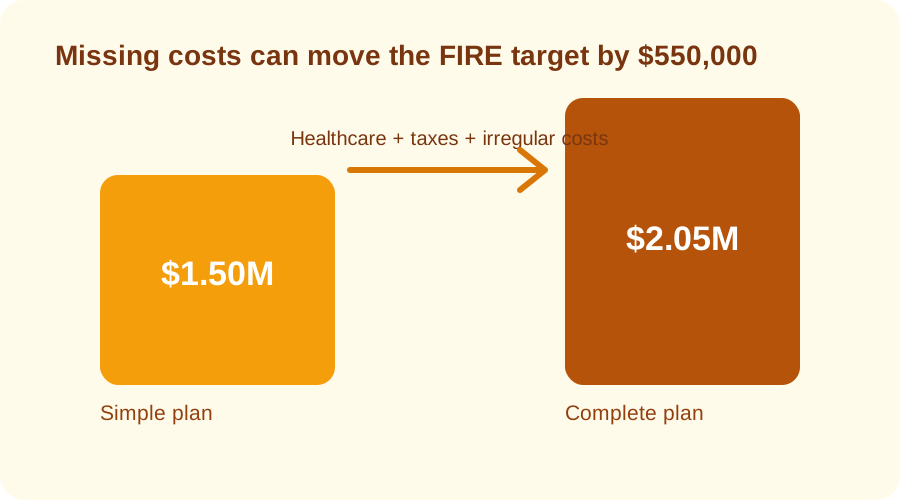
Imagine a couple wants to retire at 45. Their regular bills total $60,000 a year, so they multiply by 25 and set a FIRE target of $1.5 million. That looks clean, but their first estimate leaves out several real costs:
| Planning item | Simple estimate | More complete estimate |
|---|---|---|
| Regular living expenses | $60,000 | $60,000 |
| Healthcare and out-of-pocket costs | Included in regular bills | $12,000 |
| Taxes on withdrawals and gains | $0 | $5,000 |
| Home, car, and other irregular costs | $0 | $5,000 |
| Total annual need | $60,000 | $82,000 |
At a 4% withdrawal rate, $82,000 requires about $2.05 million, not $1.5 million. At 3.5%, it requires about $2.34 million. The couple does not necessarily need to save that full amount. They could reduce spending, work part time, or expect Social Security later. But now they are making a decision with the real tradeoffs in view.
A FIRE number is the start, not the finish
Your basic FIRE number is annual portfolio spending divided by your starting withdrawal rate. If investments must provide $60,000 and you use 4%, the number is $1.5 million. If investments must provide $80,000, it is $2 million.
That formula answers one question: how much money might support a chosen level of spending? It does not answer where spending money comes from before 59½, what happens after a 30% market drop, or how a Roth conversion affects an ACA subsidy. Those are separate parts of the retirement-income plan.
A practical FIRE plan needs ranges instead of one perfect forecast. Test lower returns, higher spending, a longer life, and a bad first decade. Then identify which choices remain under your control, such as optional spending, part-time income, and retirement timing.
Five research-backed lessons that matter for FIRE
1. The 4% rule is not a promise
Withdrawal-rate research is based on historical or modeled portfolios under specific assumptions. It does not guarantee that every diversified portfolio can support the same inflation-adjusted withdrawal for 40, 50, or 60 years.
A small rate change creates a large dollar difference. Funding $80,000 of annual spending requires $2 million at 4%, about $2.29 million at 3.5%, and about $2.46 million at 3.25%. Compare several rates instead of choosing 4% because it produces the earliest retirement date. Our guide on whether the 4% rule is still safe for FIRE explains the tradeoffs.
2. Average returns can hide a bad retirement
Poor returns early in retirement are more damaging than poor returns later. You are selling investments while prices are down, leaving fewer shares to recover. This is called sequence-of-returns risk, and it is why the first decade of retirement can matter more than the long-run average.
Suppose a $1 million portfolio loses 20% and you then withdraw $40,000. Only $760,000 remains. The next $40,000 withdrawal is already 5.3% of that balance. A long-term average return may still look fine, but the first few years can permanently change the outcome.
The most useful protection is flexibility: keep fixed expenses manageable, hold a diversified portfolio, and know which optional costs you could pause. Even temporary earnings can reduce the number of shares sold during a downturn.
3. Your personal inflation rate is not one tidy number
Housing, insurance, healthcare, travel, and food do not rise at the same rate. A spreadsheet using 2% inflation for every expense may understate the costs that matter most to your household.
At 2% inflation, a $60,000 budget becomes about $89,000 after 20 years. At 2.9%, it becomes about $106,000. That is a difference of roughly $17,000 per year. Use separate assumptions for major categories, especially healthcare and housing, and rerun the plan at a higher blended rate.
4. Healthcare and taxes are connected
Pre-Medicare healthcare is not simply another bill. Marketplace subsidies depend on modified adjusted gross income. A Roth conversion, capital gain, dividend, or traditional IRA withdrawal can raise income and reduce a subsidy even when your spending stays the same.
Price actual plans for your ages and ZIP code, include premiums plus expected out-of-pocket costs, and track income throughout the year. Start with our Healthcare Before Medicare guide before assuming your current employer-plan cost will continue.
5. Retirement-account rich can still mean cash poor
A 45-year-old can have enough total assets for FIRE and still lack accessible money. Most withdrawals from traditional retirement accounts before age 59½ can trigger ordinary income tax and an additional 10% tax unless an exception applies.
Build an account-access timeline before retiring. Taxable investments, cash, Roth contribution basis, a Roth conversion ladder, the Rule of 55, and 72(t) distributions can each play a role, but they follow different rules. The IRS early-distribution exceptions explain when the additional 10% tax may not apply. A conversion ladder also needs roughly five years of bridge funding before the first converted amount is available.
The biggest FIRE planning mistakes to avoid
Using average spending instead of your spending
Review two or three years of bank, card, and tax records. Separate expenses into core, flexible, and irregular buckets. A $30,000 roof every 15 years is still about $2,000 per year of long-run spending. At 4%, that one line adds $50,000 to your FIRE number.
Forgetting taxes on retirement cash flow
Spending $70,000 does not always mean withdrawing $70,000. Traditional-account distributions, capital gains, dividends, state taxes, and later Social Security taxation can increase the amount you need. Map a likely withdrawal source and tax estimate for each year, and plan for quarterly estimated payments when withholding will not cover the bill.
Entering FIRE with too many fixed costs
Every fixed bill reduces your ability to respond to a bad market. A $1,000 monthly car payment and insurance burden consumes $12,000 per year, equivalent to $300,000 of portfolio at a 4% rate. Paying off every debt is not always the best mathematical choice, but reducing required monthly spending makes a FIRE plan much easier to manage.
Assuming your best recent returns will continue
A plan that needs unusually strong returns is not ready. Test lower real returns and diversify large employer-stock or sector positions before retirement. If 40% of a $2 million portfolio sits in one stock and that stock falls 50%, the overall portfolio loses $400,000.
Ignoring Social Security or claiming without a plan
Treating Social Security as zero can make you work longer than necessary — a close cousin of one more year syndrome, where a plan that already works keeps getting padded out of fear. Claiming at 62 without comparing later benefits can reduce a valuable lifelong income floor. Use a conservative estimate, compare claim ages, and model the years before benefits separately with a Social Security bridge.
Planning only to age 85
Early retirement can last 40 to 60 years. Test the plan to age 95 or 100, especially for a couple, and make a deliberate plan for long-term care. Medicare generally does not cover most ongoing custodial care, so “Medicare will handle it” is not a complete answer.
Stress-test your FIRE plan before leaving work
Run more than one calculator scenario. Start with your current plan, then increase spending, lower the withdrawal rate, add healthcare and taxes, and test part-time income. The point is to discover which assumptions control your retirement date. When you are close to leaving, work through the FIRE checklist before quitting your job so healthcare, account access, and your cash buffer are all in place first.
If the full FIRE number feels too far away, the Coast FIRE Calculator shows when your existing investments may grow into your retirement target without additional contributions. The Barista FIRE Calculator shows how part-time income can reduce the portfolio required today.
FIRE planning mistakes FAQ
What is the biggest FIRE planning mistake?
The biggest mistake is treating a simple FIRE number as a complete retirement plan. Your plan also needs to cover healthcare, taxes, account access, market downturns, irregular spending, and a potentially very long retirement.
Is 25 times expenses enough for FIRE?
It can be a useful starting target because it represents a 4% initial withdrawal rate. It may not be enough for a long retirement with rigid spending, high healthcare costs, or no future income. Compare it with lower withdrawal rates and realistic expenses.
How much extra cushion should a FIRE plan have?
There is no universal percentage. A better cushion is a plan that still works with higher spending, lower returns, and a bad first decade. Flexible expenses and optional earned income can be as valuable as a larger portfolio. If you want more margin without going full luxury, Chubby FIRE is the middle ground worth modeling.
Should I include Social Security in my FIRE plan?
Yes, but use a conservative estimate and test more than one claiming age. Social Security can reduce later portfolio withdrawals, while your investments must bridge the years before benefits begin.
How often should I review my FIRE plan?
Review it at least annually and after major changes in spending, income, tax law, healthcare, or markets. A FIRE plan is a decision system, not a number you calculate once.
The bottom line
FIRE planning fails when a household optimizes for one attractive number and ignores how retirement cash flow works. The strongest plans use realistic spending, several withdrawal scenarios, flexible expenses, diversified investments, and clear strategies for healthcare, taxes, and account access.
You do not need a forecast that gets every future year right. You need a plan that gives you useful choices when the future is different from the spreadsheet.
What to read next
This article is educational and does not constitute financial, tax, or investment advice. Rules and costs can change, so verify current details before making decisions.