

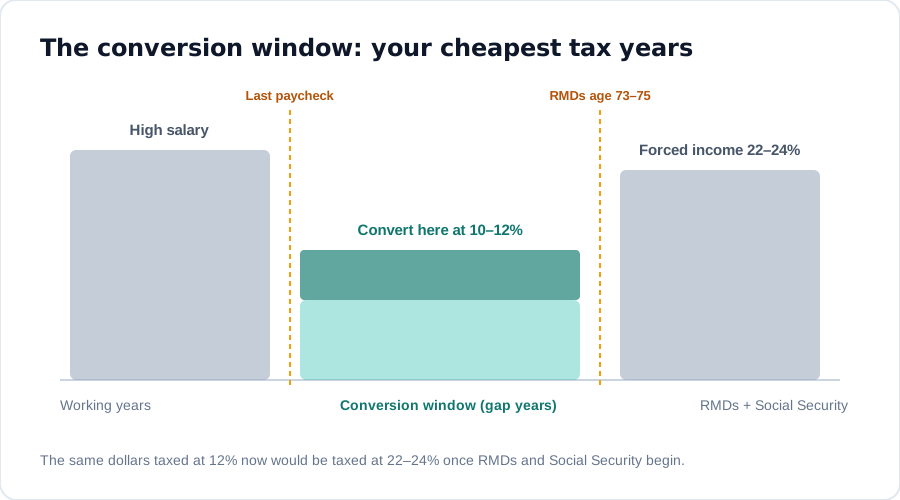
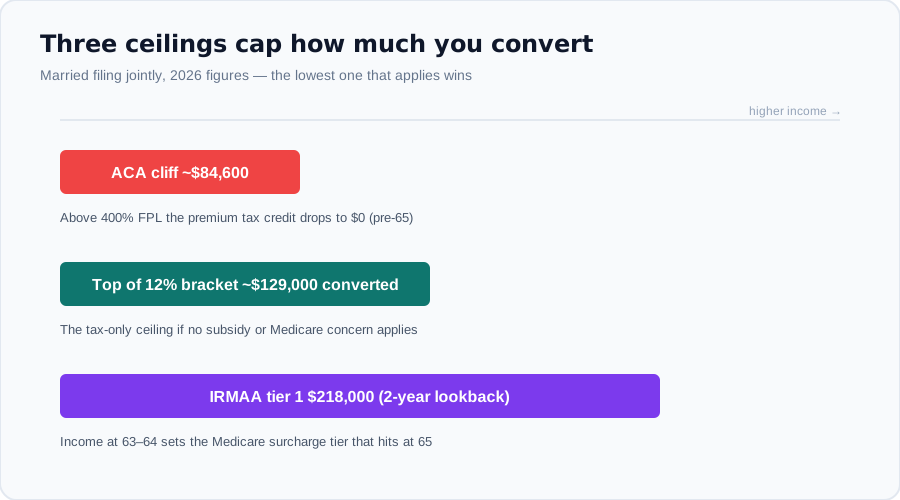
The Roth conversion window is the stretch of low-income years between your last paycheck and the year required minimum distributions (and usually Social Security) begin. In those years a FIRE retiree often has little forced taxable income, which leaves room to voluntarily move pre-tax money into a Roth IRA at a deliberately low tax rate. For a married couple filing jointly in 2026 with no other income, that room can be large: the 12% bracket tops out at $96,950 of taxable income, so adding the $32,200 standard deduction means roughly $129,000 converted while keeping the top marginal rate at 12%.
The whole idea is arbitrage across time. Every dollar you convert at 12% in a quiet early-retirement year is a dollar that never gets taxed at 22% or 24% later, when RMDs stack on top of Social Security and force money out whether you need it or not. The window is the strategic heart of an early-retirement tax plan — and it is also where the planning gets hard, because the same conversion income drives three separate penalties. This guide is the companion to our Roth conversion ladder walkthrough: the ladder is the mechanism, the window is the timing.
What is the Roth conversion window?
The gap between paychecks, RMDs, and Social Security
While you work, your salary fills your tax brackets, so converting pre-tax money then just piles ordinary income on top of ordinary income at a high marginal rate. Decades later, required minimum distributions and Social Security do the same thing involuntarily. Under IRS rules in Publication 590-B and SECURE 2.0, RMDs begin at age 73 for those born 1951–1959 and age 75 for those born in 1960 or later. The years in between — after wages stop but before those forced-income sources switch on — are the only time many retirees control their taxable income from near zero.
Why low-income years are a rare tax opportunity
Tax brackets are progressive, so empty low brackets are a perishable asset. If you do not deliberately fill the 10% and 12% brackets with conversion income during the gap years, that cheap bracket space simply expires each year. Worse, the pre-tax balance you left untouched keeps compounding, so the eventual RMD that drains it lands in a higher bracket. The window is your chance to pull that future taxable income forward into years when it costs far less.
The bracket-filling strategy (2026 numbers)
The core tactic is to “fill up” your low brackets with exactly enough conversion income to hit a target, then stop. Here is how the math looks for a married couple filing jointly in 2026 with no other taxable income, using the $32,200 standard deduction.
| Amount converted (MFJ, no other income) | Taxable income after $32,200 deduction | Top marginal rate reached |
|---|---|---|
| $32,200 | $0 | 0% — erased by the standard deduction |
| $80,000 | $47,800 | 12% |
| $129,150 | $96,950 | 12% (top of the 12% bracket) |
| $170,000 | $137,800 | 22% |
Filling the 12% bracket, then deciding on 22%
For a single filer in 2026 the same logic applies on smaller numbers: the standard deduction is $16,100 and the 12% bracket tops at $48,475 of taxable income, so roughly $64,500 can be converted while staying within 12%. The 22% bracket then runs to $103,350 (single) and $206,700 (married filing jointly). Whether to push past 12% into 22% depends entirely on what your future RMDs are projected to cost. If your pre-tax balance is large enough that future RMDs would land in the 24% bracket, converting at 22% today can still be a win.
The effective rate is lower than the bracket
Your marginal bracket is not your effective rate. Because the standard deduction comes off first and the 10% bracket fills before the 12% bracket, a married couple who converts right up to the top of the 12% bracket pays an effective federal rate in the single digits on the full amount converted — well below the 22–24% those same dollars could face as RMDs later. That gap between today's effective rate and tomorrow's marginal rate is the entire reason the window exists.
The three ceilings that cap your conversions
If brackets were the only constraint, you would simply convert to the top of the 12% bracket every year. They are not. Conversion income raises your modified adjusted gross income (MAGI), and MAGI drives three separate costs that can each bind before the tax bracket does.
ACA premium tax credits and the 400% FPL cliff
Before Medicare, most early retirees buy health insurance through the ACA marketplace, and conversion income directly raises the MAGI that determines their premium tax credit. As of June 14, 2026, this is acute: the enhanced premium tax credits enacted in 2021 expired on December 31, 2025, and the 400%-of-poverty “subsidy cliff” returned January 1, 2026 under current law. For 2026 coverage that cliff sits near $62,600 for one person and $84,600 for a two-person household. Cross it by a single dollar and the premium tax credit drops to $0 — a marginal cost that can run into thousands. A House-passed three-year extension (230–196 on January 8, 2026) had not been enacted by the Senate as of mid-June 2026, so the cliff is the law you should plan around today. Verify the current status before you convert; our ACA subsidies for FIRE guide tracks how the MAGI definition used by the marketplace is built.
IRMAA and the two-year lookback — convert before 63
Once you are on Medicare at 65, your MAGI determines income-related monthly adjustment amounts (IRMAA) — surcharges on Part B and Part D premiums — on a two-year lookback. That means your 2026 premiums are set by your 2024 income. For 2026, the first IRMAA threshold is $109,000 (single) and $218,000 (married filing jointly), per the official Medicare cost figures, and crossing a tier by even $1 jumps the entire surcharge with no phase-in. Because of the two-year lookback, the practical rule is to do your largest conversions before age 63, since income at 63 and 64 is what sets the IRMAA tier that first applies at 65.
Social Security provisional income and the torpedo
Conversions also interact with how much of your Social Security benefit is taxable. Provisional income — your other income plus half of your benefits — determines whether up to 50% or up to 85% of benefits are taxed, using thresholds that have never been inflation indexed since the 1980s ($25,000/$34,000 single, $32,000/$44,000 married). Converting before you claim Social Security keeps benefits out of the provisional-income math during your conversion years, and shrinks the future RMDs that would otherwise trigger the “tax torpedo,” where an extra $1,000 of IRA income makes another $850 of benefits taxable. The Social Security Administration's benefit-taxation rules spell out the thresholds; our Social Security bridge guide explains why many FIRE households convert hardest in the years before claiming.
How big should each conversion be?
There is no universal number, but the annual decision follows a repeatable framework. Work it in this order, and let whichever ceiling binds first set your conversion size:
- Estimate all other taxable income for the year — dividends, interest, realized gains, part-time work, pensions.
- Pick your tax ceiling. Usually the top of the 12% bracket, or the 22% bracket if your projected future RMDs justify it.
- Check the ACA cliff (before 65). If marketplace subsidies are worth more than the cheap conversion, the 400% FPL line may cap you below the 12% bracket.
- Check IRMAA (ages 63+). Keep income under the next surcharge tier you care about, remembering the two-year lookback.
- Convert up to the lowest binding ceiling, then stop. Pay the conversion tax from taxable or cash, never by withholding from the conversion itself if you are under 59½.
Many FIRE retirees deliberately accept a smaller ACA subsidy in exchange for cheaper conversions, or hold conversions under 400% FPL — whichever wins on the math that year. The point of the framework is that you re-run it every December, because your income, the limits, and the law all change annually.
Coordinating conversions with the ladder and RMD reduction
The window and the ladder are two views of the same plan. The Roth conversion ladder is the mechanism that turns converted dollars into penalty-free spending money after a five-tax-year season; the conversion window is the period during which you do that converting at low rates. Money you need to spend before 59½ comes from a taxable brokerage bridge while the early rungs season.
Every dollar you move to Roth during the window does triple duty: it never triggers a future RMD, it never counts toward IRMAA or provisional income later, and it never lands in a surviving spouse's compressed single-filer brackets. That is why aggressive gap-year conversions are one of the most reliable ways to defuse a future required-distribution problem — the subject of our tax-efficient withdrawal order guide. Just remember that conversions move taxes; they do not erase them. Treating the window as a guaranteed free lunch instead of a controllable trade-off is one of the biggest FIRE planning mistakes.
Size the portfolio that creates your window
A long, tax-light conversion window only exists if you retire with the right account mix and enough bridge money to live on while you convert. Start by sizing the portfolio your spending requires, then earmark the slice that has to sit in accounts you can reach before 59½.
Roth conversion window FAQ
When does the Roth conversion window open and close?
It opens when your earned income stops — usually at early retirement — and effectively closes when RMDs (age 73 or 75) and Social Security refill your tax brackets. For someone who retires at 50 and delays Social Security to 70, the window can run two decades or more.
How much can I convert in the 12% bracket in 2026?
With no other income, a married couple can convert about $129,000 and a single filer about $64,500 while keeping the top marginal rate at 12%, because the standard deduction comes off before the bracket math. Any other income you have reduces that room dollar for dollar.
Why does age 63 matter for conversions?
Medicare IRMAA surcharges use a two-year income lookback, so the income you report at 63 and 64 sets the Part B and Part D surcharge tier that first applies at 65. Doing your largest conversions before 63 helps keep that first Medicare premium tier low.
Should I ever convert into the 22% bracket?
Sometimes. If your pre-tax balance is large enough that future RMDs would be taxed at 24% or more — especially after one spouse dies and the survivor files single — converting at 22% now can still come out ahead. Compare today's rate to your projected future rate, not to zero.
Does converting hurt my ACA subsidy?
Yes. Taxable conversion income raises ACA MAGI, and in 2026 the 400% federal poverty cliff is back, so crossing it can eliminate your premium tax credit entirely. Before 65, the ACA cliff often caps conversions below the 12% bracket. Verify the current subsidy rules before each year's conversion.
What to read next
This article uses federal rules and 2026 figures for illustration. Tax brackets, the standard deduction, IRMAA tiers, ACA poverty thresholds, and RMD ages change over time and vary by household and filing status, and many states tax Roth conversions differently from the federal government. ACA subsidy rules were in legislative flux as of June 2026 — verify the current law before converting. This content is educational and is not tax, legal, or financial advice.