

A Roth conversion ladder can let early retirees access converted pre-tax retirement money before age 59½ without the usual 10% early-withdrawal penalty. Each year, you convert part of a traditional IRA or pre-tax 401(k) into a Roth IRA, pay income tax on the taxable conversion amount, wait five tax years, and then generally withdraw that converted amount without the penalty. The IRS Roth IRA distribution rules apply a separate five-tax-year period to each conversion or rollover.
The strategy works best when you retire with a large pre-tax balance, several low-income years, and enough money outside retirement accounts to cover the first five years. It does not make taxes disappear. It gives you control over when you recognize taxable income. If you are still deciding how to split contributions between a 401(k), Roth IRA, and taxable account, see our 401(k) vs Roth IRA for FIRE guide first.
A Roth conversion ladder example with real numbers
Imagine you retire at age 45 and spend $60,000 per year. Most of your savings are in a traditional 401(k), but you also have $350,000 in cash and a taxable brokerage account. You roll the old 401(k) into a traditional IRA and convert $70,000 to a Roth IRA each year.
| Year | Age | Roth conversion | Spending source | Oldest available rung |
|---|---|---|---|---|
| 2027 | 45 | $70,000 | Cash and taxable account | None |
| 2028 | 46 | $70,000 | Cash and taxable account | None |
| 2029 | 47 | $70,000 | Cash and taxable account | None |
| 2030 | 48 | $70,000 | Cash and taxable account | None |
| 2031 | 49 | $70,000 | Cash and taxable account | None |
| 2032 | 50 | $70,000 | 2027 conversion | $70,000 |
If the simplified effective tax on each conversion were 12%, the annual conversion tax would be $8,400. During the first five years, the household would need roughly $60,000 for spending plus $8,400 for conversion tax, or $342,000 total. Their $350,000 bridge covers that runway with a small cushion.
Beginning in 2032, the first $70,000 rung is available. The household can spend from that matured conversion while continuing to create a new rung for a future year. Actual taxes will depend on deductions, other income, filing status, state taxes, and tax law.
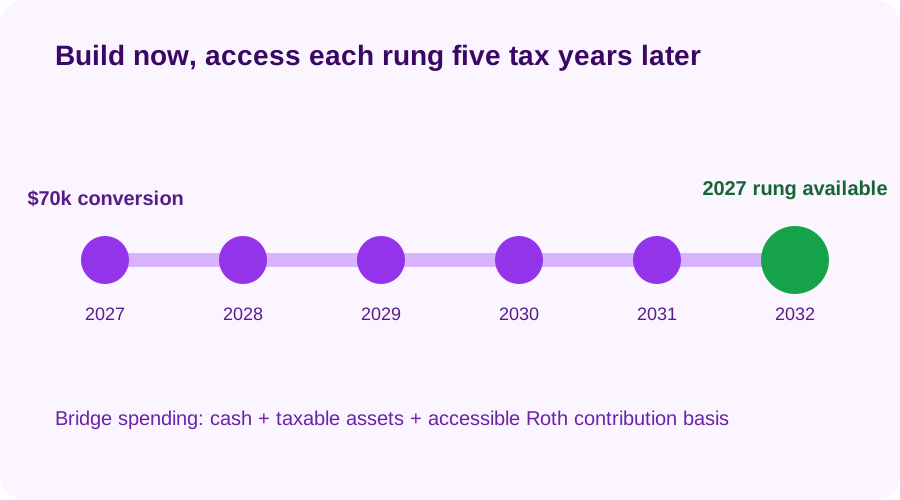
How a Roth conversion ladder works
A ladder is a pipeline. You move a chosen amount from a pre-tax retirement account to a Roth IRA every year. The taxable part of the conversion is ordinary income for that year. After the conversion has completed its five-tax-year waiting period, you can withdraw that converted principal without the usual early-distribution penalty.
There is no annual dollar limit on Roth conversions. That makes conversions different from regular Roth IRA contributions, which have annual limits and income restrictions. You can choose a conversion amount that fits your tax plan, but a larger conversion can also affect ACA subsidies, state taxes, taxable Social Security, and later Medicare premiums.
Roth IRA withdrawal order matters
The IRS generally treats Roth IRA withdrawals as coming out in this order, as detailed in IRS Publication 590-B:
- Regular Roth IRA contributions
- Conversions, oldest conversion first
- Investment earnings
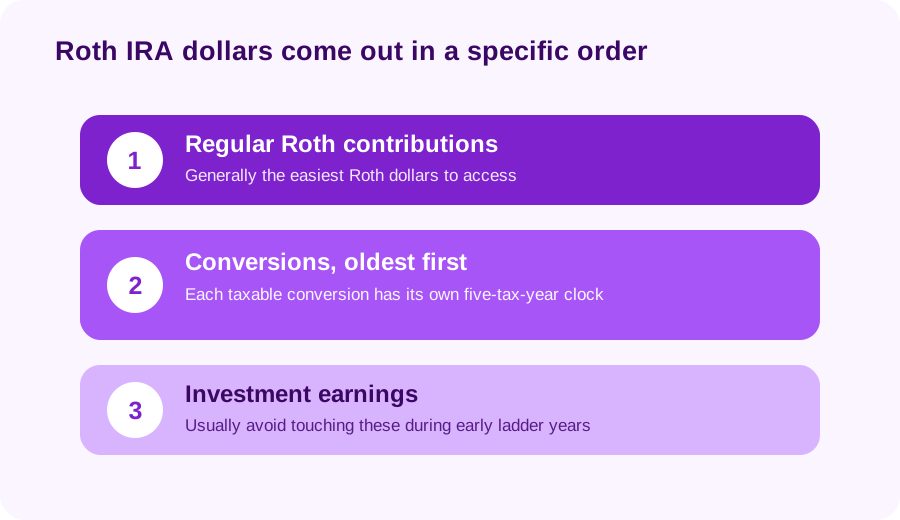
That order is helpful for FIRE. Regular contributions are generally accessible first, and matured conversions follow. Earnings come out last and are usually the dollars an early retiree should avoid touching until they qualify for tax-free treatment. Within the conversion layer, the IRS treats taxable conversion amounts as coming out before non-taxable conversion amounts for the same year.
Do not confuse the two Roth five-year rules
Roth IRAs have two separate five-year concepts. The first helps determine whether investment earnings can be withdrawn tax-free as part of a qualified distribution. The second applies separately to each taxable conversion and matters mainly when you withdraw it before age 59½.
| Five-year rule | What it controls | Why FIRE readers care |
|---|---|---|
| Qualified-distribution rule | Whether Roth earnings can come out tax-free | Earnings are not the main fuel for a ladder |
| Conversion rule | Whether a taxable conversion withdrawn before 59½ faces the 10% penalty | Each annual conversion has its own clock |
A conversion completed anytime in 2027 begins its conversion clock on January 1, 2027. Under the five-tax-year rule, that rung is generally available beginning January 1, 2032. Keep a year-by-year record instead of relying only on the balance shown by your custodian.
Why the ladder can work so well for FIRE
Early retirement can create valuable low-tax years
Your income may drop sharply after your final paycheck. Later, Social Security and required minimum distributions can fill your tax brackets again. The years between work and those later income sources — the Roth conversion window — may be your best chance to convert pre-tax money at a manageable rate.
For example, a couple with little other taxable income might deliberately convert enough to use a lower tax bracket. The same conversion made while they were earning salaries, or after required distributions begin, could be taxed at a higher marginal rate.
A ladder can reduce future required-distribution pressure
Every dollar converted reduces the balance left in pre-tax accounts. That can mean smaller required minimum distributions later and more control over taxable income. The IRS RMD guidance confirms that traditional IRAs are subject to RMD rules while Roth IRAs are not subject to them during the owner's lifetime. A conversion also builds a Roth bucket that can be useful when a large expense would otherwise push you into a higher bracket. For larger multi-account portfolios, read how Fat FIRE tax planning coordinates conversions with gains, future RMDs, and Medicare IRMAA, and why required minimum distributions matter for FIRE decades before they begin.
The five-year bridge is the real entry price
A ladder does not provide immediate spending money. You need enough accessible assets for the first five years, including conversion taxes. Common bridge sources include cash, Treasury bills, a taxable brokerage bridge, and existing Roth contribution basis.
If part-time income will cover some expenses, model it with the Barista FIRE Calculator. If you are still working and mainly waiting for investments to compound, the Coast FIRE Calculator may fit better than starting a ladder immediately.
Four research-backed lessons for everyday planning
1. Conversions move taxes; they do not erase them
Pre-tax money generally becomes taxable income when converted. The potential advantage is paying tax during a lower-income year instead of waiting for a higher-income year. Compare the full cost now with the likely cost later rather than assuming every conversion is a win.
2. Healthcare can change the best conversion amount
Before Medicare, taxable conversions raise ACA modified adjusted gross income and may reduce premium tax credits. Near and after Medicare enrollment, large conversions can raise income-related Medicare premiums two years later. Read our healthcare before Medicare guide and our ACA subsidies for FIRE guide before choosing a conversion target.
3. Social Security can shrink your conversion window
Conversions can cause more Social Security benefits to become taxable. That is one reason some FIRE households convert more before claiming benefits. Delaying Social Security is not automatically right, but it should be coordinated with the conversion plan. Our Social Security bridge guide explains the broader trade-off.
4. Traditional IRA basis can complicate the math
If you made nondeductible IRA contributions, you generally cannot convert only those after-tax dollars while leaving all pre-tax IRA dollars untouched. The pro rata rule looks across traditional, SEP, and SIMPLE IRA balances. Review the IRS Form 8606 guidance before estimating the taxable portion of a conversion.
Suppose your IRAs total $500,000, including $50,000 of tracked after-tax basis. About 10% of a $100,000 conversion would be nontaxable and about $90,000 would be taxable in this simplified example. Form 8606 tracks that basis and is essential when it applies.
Common Roth conversion ladder mistakes
- Starting without a five-year bridge. A ladder cannot fund the first five years by itself.
- Confusing conversion principal with earnings. The ladder is designed to spend matured conversion amounts, not Roth investment gains.
- Filling a tax bracket without checking ACA subsidies. A seemingly cheap conversion may cause a much larger healthcare cost.
- Paying conversion tax from the IRA. This reduces the amount reaching the Roth and may create an early-distribution problem when you are under 59½.
- Ignoring the pro rata rule. Existing pre-tax IRA balances can make a conversion more taxable than expected.
- Assuming a conversion can be undone. Roth conversions made in 2018 or later generally cannot be recharacterized back to traditional status under IRS Publication 590-A.
- Keeping weak records. Save Forms 8606, 1099-R, 5498, and confirmation of every conversion by tax year.
Build the ladder into your FIRE number
Your FIRE target must cover more than annual living expenses. Add the first five years of accessible spending, estimated conversion taxes, healthcare, and a buffer for market losses or unexpected income. Then test smaller and larger annual conversions.
A practical annual process is to estimate all other income, choose a tax and healthcare income target, size the conversion, and check the plan again before December 31. Use direct trustee-to-trustee transfers when practical, and consider a tax professional when basis, multiple account types, or large conversions make the return complicated.
Roth conversion ladder FAQ
Can I use a Roth conversion ladder before age 59½?
Yes. That is its main FIRE use. After each taxable conversion completes its separate five-tax-year period, the converted amount can generally be withdrawn without the usual 10% early-distribution penalty.
How much should I convert each year?
Convert an amount that fits your future spending need and current tax plan. Check federal and state taxes, ACA subsidies, Medicare premiums, capital gains, and other income. The amount should be reviewed every year rather than set once forever.
Do I need five full calendar years after every conversion?
The conversion rule uses tax years. A conversion made anytime during 2027 generally starts its clock on January 1, 2027 and completes the five-tax-year period on January 1, 2032.
Can I withdraw Roth conversion earnings after five years?
The five-year conversion rule applies to converted principal, not the earnings generated after conversion. Earnings have separate qualified-distribution requirements and come out last under Roth ordering rules.
What if I do not have enough money for a five-year bridge?
A full ladder may not be the right immediate strategy. Options may include working longer, building taxable savings, using part-time income, making smaller conversions, or evaluating another early-access method such as substantially equal periodic payments. See Roth conversion ladder vs 72(t) for that comparison.
Does a Roth conversion affect ACA subsidies?
Yes. The taxable conversion amount generally raises ACA MAGI and can reduce or eliminate premium tax credits. Coordinate the ladder with healthcare planning before Medicare.
The bottom line
A Roth conversion ladder can turn pre-tax retirement savings into a planned stream of penalty-free money for early retirement. Its power comes from choosing lower-income years, converting deliberately, and waiting for each rung to mature.
The strategy only works cleanly when you have a real five-year bridge, understand the two Roth five-year rules, and track every conversion. Start with your spending and FIRE number, then choose conversion amounts that balance current taxes, healthcare costs, and future flexibility.
What to read next
This article is educational and does not constitute tax, legal, or financial advice. Tax rules and household circumstances vary; verify your plan before completing a conversion.