

A mini-retirement and FIRE solve different problems with different money. A mini-retirement is a funded 3–12 month break — paid for with cash savings — that ends when you go back to work. FIRE means a portfolio sized to support long-term withdrawals without a planned return to work. The bright line: someone with $60,000 in cash and a $40,000-a-year lifestyle has an 18-month runway, not independence; someone with $1,000,000 invested and the same lifestyle may be near a 4%-rule FIRE target. One is a planned detour; the other is designed to make work optional.
Confusing the two is the most expensive mistake in this space. This guide draws the line clearly, shows how much cash a mini-retirement actually needs, and covers the risks people underestimate — healthcare, re-entry, and raiding retirement accounts. Healthcare and tax rules below come from official US sources.
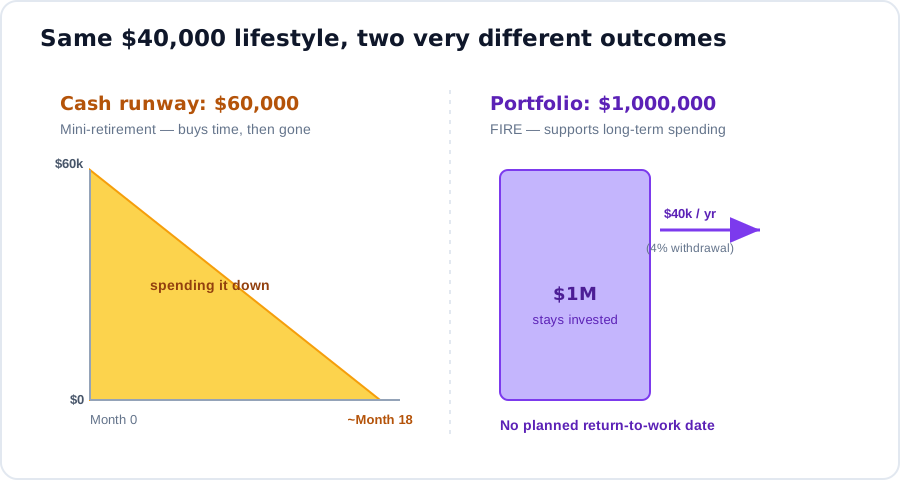
Mini-retirement vs FIRE: the core difference
The deepest source of confusion in flexible-FIRE planning is treating cash runway and portfolio independence as the same thing. They are different assets doing different jobs:
- Cash runway = months of expenses you can spend down. It buys time off. When it's gone, it's gone. A 6–24 month runway funds a break, a gap, or a transition — not a retirement.
- Portfolio independence = invested assets large enough that withdrawals (commonly ~4% a year, per the 4% rule) are designed to support long-term spending. It buys freedom from a planned return-to-work date.
This is the same distinction as an emergency fund vs. a FIRE portfolio: cash handles the short term; invested assets support the long term. A mini-retirement is not financial independence unless the portfolio behind it could support your spending long-term.
What is a mini-retirement?
A mini-retirement is a planned, self-funded break from work — typically 3–12 months — to rest, travel, learn, or reset, with the intention of returning to work afterward. It answers the "why wait until 65 to live?" problem and relieves burnout while you're young and healthy. What it does not do is make you financially independent: it's a cash-runway strategy with a built-in return date.
Vs. sabbatical vs. career break
| Type | Length | Job waiting? | Funding |
|---|---|---|---|
| Sabbatical | Weeks to months | Usually yes (employer-tied, sometimes paid) | Employer or light savings |
| Mini-retirement | 3–12 months | No — you fully exit and plan to re-enter | Dedicated cash fund |
| Career break | 1–2+ years | No, and highest re-entry risk | 1–2+ years of cash |
A paid sabbatical is the safest version because your job (and sometimes pay) waits. An unpaid sabbatical is effectively a short mini-retirement. A career break is the riskiest because the gap is long, skills decay, and there's no guaranteed job on return.
What FIRE — and "financially independent" — really means
FIRE (Financial Independence, Retire Early) means your invested assets are large enough that you can stop working and live on withdrawals. The target comes from your FIRE number: annual spending divided by your withdrawal rate, or about 25× spending at 4%. A $40,000-a-year lifestyle needs roughly $1,000,000; a $60,000 lifestyle needs about $1,500,000. Once that portfolio exists, work can become optional — no planned return date required, though the withdrawal plan still needs monitoring and flexibility.
Side-by-side comparison
| Dimension | Mini-retirement | FIRE |
|---|---|---|
| Core idea | A funded break, then back to work | Assets are sized to support long-term spending |
| Required money | Cash fund for the break + buffer (often $30k–$100k+) | ~25× annual spending ($1M–$1.5M+) |
| Funding source | Cash savings (HYSA) | Portfolio withdrawals (~4%) |
| Healthcare | Bridge the gap (COBRA or ACA) | Permanent self-funded plan pre-65 |
| Account access | Use taxable cash; avoid the 59½ penalty | Roth ladder, 72(t), Rule of 55, taxable |
| Career re-entry | Required and planned | Not required |
| Are you independent? | No | Yes |
How much cash a mini-retirement actually needs
Budget the full break plus a buffer for a longer-than-expected re-entry and self-funded healthcare — and keep it separate from your standard 3–6 month emergency fund. The ranges below assume a roughly $40,000–$45,000 annual lifestyle.
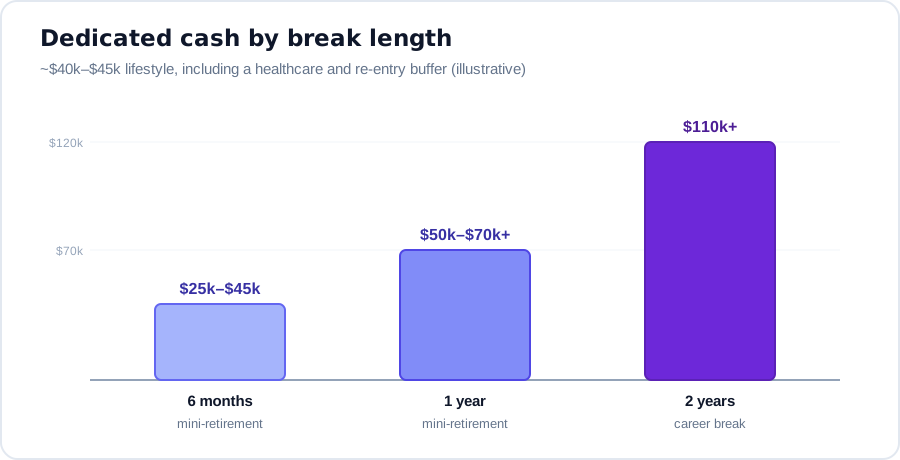
6-month mini-retirement
Roughly $25,000–$45,000 in dedicated cash for a domestic-travel-and-rest reset, plus COBRA or a marketplace plan for six months, plus a budgeted 2–3 month job-search cushion on top. It solves burnout; it does not solve long-term income.
1-year mini-retirement
Roughly $50,000–$70,000+ in cash, a full year of self-funded healthcare, and a serious re-entry plan because a 12-month gap is more visible to employers. Still a runway, not independence.
2-year career break
Two-plus years of expenses in cash — often $110,000+ — plus a skills and network maintenance plan. This carries the highest re-entry and wage-penalty risk and is usually driven by caregiving or a major life change rather than leisure.
The risks people underestimate
The healthcare gap (COBRA vs ACA)
Employer coverage typically ends when you leave, and you have two ways to bridge it. COBRA lets you keep your employer plan, generally for up to 18 months, but you can be charged up to 102% of the full premium (the entire employer-plus-employee cost plus a 2% admin fee) — often a shock versus your old payroll deduction. Alternatively, losing job-based coverage triggers an ACA Special Enrollment Period — generally 60 days before or after the loss. For 2026, note that the enhanced ACA premium tax credits expired at the end of 2025 and the 400%-of-poverty subsidy cliff returned under current law, so a break with little income may still face higher net premiums than in prior years. Compare the two in COBRA vs ACA for early retirement, and plan coverage before you quit.
Re-entry and the wage penalty
Re-entry is harder than people assume, and the cost compounds. The Center for American Progress, in research by economist Michael Madowitz, estimated that workers can lose up to three to four times their annual salary for each year out of the workforce once lost wages, lost wage growth, and lost retirement contributions are combined — far more than the foregone paycheck alone. A short, well-planned mini-retirement is a fraction of that cost; an open-ended one is where the damage lives. Budget for a longer, possibly lower-paid return, and keep your skills and network alive while you're out.
Don't raid retirement accounts
Funding a short break by pulling from a 401(k) or traditional IRA before age 59½ generally means a 10% early-withdrawal penalty plus ordinary income tax (IRS Topic No. 558) — and you lose the future compounding those dollars would have earned. Use taxable cash for a mini-retirement. Penalty-free strategies like the Roth conversion ladder are for funding real early retirement, not a temporary break.
Coast FIRE and Barista FIRE — the middle paths
Between a cash-only break and full independence sit two portfolio strategies that get confused with a mini-retirement:
- Coast FIRE = a portfolio milestone that lets you stop saving but keep working full-time for current expenses. The money stays invested and untouched. Cheapest to reach.
- Barista FIRE = a larger portfolio you actively withdraw from, topped up by part-time income (often for benefits). Needs more saved — e.g., $750,000 for a $30,000 spending gap — and exposes you to sequence-of-returns risk.
Why the labels matter: someone who says "I'll Barista FIRE" but only has a year of cash is actually describing a mini-retirement. Someone who says "I've Coast FIREd" but is still withdrawing from the portfolio is really doing Barista FIRE. The labels imply different math, different healthcare needs, and different risk. If you want the slower, sustained version of building the portfolio itself, that's Slow FIRE.
When a mini-retirement makes sense vs. when you want FIRE
Match the tool to the goal. Take a mini-retirement when the pain point is a need for a defined reset or adventure and you have: a clear end date, a dedicated cash fund plus buffer, a healthcare bridge, and a concrete plan to return to income. Pursue FIRE when the goal is to make work optional for good — that requires the full portfolio, not a cash pile. A mini-retirement only becomes a problem when it has no end date and quietly turns into an unplanned, indefinite withdrawal that drains savings and erodes earning power.
Mini-retirement vs FIRE FAQ
Is a mini-retirement the same as FIRE?
No. A mini-retirement is a funded break (typically 3–12 months) on cash savings, with a planned return to work. FIRE means a portfolio sized to support long-term spending without a planned return-to-work date. One buys time; the other is designed to make work optional.
How much money do I need for a mini-retirement?
Plan for the full break plus a buffer for re-entry and healthcare, held separately from your emergency fund. Roughly $25,000–$45,000 covers a 6-month break at a $40,000–$45,000 lifestyle, $50,000–$70,000+ a one-year break, and $110,000+ a two-year career break.
Can I use my 401(k) to fund a mini-retirement?
You shouldn't. Withdrawing before age 59½ generally triggers a 10% penalty plus income tax, and you lose decades of compounding. Fund a mini-retirement with taxable cash instead.
What about health insurance during a mini-retirement?
Bridge the gap with COBRA (up to 18 months, but you may pay up to 102% of the full premium) or an ACA marketplace plan (the special enrollment window generally runs for 60 days before and 60 days after you lose job-based coverage). Compare the options before you quit.
Is a mini-retirement worth the career risk?
It can be, if it's short, funded, and planned. Research links employment gaps to lower callback rates and lasting wage costs, so the risk rises with the length of the break and the absence of a re-entry plan.
What to read next
Dollar figures use illustrative assumptions (a ~$40,000–$45,000 lifestyle, the 4% rule, and steady returns) and are planning tools, not predictions. Healthcare, tax, and ACA rules change and vary by state and situation — verify current details with HealthCare.gov, IRS.gov, and DOL.gov. This article is educational and does not constitute financial advice.