

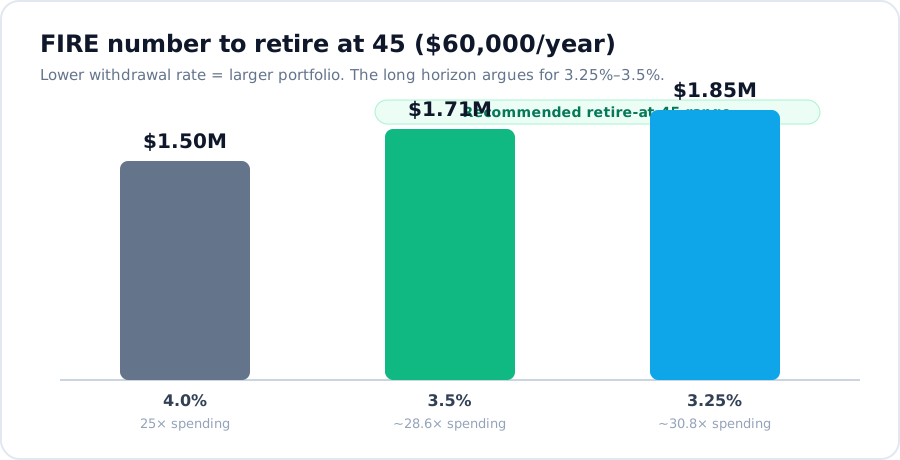
To retire at 45 on $60,000 a year, plan for roughly $1.71 million to $1.85 million — not the $1.5 million a quick 4%-rule calculation suggests. The reason is time. A 45-year-old is planning a retirement that could run 50 years, and the famous 4% rule was tested on 30-year retirements. Stretch the horizon and the safe withdrawal rate drops, so the multiple of spending you need climbs from 25× to roughly 28.6×–30.8×.
But the portfolio total is only half the answer. Retiring at 45 means a 20-year bridge to Medicare, about 14.5 years before you can tap a 401(k) or IRA without a 10% penalty, and 17 years before the earliest Social Security claim. The money has to be the right kind of money, in the right kind of account, sequenced to get you there. This guide walks through the number, the bridges, and what separates a retire-at-45 plan that holds from one that only works if nothing goes wrong.
The short answer (and why it is bigger than you think)
Your FIRE number is annual spending divided by your withdrawal rate — the same FIRE number formula behind every early-retirement plan. At 4%, that is 25× spending. The catch is that 4% comes from the Trinity Study, which tested whether a portfolio survived a 30-year retirement. A 45-year-old is not planning for 30 years.
When researchers extend the horizon, the safe rate falls. Financial planner Michael Kitces has noted that increasing a time horizon from 30 years to 45 years pulls the safe withdrawal rate from about 4% down toward 3.5%, which he treats as a practical floor for very long retirements. The early-retirement blog Early Retirement Now, modeling 60-year horizons, lands even lower — closer to 3.25%. For a 45-year-old, anchoring to 3.25%–3.5% rather than 4% is the more defensible starting point.
The $60,000 example at three rates
| Withdrawal rate | Multiple of spending | FIRE number ($60k spending) |
|---|---|---|
| 4.0% | 25× | $1,500,000 |
| 3.5% | ~28.6× | $1,714,286 |
| 3.25% | ~30.8× | $1,846,154 |
That spread — about $346,000 between the 4% and 3.25% targets — is the price of the extra margin a 50-year retirement deserves. It is not wasted money; it is the buffer that lets the plan survive a bad first decade. These figures assume the portfolio funds the whole budget and do not yet add healthcare or subtract future income.
Why retiring at 45 is structurally different
Three government age thresholds — 65 for Medicare, 59½ for penalty-free retirement-account access, and 62/67 for Social Security — sit far in the future for a 45-year-old. Each one is a gap the portfolio must cover on its own.
The 20-year healthcare bridge
Medicare eligibility is age 65 for nearly everyone, so retiring at 45 means buying your own coverage for two decades, often through the ACA Marketplace. That cost is real and rises with age, because Marketplace premiums can be up to three times higher for older people than for younger ones. And the rules tightened for 2026: the enhanced premium tax credits from the American Rescue Plan expired on December 31, 2025, so under current law the "subsidy cliff" at 400% of the federal poverty level returned — earn $1 over the line and the premium tax credit can drop to zero. Congress has been debating an extension, so verify the rule for your coverage year before relying on it.
How you carry that cost into the number matters. A simple way to picture it: budget, say, $18,000 a year of premiums and treat it like perpetual spending, and at 3.5% it adds about $514,000 to the target. But a 20-year bridge is finite — it ends at 65 — so funding it forever overstates the cost. The cleaner approach is to size the present value of premiums through age 65 and add that, then plan to manage your ACA MAGI and other subsidy inputs. Our guide to health insurance before Medicare walks through that finite calculation, and the 2026 ACA subsidy cliff covers the income management.
14.5 years until penalty-free account access
Most retirement money sits in 401(k)s and traditional IRAs, which the IRS penalizes 10% for withdrawals before age 59½ (on top of ordinary income tax). At 45, you are ~14.5 years from that date, and the Rule of 55 — penalty-free 401(k) access for people who leave work at 55 or later — is not available to you. So a retire-at-45 plan leans on a large taxable brokerage bridge plus a Roth conversion ladder, where each conversion seasons five tax years before it can come out penalty-free. You fund the first five years from taxable money and Roth contribution basis while the ladder cooks.
17 years until Social Security (and a smaller benefit)
The earliest you can claim Social Security is 62, and full retirement age is 67 for anyone born in 1960 or later. A 45-year-old is 17 years from even the earliest claim, so Social Security cannot fund the early years. Worse, retiring early can shrink the benefit itself: the SSA averages your highest 35 years of earnings, and any missing years count as zeros, dragging the average down. Treat Social Security as a late-life backstop that reduces portfolio reliance in your 60s and beyond — not as core early-retirement income. The Social Security bridge strategy shows how delaying to 70 can still strengthen the plan.
Sequence-of-returns risk in the first decade
A bad market in the first 5–10 years is one of the biggest threats to a retire-at-45 plan. Withdraw from a portfolio while it is down and you sell more shares at low prices, locking in losses the later recovery cannot fully undo — this is sequence-of-returns risk, and a 45-year-old has a long horizon over which the damage must be absorbed.
This is exactly why the lower withdrawal rate matters: starting at 3.25%–3.5% instead of 4% leaves room to ride out an early crash without selling into it. The defenses that pair with it — a 2–3 year cash buffer, willingness to trim spending after bad years, and some part-time income in the first decade — are what turn a fragile number into a durable one.
Building the bridge: taxable, Roth ladder, 72(t)
Because the penalty-free date is so far off, a 45-year-old needs an explicit plan to reach money before 59½. The three workhorses:
- Taxable brokerage account. No age limit and no early-withdrawal penalty; you pay long-term capital gains rates, potentially 0% in low-income years. This is the cleanest bridge and the reason FIRE planners build a taxable account, not only a 401(k).
- Roth IRA contribution basis. Direct Roth contributions (not earnings, not conversions) can be withdrawn anytime, tax- and penalty-free, under the IRS ordering rules.
- Roth conversion ladder or 72(t). Convert traditional dollars to Roth in low-income years and wait five tax years per conversion; or use 72(t) substantially-equal payments to tap an IRA at any age, accepting that the payments lock for the longer of five years or until 59½.
The practical takeaway for a young saver: do not pour everything into pre-tax accounts. An all-401(k) saver hits 45 with a healthy net worth and almost no way to spend it for 14 years without penalties or elaborate workarounds.
45 vs 50 vs 55 — how the number changes
The same $60,000 budget produces a similar headline FIRE number at any age, but the structure around it changes sharply. The later you retire, the shorter every bridge and the simpler the plan.
| Variable | Retire at 45 | Retire at 50 | Retire at 55 |
|---|---|---|---|
| Years to Medicare (65) | 20 | 15 | 10 |
| Years to penalty-free access (59½) | 14.5 | 9.5 | 4.5 |
| Years to earliest Social Security (62) | 17 | 12 | 7 |
| Suggested starting withdrawal rate | ~3.25% | ~3.25–3.5% | ~3.5% |
| FIRE number at $60k | ~$1.85M | ~$1.71–1.85M | ~$1.71M |
| Rule of 55 available? | No | No | Yes |
Age 50 looks like a midpoint but sits structurally closer to 45: still no Rule of 55, still a 15-year health bridge. Age 55 is the real break — the Rule of 55 can cover much of a short 4.5-year gap to 59½, Social Security is only seven years away, and the required multiple is the lowest of the three.
What makes a retire-at-45 plan stronger
Beyond hitting the number, five levers separate a robust plan from a fragile one — and the two biggest swing factors are housing and location:
- A lower starting rate (3.25%). A simple way to add margin against a long horizon and a bad early market.
- Housing under control. A mortgage is a fixed bill that forces withdrawals in down years. Carrying one into early retirement can raise your required portfolio by hundreds of thousands — see FIRE with a mortgage for the full math.
- A lower cost base. Relocating to a cheaper area can cut the required number by a large margin; geographic arbitrage explains the real tradeoffs, taxes included.
- A 2–3 year cash buffer so you can spend from cash instead of selling stocks in a downturn — and avoid realizing income solely to fund spending.
- Flexibility and some early income. Modest part-time earnings in the first decade disproportionately reduce sequence risk, though they cannot be assumed forever.
If your plan only works when markets cooperate, healthcare stays cheap, and you never touch the portfolio early, it is closer to the biggest FIRE planning mistakes than to a finished plan. And before you actually pull the trigger, run the full pre-quit checklist.
How much to retire at 45 — FAQ
How much do I need to retire at 45 on $60,000 a year?
Roughly $1.71 million at a 3.5% withdrawal rate or $1.85 million at 3.25% — the conservative rates a 50-year horizon argues for. A 4% calculation gives $1.5 million, but that leaves less margin for a retirement this long. Add a separate healthcare line for the 20-year bridge to Medicare.
Can I use the 4% rule to retire at 45?
The 4% rule was built for 30-year retirements, and a 45-year-old may face 50 years. Research suggests the safe rate falls toward 3.5% at that horizon, so 4% is a starting reference, not a target. See whether the 4% rule is still safe for the evidence.
How do I access my money before 59½?
Through a taxable brokerage account, Roth contribution basis, a five-year Roth conversion ladder, or 72(t) payments — not by paying the 10% penalty. The Rule of 55 is unavailable to someone who stops working at 45.
What is the biggest risk of retiring at 45?
A poor market in the first decade. Selling shares while the portfolio is down does lasting damage, which is why a lower starting rate, a cash buffer, and spending flexibility matter more the earlier you retire.
What to read next
Withdrawal rates are historical estimates, not guarantees, and depend on asset allocation, valuations, inflation, and your willingness to adjust spending. Tax, ACA, Medicare, and Social Security rules change yearly — verify current figures with IRS.gov, HealthCare.gov, Medicare.gov, and SSA.gov before planning. This article is educational and does not constitute financial advice.