

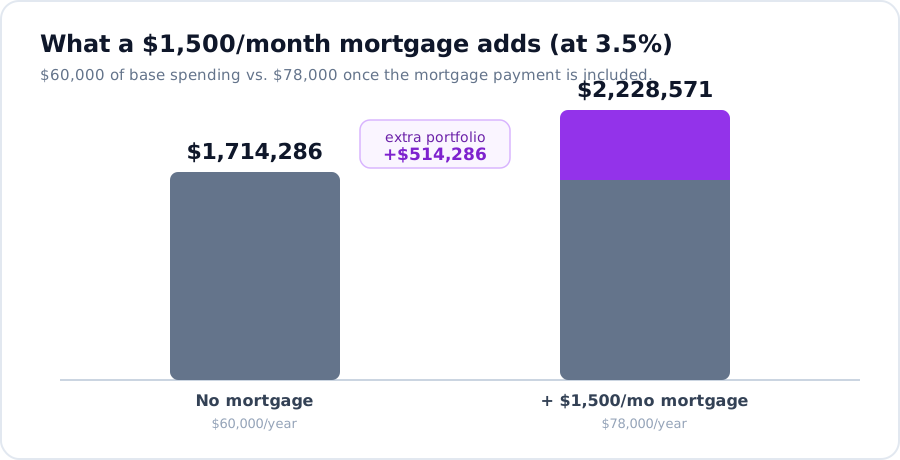
You can absolutely reach FIRE with a mortgage — but carrying one into early retirement raises the portfolio you need by a lot. A $1,500-a-month mortgage adds $18,000 to your annual spending, and at a 3.5% withdrawal rate that means about $514,000 more in your FIRE number. The mortgage payment is not just an interest-rate question; it is a fixed monthly bill that follows you into retirement and forces withdrawals whether the market is up or down.
The honest answer to "should I pay it off or invest?" is: it depends on your rate, your cash-flow risk, and how you sleep. If your mortgage rate is well below your expected return, the math usually favors keeping the loan and investing the difference. But FIRE adds layers the pure math misses — sequence risk, ACA income limits, and liquidity — that can flip the decision. This guide works through both the numbers and the parts the numbers leave out.
Should you carry a mortgage into early retirement?
Start with the math, because it sets the baseline. If your effective mortgage rate is well below the return you expect from a stock-heavy portfolio, keeping the mortgage and investing the cash usually wins on expected value. A rough practitioner consensus:
| Mortgage rate (real, after inflation) | Which usually wins on the math |
|---|---|
| Below ~4% | Investing often has the higher expected value over a long horizon |
| ~4–6% | A genuine gray zone — risk tolerance decides |
| Above ~6% | Paying down becomes competitive with investing |
This is the same logic behind dollar-cost averaging into index funds: a guaranteed return equal to your mortgage rate (what you earn by paying it off) competes with an uncertain, on average higher, market return. A 3% mortgage is easy to keep; an 8% mortgage is closer to a high-interest debt you would not want hanging over a fixed income.
Why FIRE changes the calculation
For someone still working, the mortgage-versus-invest decision is mostly about expected return. In early retirement, three things the pure-math version ignores start to dominate: your withdrawals are now your income, a bad early market does outsized damage, and your household income affects your healthcare subsidies. Each of those turns a clean rate comparison into a risk decision.
The hidden costs of a mortgage in FIRE
It amplifies sequence-of-returns risk
A mortgage is a fixed, non-negotiable bill. In a market downturn early in retirement, you must sell more shares — at depressed prices — to make the payment, which is exactly how sequence-of-returns risk destroys a portfolio. A paid-off home lowers your required withdrawal and shrinks that risk. The bigger your mortgage relative to your portfolio, the more a bad first decade hurts.
It can push your income over the ACA subsidy cliff
Because the mortgage forces higher withdrawals, it can raise your ACA MAGI — one key Marketplace subsidy input — when the withdrawals create taxable income, such as realized gains or traditional-account distributions. For 2026, the enhanced premium tax credits expired at the end of 2025, so under current law a household earning $1 over 400% of the federal poverty level can lose the premium tax credit entirely. A mortgage that nudges your withdrawals — and therefore your realized income — over that line is an indirect cost a rate-vs-return calculation never shows.
The other housing costs do not disappear
Paying off the loan ends the principal-and-interest payment, but property taxes, homeowners insurance, and maintenance (often estimated near 1% of home value a year) continue — and tend to rise with inflation. "No mortgage" is not "no housing cost." Budget the ongoing line whether or not the loan is gone.
Worked example: $60k vs $78k spending
Take a baseline of $60,000 a year with no mortgage, then add a $1,500/month mortgage ($18,000/year) to reach $78,000. Here is how the FIRE number moves across three withdrawal rates:
| Withdrawal rate | No mortgage ($60k) | +$1,500/mo mortgage ($78k) | Extra portfolio needed |
|---|---|---|---|
| 4.0% | $1,500,000 | $1,950,000 | +$450,000 |
| 3.5% | $1,714,286 | $2,228,571 | +$514,286 |
| 3.25% | $1,846,154 | $2,400,000 | +$553,846 |
The mortgage raises the required portfolio by $450,000–$554,000 depending on the rate. That is the real "price" of carrying it into retirement at a fixed-income stage of life — and why the decision is about cash-flow structure, not just the interest rate.
The counterpoint is just as real: if you would have paid the loan off with, say, $300,000 of invested assets, that $300,000 could keep growing faster than a low mortgage costs you. You cannot have it both ways — the larger portfolio in the table assumes you keep the cash invested rather than retiring the debt. That tension is the whole decision.
Five housing paths for FIRE
Carrying a mortgage and paying it off are only two of the choices. The full menu:
| Path | What it does to the plan |
|---|---|
| FIRE with a mortgage | Keeps capital invested; raises required portfolio and sequence risk |
| FIRE with a paid-off home | Lowest withdrawals and sequence risk; least liquid; drag if the rate was very low |
| Renting in FIRE | Maximum flexibility and liquidity; exposed to rent inflation; no equity build |
| Downsizing before retirement | Frees equity, cuts ongoing costs, can fund the taxable bridge |
| Relocating to a cheaper area | Can reset the entire housing cost base — geographic arbitrage |
The last two are levers, not just lifestyle choices. Downsizing or moving can free home equity and slash the budget at the same time — see geographic arbitrage for FIRE for how far a lower cost base can cut the number, and the Lean FIRE housing cost comparison for a side-by-side of renter, mortgage, and paid-off-home scenarios.
Liquidity vs. peace of mind
Paying off a mortgage converts liquid, flexible investments into illiquid home equity. As more than one Bogleheads commenter has pointed out, sinking a large share of a modest portfolio into a single illiquid asset can actually increase risk — home equity cannot pay a medical bill without a sale or a HELOC. A paid-off home lowers your monthly outflow but reduces the money you can actually reach in a crisis.
Against that is the psychology. Many people simply sleep better with no mortgage, and that is a legitimate input — financial plans you cannot stick to do not work. Just be honest about which one you are buying. If the urge to pay off the loan really reflects doubt about your withdrawal plan, the fix may be a bigger cash buffer or a lower withdrawal rate, not killing a 3% loan.
How your retirement age changes the answer
The earlier you retire, the more a mortgage matters, because the fixed payment overlaps with your most sequence-risk-exposed years and your longest healthcare bridge. Someone retiring at 45 carries the payment through a 50-year horizon and a 20-year pre-Medicare gap, where every forced withdrawal also threatens an ACA subsidy. Someone retiring at 60 carries it for a shorter, less fragile window. A mortgage that only works as long as you keep a full-time income is, in practice, a reason you cannot retire early at all.
FIRE with a mortgage — FAQ
Should I pay off my mortgage before retiring early?
There is no universal answer. If the rate is well below your expected return and you have liquidity elsewhere, keeping it can win on the math. If the payment is large relative to your portfolio or would force selling in a downturn, paying it off lowers your withdrawals and sequence risk. Many early retirees split the difference and pay it down partway.
How much does a mortgage add to my FIRE number?
At a 3.5% withdrawal rate, every $1,000/month of housing payment adds about $343,000 to the target; a $1,500/month payment adds roughly $514,000. At 4% it is smaller (about $450,000), at 3.25% larger (about $554,000).
Does a mortgage affect my ACA subsidies?
Indirectly. A mortgage forces larger withdrawals, which can raise your MAGI and push you over the 400% federal-poverty-level subsidy cliff that returned for 2026 under current law. Managing which accounts you draw from helps keep income — and subsidies — in range.
Is renting better for FIRE than owning?
Renting maximizes flexibility and liquidity and removes maintenance and property-tax surprises, but it exposes you to rent inflation and builds no equity. Owning a paid-off home does the reverse. Neither is universally better; it depends on local prices, how long you will stay, and how much you value the ability to move.
What to read next
Withdrawal rates are planning assumptions, not guarantees, and the mortgage-versus-invest decision depends on your rate, taxes, and risk tolerance. ACA and tax rules change yearly — verify current figures with HealthCare.gov and IRS.gov. This article is educational and does not constitute financial or tax advice.