

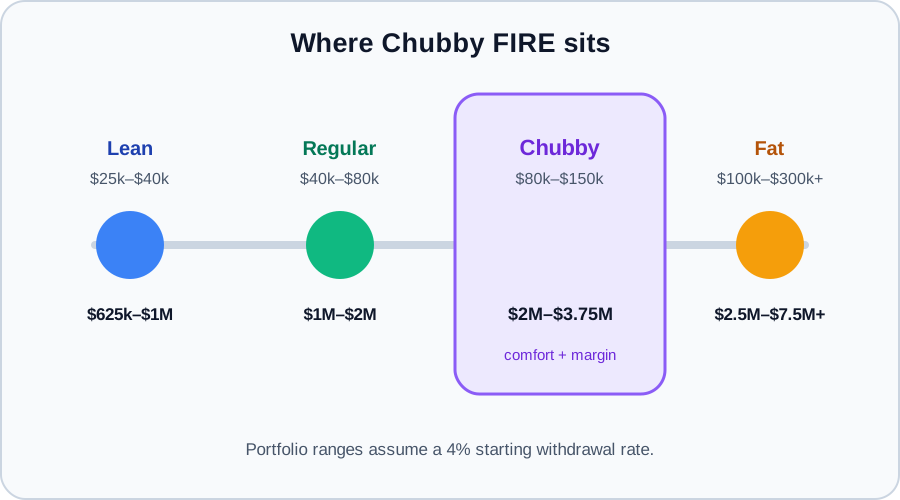
Chubby FIRE is the middle zone between regular FIRE and Fat FIRE: enough portfolio margin for a comfortable life, but usually without the highest-spending lifestyle or full tax complexity of Fat FIRE. There is no official threshold, so Worth101 uses a working range of $80,000 to $150,000 of annual spending, which implies roughly $2 million to $3.75 million at a 4% starting withdrawal rate.
The label is informal, and the dollar range is not a rule. The useful idea is that Chubby FIRE buys more room than Lean or regular FIRE: room for healthcare, travel, family support, and bad markets. In exchange, you accept more saving years and some tax planning, but usually less friction than a portfolio funding $200,000 or $300,000 every year. That extra room matters when you are pricing healthcare before Medicare.
Lean vs regular vs Chubby vs Fat FIRE
| FIRE style | Annual spending | Portfolio at 4% | Primary risk | Best-fit reader |
|---|---|---|---|---|
| Lean FIRE | $25,000–$40,000 | $625,000–$1 million | Thin buffer against housing, healthcare, and bad early returns | Minimalist with low fixed costs and flexible geography |
| Regular FIRE | $40,000–$80,000 | $1 million–$2 million | A normal lifestyle with limited room for major shocks | Household seeking independence near current middle-class spending |
| Chubby FIRE | $80,000–$150,000 | $2 million–$3.75 million | Comfort spending quietly becoming permanent | High saver who wants margin without a luxury-scale plan |
| Fat FIRE | $100,000–$300,000+ | $2.5 million–$7.5 million+ | Tax friction, large RMDs, IRMAA, and lifestyle drift | High earner or business owner preserving a high-cost lifestyle |
These ranges overlap because household size, location, taxes, and housing change what the same spending buys. That overlap is the point: a $120,000 budget can feel Chubby for one household and Fat for another when housing, dependents, taxes, or location change how much is truly optional. Use the FIRE Number Calculator to calculate the portfolio behind your actual budget instead of treating a community label as a finish line.
What Chubby FIRE really means
No regulator or research body defines Chubby FIRE. It is community shorthand for a plan that funds more than a basic middle-class retirement but stops short of a luxury-scale lifestyle. The most useful distinction is not the exact dollar threshold. It is the plan's available margin.
Chubby FIRE is not just a scaled-down Fat FIRE. In practice it is a comfort-focused plan whose real advantage is optional spending: the ability to cut back without touching rent, food, insurance, healthcare, or essential transportation.
A Lean FIRE household may need almost every dollar for housing, healthcare, food, and transportation. A Chubby FIRE household can usually absorb a repair, help family, or reduce travel during a downturn without threatening the basics. That difference is why our Lean FIRE vs Fat FIRE comparison treats FIRE styles as different risk systems rather than a single spending ladder.
The Chubby FIRE number
The basic math is annual portfolio-funded spending divided by your withdrawal rate. At 4%, multiply annual spending by 25. At 3.5%, multiply by about 28.6. The original research behind the 4% rule tested a 30-year retirement using historical data. A much longer early retirement and a less flexible budget can justify testing lower starting rates rather than treating 4% as a guarantee. Use the Safe Withdrawal Rate Calculator to compare how 4%, 3.5%, and 3.25% change the portfolio required for the same Chubby FIRE lifestyle.
| Annual spending | At 4% | At 3.5% | At 3.25% |
|---|---|---|---|
| $80,000 | $2,000,000 | $2,285,714 | $2,461,538 |
| $100,000 | $2,500,000 | $2,857,143 | $3,076,923 |
| $120,000 | $3,000,000 | $3,428,571 | $3,692,308 |
| $150,000 | $3,750,000 | $4,285,714 | $4,615,385 |
Read the FIRE number formula guide before choosing a target. Your calculation should subtract reliable future income and include taxes, healthcare, irregular expenses, and any spending that starts later.
Chubby FIRE buys more margin than Lean FIRE
Consider a $120,000 Chubby FIRE budget with a $70,000 essential spending floor and $50,000 of flexible spending. If markets fall, the household can reduce travel, dining, gifts, and upgrades while keeping housing, insurance, food, and healthcare intact. A $40,000 Lean FIRE budget may have only $6,000 or $8,000 that can be cut.
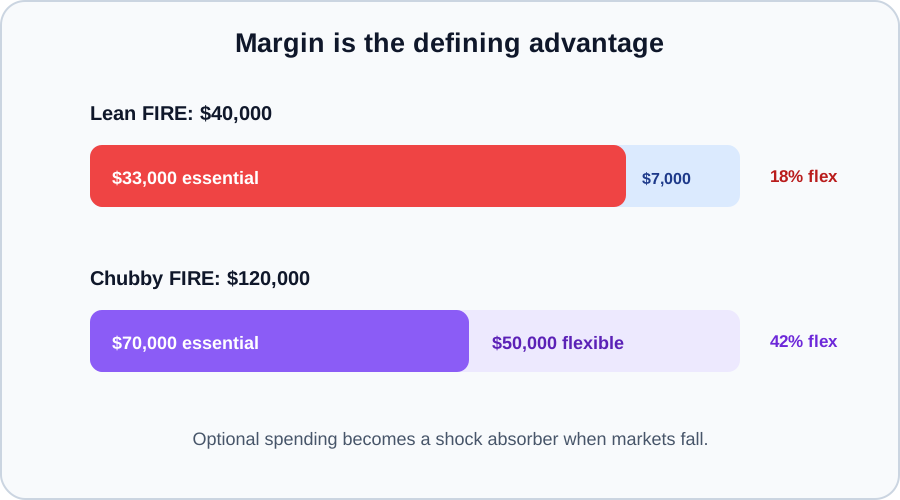
Margin also helps with expenses that do not arrive neatly every month: replacing a car, supporting a parent, repairing a home, or paying a large deductible. The plan is less dependent on every forecast being right. That does not make it failure-proof, but it gives you more realistic responses than immediately returning to full-time work.
Chubby FIRE usually has less tax complexity than Fat FIRE
Chubby FIRE portfolios can still create meaningful dividends, capital gains, Roth conversions, and future required distributions. The IRS generally requires many retirement-account owners to begin RMDs at age 73. Tax planning matters, but tax friction is usually less likely to define the entire retirement than it is for a household funding a much larger lifestyle from several large account buckets.
The practical goal is to preserve choices across taxable, traditional, and Roth accounts without turning retirement into a permanent tax-optimization project. Chubby FIRE often works best when the plan can fund its core lifestyle without realizing large gains or conversions in every year.
For example, a household spending $120,000 may be able to fund the year with a mix of taxable-account basis, moderate gains, and planned traditional withdrawals. At $250,000 of spending, larger gains, dividends, and conversions leave less room before income-related costs become relevant. For 2026, CMS applies higher Part B premiums above $109,000 for single filers and $218,000 for joint filers. The thresholds use tax-return income from two years earlier, so a large taxable year can affect Medicare costs later.
Who Chubby FIRE fits best
Chubby FIRE tends to fit high savers who already know what a comfortable life costs and want more margin before leaving work. It can be especially useful when healthcare, dependents, travel, or housing make regular FIRE feel too rigid, but the household does not want to fund a permanently luxury-scale lifestyle. If ACA pricing is part of that decision, our ACA subsidies for FIRE guide shows how income planning can change the real healthcare buffer you need.
Regular FIRE may already be enough when your essential spending floor is low, housing is stable, and you would rather reclaim time than work several more years for optional upgrades. The right stopping point is where the additional portfolio meaningfully changes your resilience or quality of life.
The Chubby FIRE risk profile
Comfort can become a fixed cost
Chubby FIRE is resilient while a meaningful portion of spending remains optional. It becomes fragile when a larger home, expensive vehicles, recurring family support, and premium travel all become non-negotiable. Measure the core lifestyle separately from the comfort layer.
Extra saving years have a cost
Moving from a $2 million regular FIRE target to a $3 million Chubby FIRE target can require years of additional work. That trade can be worthwhile, but only when the extra million funds a life you value or reduces a risk you genuinely carry. Do not delay freedom merely to earn a more flattering label. If you already have a large portfolio but are not ready to leave work, the Coast FIRE Calculator can show whether your current savings may already grow into a larger target without more contributions.
Sequence risk still matters
A larger portfolio does not eliminate the damage caused by poor returns early in retirement. The defense is the Chubby FIRE plan's flexible layer: reduce optional spending before selling more assets from a depressed portfolio. A rigid $120,000 budget can be less resilient than a flexible $100,000 budget.
Common Chubby FIRE mistakes
Using a net-worth label instead of a spending plan
A $3 million portfolio is not automatically Chubby FIRE. At $80,000 of spending it starts near a 2.7% withdrawal rate; at $150,000 it starts at 5%. The same net worth can describe two very different plans.
Counting flexible spending that will not be cut
A category is flexible only if you would actually reduce it after a market decline. Name the first $10,000, $20,000, and $30,000 you would cut. If you cannot, your spending floor is higher than the spreadsheet says.
Ignoring taxes and healthcare
A $100,000 after-tax lifestyle may require more than $100,000 of gross withdrawals when part of the money comes from traditional retirement accounts. It can also require a separate healthcare bridge before Medicare. Calculate the portfolio from after-tax spending needs, then model the gross withdrawals required to fund them. If you are choosing between employer coverage and the marketplace, compare the tradeoffs in COBRA vs ACA for early retirement.
A plan that works only when every category stays flexible and every tax assumption is right still needs a stress test. Review the biggest FIRE planning mistakes before treating extra portfolio size as protection against every risk.
Chubby FIRE FAQ
How much money do you need for Chubby FIRE?
Worth101 uses a working Chubby FIRE range of $2 million to $3.75 million, supporting $80,000 to $150,000 of first-year spending at 4%. There is no official definition, so your actual target depends on your withdrawal rate, taxes, healthcare, future income, and spending flexibility.
Is $3 million enough for Chubby FIRE?
$3 million supports $120,000 at 4%, $105,000 at 3.5%, or $97,500 at 3.25% in first-year withdrawals. Whether that is enough depends on how much of the budget is essential and how long the portfolio may need to last.
What is the difference between Chubby FIRE and Fat FIRE?
Chubby FIRE aims for comfort and margin without funding the highest-cost lifestyle. Fat FIRE generally supports more luxury spending and therefore creates more potential tax friction, account complexity, and lifestyle-inflation risk.
Is Chubby FIRE worth working longer?
It can be when the extra savings materially reduce healthcare, housing, family, or market risk. It may not be when you already have a durable regular FIRE plan and the larger target only postpones a life you prefer.
What to read next
The bottom line
Chubby FIRE is useful because it names a real middle ground. It offers more margin than Lean or regular FIRE without requiring the highest-cost lifestyle or tax machinery of Fat FIRE. Done well, it protects a modest core lifestyle and keeps a meaningful comfort layer truly optional.
This article is educational and does not constitute tax, legal, or financial advice. Withdrawal rates and FIRE categories are planning conventions, not guarantees or official definitions.