

Early retirement tax brackets work by stacking your income, not by taxing it all at one rate. Ordinary income — pre-tax withdrawals, Roth conversions, interest, and a part-time paycheck — fills the brackets from the bottom up after your standard deduction. Then long-term capital gains and qualified dividends stack on top in their own separate 0%, 15%, and 20% bands. Understanding that stack is what lets a FIRE household legally pay 0% federal tax on the long-term gains inside a $70,000 spending year, or fill a low bracket with cheap Roth conversions.
Most people only ever see their tax through paycheck withholding, where it feels like a single rate. In early retirement you control the inputs — how much you withdraw, convert, and realize each year — so knowing how the layers stack is the difference between a planned low-tax year and an accidental expensive one.
How income stacks in retirement
Picture your income as a glass you fill from the bottom. The order matters:
- Standard deduction first. For 2026 it is $16,100 single and $32,200 married filing jointly, per IRS Revenue Procedure 2025-32. This much income is taxed at 0% before any bracket starts.
- Ordinary income next. Wages, pre-tax 401(k)/IRA withdrawals, Roth conversions, interest, and short-term gains fill the 10%, 12%, 22%, and higher brackets in order.
- Long-term gains and qualified dividends on top. They sit above your ordinary income and are taxed on their own 0/15/20% schedule — described in IRS Topic No. 409.
The 0% capital-gains band is the FIRE superpower
Here is the useful rule: if your total taxable income stays below a threshold, your long-term gains and qualified dividends are taxed at 0%. For 2026, under IRS Revenue Procedure 2025-32, that ceiling is $49,450 of taxable income for a single filer and $98,900 for a married couple filing jointly — and that is after the standard deduction.
| Long-term gains rate (2026) | Single — taxable income | Married filing jointly |
|---|---|---|
| 0% | Up to $49,450 | Up to $98,900 |
| 15% | $49,451 to $545,500 | $98,901 to $613,700 |
| 20% | Above $545,500 | Above $613,700 |
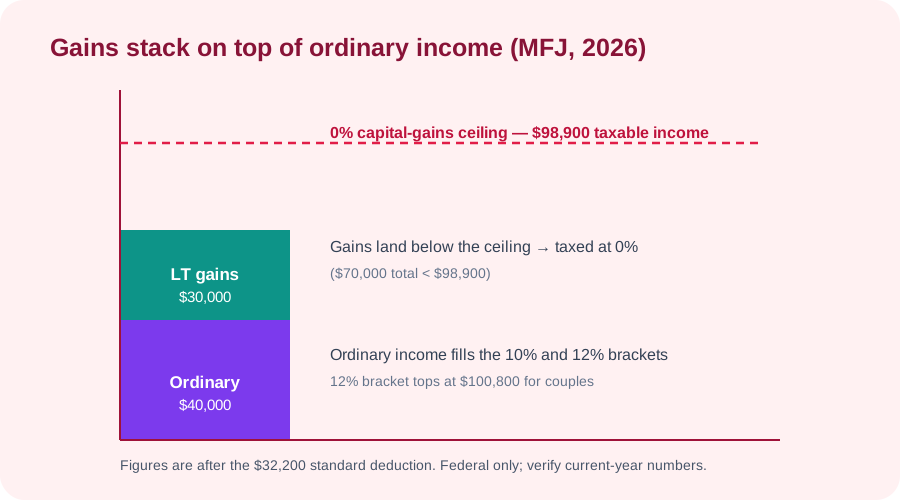
Take a married couple with $40,000 of ordinary taxable income and $30,000 of long-term gains. Their gains stack on top, from $40,000 to $70,000 — comfortably under the $98,900 ceiling — so all $30,000 of gains are taxed at 0%. The same couple could also deliberately harvest additional gains up to that ceiling and reset their cost basis tax-free, a move worth thousands over a long retirement. See the full mechanics of the 0% capital gains bracket for FIRE.
Watch the capital-gains “bump zone”
Stacking cuts both ways. Because gains sit on top of ordinary income, adding ordinary income — say, a larger Roth conversion — pushes some of your gains above the 0% ceiling and into the 15% band. So one extra dollar of conversion can cost you 12% on the conversion plus 15% on a dollar of gain that just lost its 0% treatment. This is the capital-gains bump zone, and it is why you cannot plan conversions and gain-harvesting in isolation. Decide each year whether you are running a 0%-gains year or a conversion year — trying to maximize both at once usually backfires.
Why early retirees sit in low brackets
The years between your last paycheck and the start of Social Security and required distributions are often the lowest-income years of your life. No salary, no RMDs, and you can fund much of your spending from taxable basis and Roth dollars that are not even taxable income. That creates room at the bottom of the bracket structure.
That empty room is the opportunity. You can fill the 10% and 12% brackets with Roth conversions at a deliberately low rate now, instead of letting that money compound and come out as RMDs taxed at 22%+ later. This is the central idea behind the Roth conversion ladder, and choosing how high to fill each year is the heart of your tax-efficient withdrawal order.
Brackets are not the only meter that moves
Before age 65, many dollars you add to the tax stack also raise ACA MAGI. But ACA MAGI is not taxable income: it starts with AGI, then adds items such as tax-exempt interest, non-taxable Social Security, and excluded foreign income. The standard deduction can lower taxable income without lowering ACA MAGI. A Roth conversion that looks cheap at the 12% federal rate can be expensive if it pushes you over the 2026 subsidy cliff and erases thousands in premium tax credits. Always check your bracket math against your healthcare math — our ACA subsidies for FIRE guide walks through managing MAGI to that cliff. After 65, the same income feeds Medicare IRMAA and the taxability of your Social Security.
Common bracket mistakes in early retirement
- Assuming one flat rate. Your withdrawal is not taxed at your “tax bracket” — only the dollars inside each band are taxed at that band's rate.
- Forgetting gains stack on top. A big Roth conversion can quietly knock your long-term gains out of the 0% band and into 15%.
- Leaving the low brackets empty. Doing no conversions in a low-income year wastes bracket space you can never get back and can leave you with larger taxable RMDs later.
- Ignoring the standard deduction. The first $16,100 (single) or $32,200 (joint) of income is effectively a 0% bracket — plan conversions to use it.
Run your own numbers
The size of your low-bracket window depends on your spending and how much of it comes from taxable basis versus pre-tax accounts. Start by sizing the target your plan has to support.
Early retirement tax brackets FAQ
How are retirement withdrawals taxed?
Pre-tax 401(k) and traditional IRA withdrawals are ordinary income and fill your brackets after the standard deduction. Roth IRA contribution basis is not taxable; other Roth distributions are tax-free only when the applicable Roth rules are met. Only the gain portion of taxable-account sales is taxed — at long-term rates if held over a year.
Can I really pay 0% on capital gains?
Yes, when your total taxable income stays under the 0% ceiling — about $49,450 single or $98,900 joint for 2026. Long-term gains and qualified dividends stacked below that ceiling are taxed at 0% federally. State taxes may still apply.
Do Roth conversions raise my bracket?
A conversion is ordinary income, so it fills your brackets and can push gains out of the 0% band. That is why FIRE retirees size conversions to a target — usually the top of the 12% bracket or just under an ACA or IRMAA threshold.
What to read next
The bottom line
Early retirement tax brackets reward people who understand stacking. Ordinary income fills the brackets from the bottom; gains and qualified dividends ride on top in their own 0/15/20% bands. Your standard deduction and the 0% capital-gains ceiling create real room to convert and harvest at little or no tax — as long as you plan each year on purpose and check the result against your ACA and Medicare income limits.
This article is educational and does not constitute tax, legal, or financial advice. The 2026 figures are inflation-adjusted annually and vary by filing status and state; verify current-year numbers before acting.