

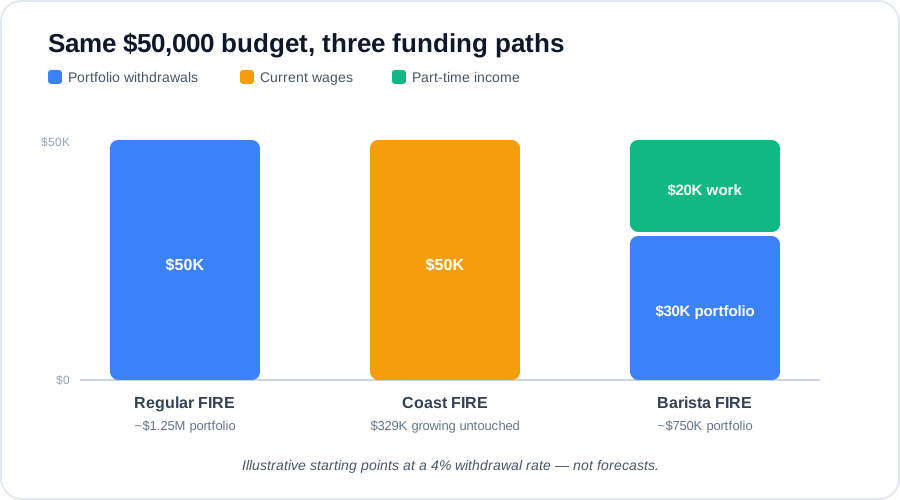
Regular FIRE, Coast FIRE, and Barista FIRE are three answers to the same question: how do you fund your life without a full-time job? Regular FIRE builds the entire portfolio — about $1,250,000 for $50,000 of spending at a 4% withdrawal rate. Coast FIRE front-loads a smaller amount early — roughly $329,000 at age 30 — then lets compounding finish the job while you keep working. Barista FIRE keeps part-time income so the portfolio covers less, around $750,000 when a $20,000 side income fills part of a $50,000 budget.
Same spending target, three very different portfolios — because each path covers the gap a different way. This guide compares all three on the numbers, the lifestyle, and the risks, so you can match the path to your plan rather than the name.
The three paths side by side
Each row below assumes the same $50,000 annual spending and a 4% withdrawal rate. The portfolio figures are illustrative starting points, not forecasts — your real number depends on healthcare, taxes, and how long the money has to last.
| Path | Portfolio needed | Keep working? | Keep saving? | Primary leverage |
|---|---|---|---|---|
| Regular FIRE | ~$1,250,000 | No | No | Full portfolio withdrawals |
| Coast FIRE | ~$329,000 invested by age 30 | Yes, to cover today's bills | No — compounding does the rest | Time and compounding |
| Barista FIRE | ~$750,000 (with $20k income) | Part-time | Usually no | Ongoing income |
Try each one with your own inputs at the FIRE hub, which runs all three targets from a single set of spending and withdrawal-rate assumptions.
Regular FIRE: the full portfolio
Regular FIRE — sometimes called traditional or full FIRE — is the version most people picture. Your portfolio covers all of your spending, with no required job and no part-time income. The target is your FIRE number: annual spending divided by your withdrawal rate, or 25× spending at 4%. For $50,000 a year, that is $1,250,000.
It is the simplest plan to describe and the hardest to reach, because you carry the whole load yourself. It is also the most exposed to a bad first decade, since there is no paycheck to lean on if markets fall early. Many early retirees use 3.5% instead of 4% for that reason — review whether the 4% rule is still safe for a long retirement before committing to a number.
Coast FIRE: front-load, then let it grow
Coast FIRE is reached when your invested balance is already large enough to compound into your full FIRE number by retirement age — without another contribution. You keep working, but only to pay today's bills; every retirement dollar is invested. For a $1.25 million goal at 65, a 30-year-old needs about $329,000 invested today, assuming a 7% return and 3% inflation (about a 3.9% real return).
The leverage is time. At 25 the Coast number is about $272,000; at 40 it is about $482,000 for the same goal. The earlier you hit it, the smaller the lump sum, because the money has more years to compound. Full details and the present-value math are in what is Coast FIRE. Coast FIRE's main risk is touching the money early or needing to stop working before the portfolio matures.
Barista FIRE: part-time income does the heavy lifting
Barista FIRE replaces a stressful career with flexible part-time work that covers part of your spending. Subtract that income from your budget before dividing. Spend $50,000 and earn $20,000 part-time, and the portfolio only funds $30,000 — about $750,000 at 4%, half a million less than Regular FIRE. Every $1,000 of reliable annual income trims $25,000 off the target. The full method is in what is Barista FIRE.
The trade is a smaller portfolio for ongoing work and income risk. If the job disappears or you no longer want it, the gap reappears. Barista FIRE is strongest when the income is reliable and — often more valuable than the wage — comes with health benefits.
Healthcare and taxes can decide the winner
On paper the three paths differ mainly by portfolio size. In practice, the cost that often decides between them is health insurance before age 65. For 2026, the enhanced premium tax credits from the pandemic era have ended — HealthCare.gov confirms the additional savings ended on December 31, 2025. That makes a Barista FIRE job with employer coverage more valuable, and it makes income planning more important for Regular and Coast FIRE households buying Marketplace plans, since a Roth conversion or capital gain can raise premiums. Our ACA subsidies for FIRE guide shows how to manage that income separately from spending.
Taxes matter more as the portfolio grows. A large Regular FIRE balance held mostly in pre-tax accounts can collide with Medicare surcharges later: for 2026, CMS sets the first Part B IRMAA threshold above $109,000 for single filers and $218,000 for joint filers. The low-income years a Coast or Barista plan creates can be useful for Roth conversions that lower that future tax bill.
Which FIRE path fits you?
| Your situation | Best-fit path |
|---|---|
| You want to stop working entirely and rely on the portfolio | Regular FIRE |
| You are young, behind on the full number, but want to stop saving | Coast FIRE |
| You want to leave your career but keep flexible income and benefits | Barista FIRE |
These are not mutually exclusive. A common arc is to hit Coast FIRE in your 30s, downshift to Barista FIRE when you leave a career, and arrive at Regular FIRE once the portfolio matures. For the deeper comparison of the two income paths, see Coast FIRE vs Barista FIRE.
Common mistakes comparing the three
Comparing only the portfolio size
Coast and Barista FIRE look cheaper because part of the funding is your future or part-time income. A smaller portfolio is not automatically safer — it usually means you depend on a paycheck for longer.
Ignoring the income risk in Coast and Barista
Both paths assume income keeps flowing — full-time wages for Coast, part-time wages for Barista. Stress-test each as if that income paused for a year, with a cash buffer and flexible spending as backstops.
Using one withdrawal rate for everything
A Regular FIRE plan that must last 45 years may need a lower starting rate than a Barista plan supported by ongoing income. Test the number and your response to a poor market, and watch the broader FIRE planning mistakes that break plans built on a single optimistic assumption.
Regular vs Coast vs Barista FIRE FAQ
Which type needs the smallest portfolio?
Coast FIRE usually needs the smallest invested balance today because compounding fills the rest over time and you keep working. Barista FIRE needs a smaller portfolio than Regular FIRE because part-time income covers part of spending. Regular FIRE needs the full 25× target.
Can you combine these paths?
Yes. Many people reach Coast FIRE first, shift to Barista FIRE when they leave full-time work, and reach Regular FIRE later as the portfolio grows. The labels describe where a plan sits at a given moment, not a permanent choice.
Is Coast or Barista FIRE safer than Regular FIRE?
Ongoing income can reduce portfolio withdrawals and soften a bad early market, but it adds job and income risk. Whether a path is safer depends on how reliable that income is and how flexible your spending can be.
How do I pick a withdrawal rate?
Start with the 4% rule as a reference, then consider 3.5% or 3.25% for a longer retirement or a rigid budget. A shorter horizon or reliable side income can support a higher rate.
What to read next
The bottom line
Regular, Coast, and Barista FIRE are not competing philosophies — they are three ways to cover the same budget. Regular FIRE asks the portfolio to do everything. Coast FIRE asks time to do it. Barista FIRE asks part-time income to do part of it.
Pick the path that matches how long you want to work and how much income risk you can tolerate, then size it against your real spending, healthcare, and taxes. The right answer is the one whose weak points you can actually manage.
This article is educational and does not constitute tax, legal, healthcare, or financial advice. Withdrawal rates and portfolio targets are planning assumptions, not guarantees. Tax, healthcare, and benefit rules can change, and individual costs vary.