

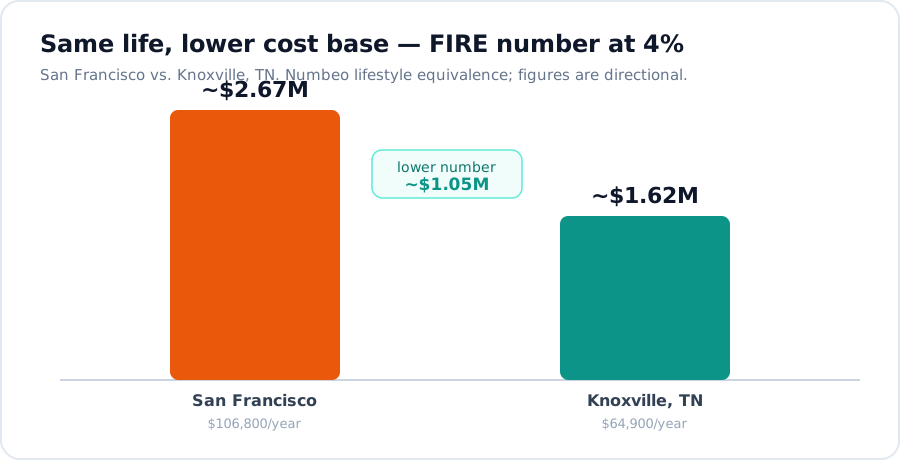
Geographic arbitrage for FIRE means relocating to a lower-cost place so the same portfolio funds a longer or richer retirement. The upside is large and real: trading a high-cost city for a low-cost one can cut your FIRE number by roughly $1 million. In one common comparison, a lifestyle that costs about $106,800 a year in San Francisco runs closer to $64,900 in Knoxville, Tennessee — and at a 4% withdrawal rate that is the difference between a $2.67M and a $1.62M portfolio.
But geographic arbitrage is a full risk tradeoff, not just "move somewhere cheaper." The headline housing savings can be eaten away by property taxes, two-car transportation, thinner ACA networks, distance from family, and disaster-driven insurance costs. The honest number is the cost cut after all of those — still usually large, but smaller than the rent comparison alone suggests. This guide covers both sides.
What geographic arbitrage really is
Your FIRE number is annual spending divided by your withdrawal rate, so anything that lowers spending lowers the target dollar-for-dollar. Geographic arbitrage attacks the biggest line in most budgets — housing — and several smaller ones at once. Because the savings recur every year, a one-time move can compound into a permanently smaller portfolio requirement.
It comes in three flavors: moving within your metro (cheaper suburb), moving across the country (high-cost state to low-cost state), and moving abroad (international arbitrage). The domestic-US version is the most common for FIRE because it keeps you in the same healthcare system, tax regime, and Social Security framework — international moves add currency, visa, and coverage complexity that deserve their own analysis.
The upside, with real numbers
Using a high-cost versus low-cost US pairing — San Francisco versus Knoxville, Tennessee — the gap is concrete:
| Measure | San Francisco | Knoxville, TN |
|---|---|---|
| Equivalent annual lifestyle cost (Numbeo) | ~$106,800 | ~$64,900 |
| FIRE number at 4% | ~$2,670,000 | ~$1,622,500 |
| Typical home value (Zillow, May 2026) | ~$1.39M | ~$375,000 |
That is roughly a $1.05 million lower FIRE number for a comparable day-to-day life. The housing gap alone — about $1 million in typical home value as of May 2026 — can free a large chunk of equity if you sell the expensive home and buy the cheaper one outright. The numbers blend sources (Numbeo for spending, Zillow for home values), and a cost-of-living index like C2ER implies a somewhat different gap, so treat the percentage as directional rather than precise.
The taxes nobody mentions
"No income tax" is the headline draw of states like Florida, Texas, and Tennessee — but it is not the same as "low tax." As of 2026, nine states levy no broad personal income tax (Alaska, Florida, Nevada, New Hampshire, South Dakota, Tennessee, Texas, Washington, and Wyoming). For an early retiree who lives mostly off a portfolio, a no-income-tax state can be a genuine win — but the state still needs revenue, and it often comes from property and sales taxes instead.
Property tax is the one that bites a FIRE household, because you pay it on the home's assessed value regardless of how little income you report. A retiree drawing from a portfolio can find that a high-property-tax, no-income-tax state costs more than a moderate-income-tax state with lower property taxes. Run the total tax bill, not the marquee one.
Healthcare is local
ACA premiums, plan choice, and provider networks vary enormously by county — and for an early retiree bridging a decade or two to Medicare, that variation is not a footnote. A cheaper town may have a single insurer, a narrow network, and a long drive to specialists. Sometimes a low premium can come with fewer insurers or narrower provider networks, so compare the plan details rather than assuming it is a bargain.
Two things to check before you move for the cost cut. First, your ACA MAGI remains a key subsidy input everywhere, alongside household and coverage details, and for 2026 the enhanced premium tax credits expired at the end of 2025, so the 400%-of-poverty subsidy cliff is back under current law — a move does not change that math. Second, look up the actual plans and networks on HealthCare.gov for the specific county you are considering, not the state average. Rural and low-cost areas can also mean longer waits and more travel for care across a 10–20 year pre-Medicare bridge.
The costs that eat the savings
Beyond taxes and healthcare, several quieter costs can erase part of the housing win:
- Transportation. Low-density, low-cost areas often force two cars where a dense city needed none. Car payments, insurance, fuel, and maintenance add up to thousands a year per vehicle.
- Family and social support. Moving away from family removes informal help — childcare, eldercare, a hand in a crisis — that has real financial value you only notice when it is gone.
- Job re-entry risk. If your plan relies on occasional income, a thin local labor market makes returning to work harder — exactly when a bad early market would make you want to.
- Climate and disaster exposure. Some low-cost areas carry higher flood, wildfire, or hurricane risk, which later shows up as soaring homeowners-insurance premiums or outright uninsurability.
- Reversibility. Moving is expensive and not free to undo. If the low-cost area later gets pricey, or you need to move back, transaction costs and higher re-entry prices bite.
None of these cancel the strategy. They just mean the real benefit is the housing-and-tax win minus these offsets — calculated for the specific place, not assumed from a rent index.
Domestic vs. international arbitrage
Moving abroad can cut costs even more dramatically, but it changes the whole financial picture. You take on currency risk, visa and residency rules, and the question of how US-based healthcare and Social Security travel with you. ACA subsidies generally require US residency, and Medicare does not cover care outside the country, so an international early retiree is often self-insuring or buying local or expatriate coverage. International arbitrage can work beautifully — but price the healthcare and tax treaty details before you count the savings, and keep a clear-eyed view of reversibility.
How to test a location before you commit
The cheapest way to de-risk a move is to treat it as an experiment, not a leap:
- Build a real budget for the new place — housing, property tax, two cars if needed, insurance, and healthcare priced from actual local ACA plans — and recompute your FIRE number on it.
- Rent before you buy. Spend a season there first; it protects your liquidity and lets you bail cheaply if it does not fit.
- Compare the housing path. Selling a high-cost home to buy a cheap one outright is one of the strongest FIRE levers — see FIRE with a mortgage for how the housing decision interacts with your withdrawals and sequence risk.
- Check the lean-budget durability. If the move is what makes the numbers work, the plan may be tighter than it looks — the Lean FIRE number guide shows how much margin a low-cost budget really needs, and Lean FIRE housing cost stress-tests the rent-vs-own choice.
Geographic arbitrage for FIRE — FAQ
How much can geographic arbitrage save?
It depends on the pairing, but moving from a high-cost metro to a low-cost one can cut annual spending by 30–40% and lower the FIRE number by hundreds of thousands to over a million dollars. The San Francisco–to–Knoxville example cuts a roughly $106,800 lifestyle to about $64,900, dropping the 4% FIRE number by around $1.05 million.
Does moving to a no-income-tax state help FIRE?
It can, especially for portfolio-funded retirees, but "no income tax" is not "low tax." Many of the nine no-income-tax states make up the revenue with high property or sales taxes. Compare the total tax bill — property, sales, and income — for your actual spending and home value.
Is geographic arbitrage worth the risk?
Often yes, but only after netting out the offsets: property taxes, transportation, ACA network quality, distance from family, and disaster-insurance exposure. The headline housing savings is the start of the calculation, not the end.
Should I move abroad to retire early?
International arbitrage can stretch a portfolio dramatically, but it adds currency, visa, and healthcare complexity — ACA subsidies generally need US residency and Medicare does not cover overseas care. Price local or expat health coverage and check tax treaties before counting the savings.
What to read next
Cost-of-living comparisons mix crowdsourced (Numbeo) and index sources and are directional, not exact. Withdrawal rates are planning assumptions, not guarantees. Tax, ACA, and Medicare rules change yearly and vary by state and county — verify with the relevant state tax authority, HealthCare.gov, and Medicare.gov. This article is educational and does not constitute financial or tax advice.