

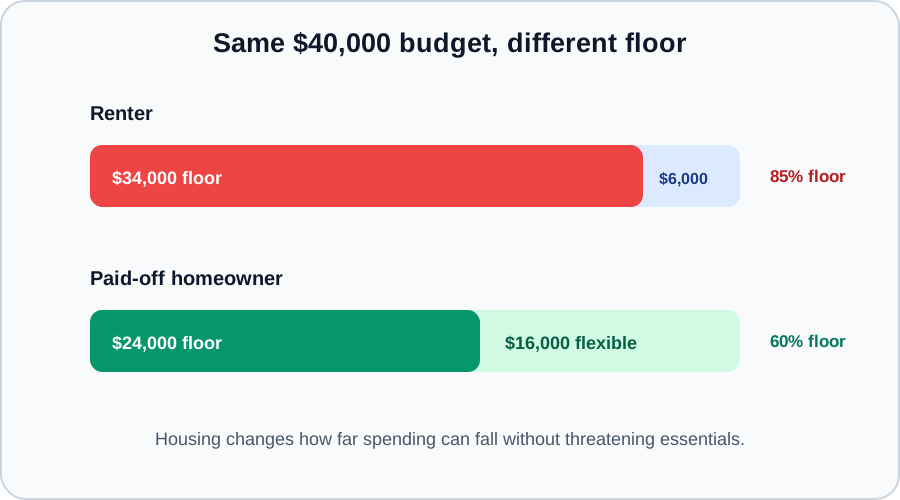
Lean FIRE housing cost often matters more than assuming a slightly higher investment return. On the same $40,000 annual budget, a renter paying $18,000 a year may have a $34,000 essential spending floor. A paid-off homeowner spending $8,000 on property tax, insurance, and maintenance may have a $24,000 floor instead.
Both households spend $40,000 today, but they do not carry the same risk. The renter needs more of the budget every year and remains exposed to future rent increases. The homeowner has repair risk, but more spending can be reduced during bad markets. For Lean FIRE, that difference changes the plan more directly than moving a spreadsheet return assumption from 7% to 8%.
Same $40,000 budget, different housing risk
| Annual category | Renter | Paid-off homeowner |
|---|---|---|
| Housing | $18,000 rent | $8,000 tax, insurance, and maintenance reserve |
| Other essentials | $16,000 | $16,000 |
| Flexible spending | $6,000 | $16,000 |
| Essential spending floor | $34,000 | $24,000 |
| Floor-only portfolio at 4% | $850,000 | $600,000 |
The full $40,000 lifestyle requires $1 million at 4% in either case. But after a market decline, the renter can reduce spending by only $6,000 before touching essentials. The homeowner can reduce it by $16,000. Use the FIRE Number Calculator to compare both the full lifestyle and the protected spending floor.
This does not mean every Lean FIRE household should buy a home. Renting can be safer when it preserves mobility, avoids concentrating wealth in one property, or makes it easier to move to a lower-cost area. The point is to model the housing floor honestly instead of treating renting or ownership as a lifestyle preference only.
Housing risk is the largest Lean FIRE lever
Housing is both large and difficult to change quickly. The Bureau of Labor Statistics reported that housing averaged $26,266, or 33.4% of U.S. household spending, in 2024. The BLS also gave shelter a 35.625% relative importance in the December 2025 CPI market basket.
That size gives housing unusual power over a Lean FIRE plan. Saving $100 a month on subscriptions lowers annual spending by $1,200 and the 4% FIRE number by $30,000. Lowering housing by $800 a month lowers annual spending by $9,600 and the same FIRE number by $240,000.
Our guide to how much Lean FIRE needs explains why low spending alone is not enough. The budget becomes durable when its largest costs are stable and enough spending remains flexible.
A paid-off home changes the risk profile, not just the budget
Paying off a mortgage removes a large required monthly payment. That can reduce the portfolio-funded spending floor and make it easier to cut withdrawals after a market decline. It also reduces the risk that a job loss or weak market arrives at the same time as a required mortgage payment.
A paid-off home is not free housing. Property taxes, insurance, utilities, routine maintenance, and major repairs continue. The honest comparison is not rent versus zero. It is rent versus the full annual cost of owning the home without a mortgage.
The trade-off is liquidity. Money used to pay off a mortgage is no longer sitting in a brokerage account or cash reserve. A paid-off home can lower required withdrawals while leaving the plan short on liquid assets if repairs, healthcare, or relocation costs arrive early.
| Paid-off-home cost | How to model it | Main risk |
|---|---|---|
| Property tax | Current bill plus a higher-cost scenario | Can rise faster than general inflation |
| Homeowners insurance | Current premium plus location-specific stress test | Premium spikes or reduced availability |
| Routine maintenance | Annual sinking fund based on the actual property | Underfunding turns predictable wear into an emergency |
| Major repairs | Separate reserve for roof, HVAC, plumbing, and appliances | Large costs arrive unevenly |
Housing determines the Lean FIRE spending floor
Your spending floor is the amount you cannot reduce without threatening basic needs or breaking commitments. For most households it includes housing, basic food, healthcare, insurance, utilities, essential transportation, taxes, and minimum family obligations.
A low annual budget with a high floor is fragile. A slightly higher budget with a lower floor can be safer because more spending can pause during a downturn. This is why housing deserves its own stress test rather than one line in a retirement budget.
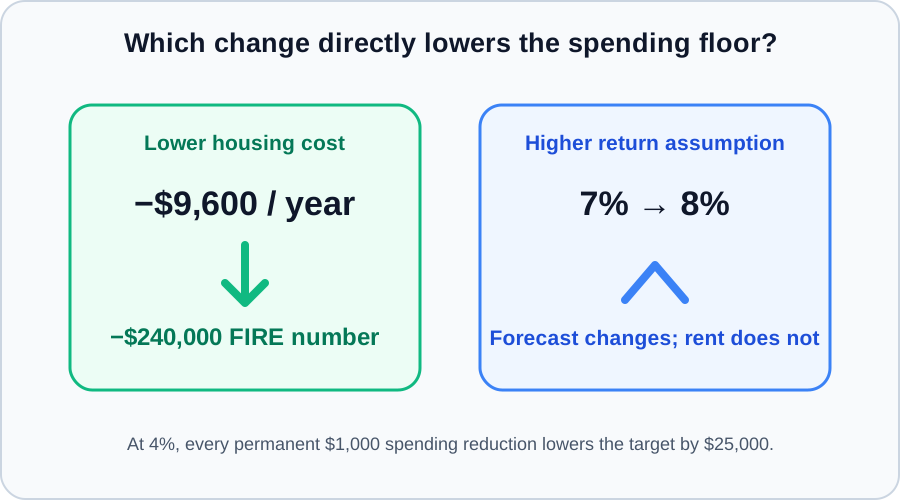
Expected returns affect how quickly you may reach the target, but they do not reduce the rent due next month. A lower housing floor changes both the target and your ability to survive weak returns after retirement. Treat higher expected returns as an uncertain forecast, not a substitute for stable essential costs.
Geographic variation can rewrite the same budget
A $40,000 budget does not buy the same life everywhere. The MIT Living Wage Calculator estimates the basic-needs income required for different household types by state, county, and metro area. Its data was updated on February 15, 2026, and makes the central point clear: location and household structure materially change the cost floor.
Geographic flexibility can therefore act like a financial reserve. A renter may be able to move after a lease ends, while a homeowner may have lower monthly costs but face transaction costs and a less liquid asset. Neither arrangement is universally safer. The safer one is the arrangement whose costs and exit options you have modeled honestly. Relocating to a cheaper area is its own strategy — see geographic arbitrage for FIRE for how far a lower cost base can cut the number, and the taxes and tradeoffs that come with it.
Mortgage vs paid-off home before Lean FIRE
The decision is not only whether the mortgage rate is lower than expected market returns. For Lean FIRE, the practical question is how much required monthly spending remains after work stops. A low-rate mortgage can be mathematically attractive while still keeping the spending floor high during a bad market.
Paying off the mortgage lowers the floor but can reduce liquidity. Keeping the mortgage leaves more money invested but requires reliable withdrawals every month. Compare the interest rate, cash reserves, taxes, job flexibility, and liquid portfolio remaining after either choice. Our full guide to FIRE with a mortgage works through the rate-vs-return math and the sequence risk a fixed payment adds.
Run a housing stress test before Lean FIRE
- Calculate your current all-in annual housing cost, not only rent or mortgage.
- For renters, test 10%, 25%, and 50% higher housing-cost scenarios.
- For owners, model one major repair year instead of smoothing every cost perfectly.
- Calculate the full lifestyle budget and the essential spending floor separately.
- Decide what you would do if housing rises while the portfolio falls.
- Keep relocation, part-time income, or a dedicated reserve as a credible backstop.
Include healthcare in the same stress test because housing and insurance are usually the two hardest pre-65 costs to cut. Read the guide to health insurance before Medicare before treating the remaining budget as flexible.
Common Lean FIRE housing mistakes
Treating a paid-off home as free
Removing the mortgage but omitting tax, insurance, maintenance, and repairs understates the spending floor. Keep those costs visible and fund irregular repairs before retirement.
Assuming rent will track general inflation
Rent is local. A national inflation assumption may not describe your neighborhood or the type of home you need. Test a higher-rent path and preserve a realistic relocation option.
Using optimistic returns to cover a high floor
Higher expected returns do not make essential spending flexible. If the plan requires strong markets to pay rent, it needs lower costs, more portfolio margin, or an income backstop. This is one of the core issues in the biggest FIRE planning mistakes.
Lean FIRE housing cost FAQ
Should you pay off your home before Lean FIRE?
Paying off a home can materially lower the required spending floor, but it is not mandatory. Compare the mortgage rate, lost liquidity, taxes, insurance, maintenance, and your need for flexibility before deciding.
Can you Lean FIRE while renting?
Yes, but the plan should include higher-rent scenarios, moving costs, and a location backstop. Renting can preserve flexibility, while ownership can reduce monthly cost volatility after the mortgage is gone.
How does housing change the FIRE number?
At a 4% withdrawal rate, every permanent $1,000 reduction in annual housing cost lowers the basic FIRE number by $25,000. Reducing housing by $9,600 a year lowers it by $240,000.
Is a paid-off home better than higher investment returns?
For Lean FIRE risk, a stable low housing cost often provides more dependable protection because it lowers required withdrawals every year. Higher returns remain uncertain and can arrive in the wrong sequence.
What to read next
The bottom line
Housing is not just another line in a Lean FIRE budget. It determines how low the portfolio target can go, how much spending can flex, and how the plan responds to a bad market. A paid-off home or stable low rent changes that risk profile directly; a slightly higher expected return remains an uncertain forecast.
This article is educational and does not constitute financial advice. Housing costs, investment returns, taxes, insurance, and withdrawal rates vary and can change.