

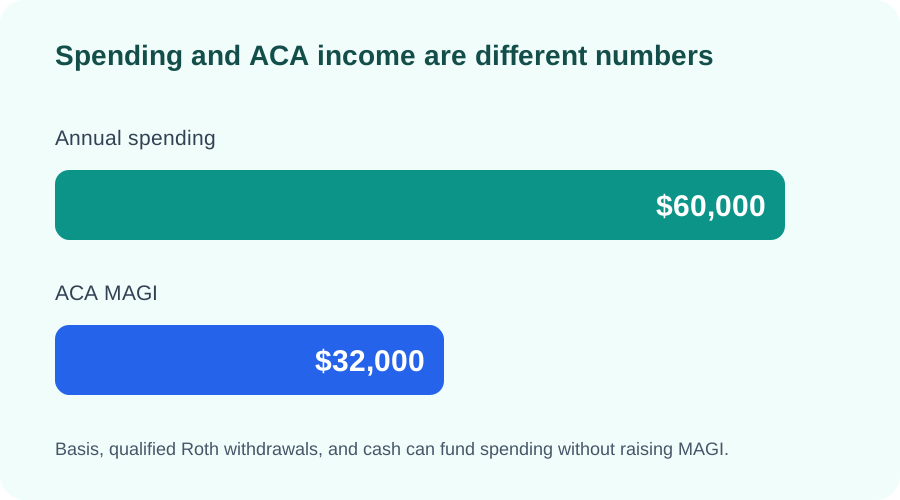
ACA subsidies for FIRE depend on your ACA modified adjusted gross income, not your portfolio size or annual spending. An early-retired couple can spend $60,000 while reporting only $32,000 of Marketplace income if much of their cash comes from savings, taxable-account basis, Roth IRA contribution basis, or qualified HSA reimbursements. That lower income may unlock thousands of dollars in premium tax credits.
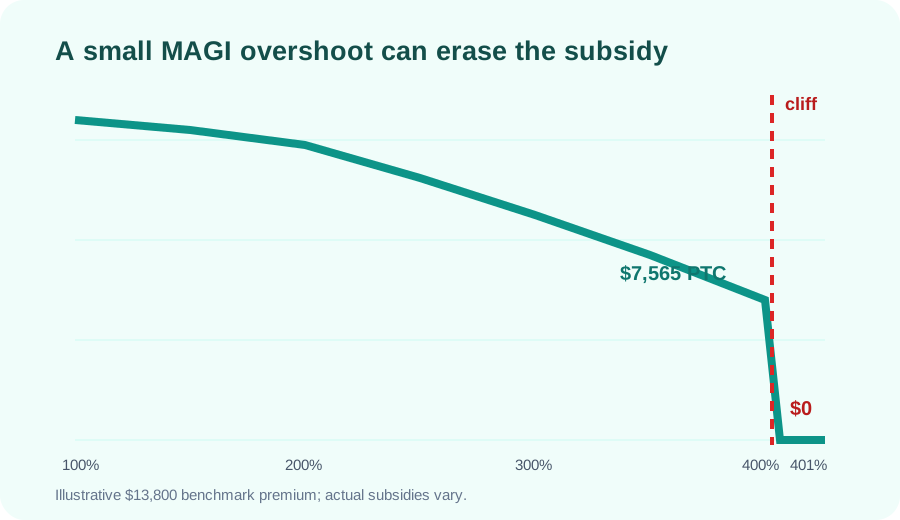
The practical move is to choose a target for your ACA modified adjusted gross income, or MAGI, before deciding which accounts to withdraw from. This matters even more in 2026: enhanced pandemic-era subsidies ended on December 31, 2025, eligibility generally stops above 400% of the federal poverty level, and the IRS removed the excess advance-credit repayment cap for tax years after 2025.
How $60,000 of spending can produce $32,000 of ACA income
Consider a married couple, both age 50, who need $60,000 for the year. They do not need $60,000 of taxable income. Their cash flow could look like this:
| Cash source | Cash available | Amount added to ACA MAGI |
|---|---|---|
| Taxable brokerage sale: cost basis | $20,000 | $0 |
| Taxable brokerage sale: long-term gain | $8,000 | $8,000 |
| Qualified dividends and interest | $4,000 | $4,000 |
| Planned Roth conversion | $20,000 | $20,000 |
| Roth IRA contribution basis | $8,000 | $0 |
| Total | $60,000 | $32,000 |
Their spending is $60,000, but their projected ACA MAGI is about $32,000. Using the 2025 federal poverty guideline that applies to 2026 Marketplace savings, $32,000 is roughly 151% of the poverty level for a two-person household in the contiguous United States. Depending on their location and plan, that may produce a large premium tax credit and valuable cost-sharing reductions on a Silver plan.
This is not a trick or a loophole. The Marketplace measures income under specific tax rules. It does not count every dollar you spend, and it does not deny subsidies simply because you have a large investment portfolio.
How ACA subsidies work for FIRE households
The ACA premium tax credit lowers the cost of a Marketplace plan. Its value is based partly on your household income and the local price of the second-lowest-cost Silver plan. You can use the credit in advance to reduce monthly premiums, then reconcile the amount on your tax return.
For 2026 coverage, a household generally needs income from 100% through 400% of the federal poverty level to qualify for the federal premium tax credit. The 2026 income limits use the 2025 HHS poverty guidelines:
| Household size | 100% FPL | 400% FPL |
|---|---|---|
| 1 person | $15,650 | $62,600 |
| 2 people | $21,150 | $84,600 |
| 3 people | $26,650 | $106,600 |
| 4 people | $32,150 | $128,600 |
Alaska and Hawaii use higher guidelines. Medicaid eligibility, state subsidies, plan prices, ages, and family details also change the result. Treat these numbers as planning boundaries, then price actual plans on your Marketplace.
Premium tax credits and cost-sharing reductions are different
Premium tax credits reduce your monthly premium and can be used with different metal-tier plans. Cost-sharing reductions lower deductibles, copays, coinsurance, and out-of-pocket maximums, but only when an eligible household chooses a Silver plan.
A cheap Bronze plan may look attractive, especially if it is HSA-eligible. But a lower-income FIRE household may get better total value from Silver with cost-sharing reductions. Compare the deductible and maximum out-of-pocket cost, not only the premium.
What counts as ACA MAGI in early retirement?
According to HealthCare.gov's Marketplace income guidance, MAGI starts with adjusted gross income and adds back tax-exempt interest, non-taxable Social Security, and excluded foreign income. For a full breakdown of the formula and what each piece means, see ACA MAGI for FIRE. For most households, the easiest approach is to separate cash sources into two buckets: dollars that raise MAGI and dollars that usually do not.
| Usually raises ACA MAGI | Usually does not raise ACA MAGI |
|---|---|
| Traditional 401(k) and IRA withdrawals | Cash savings |
| Taxable Roth conversions | Cost basis returned from taxable investments |
| Capital gains and dividends | Roth IRA contribution basis and other tax-free Roth distributions |
| Pension income | Qualified HSA reimbursements |
| Social Security, including its non-taxable portion | Direct rollovers between pre-tax retirement accounts |
The details matter. Selling $30,000 of stock does not necessarily create $30,000 of income. If the shares cost you $22,000, only the $8,000 gain generally enters MAGI. Likewise, a qualified dividend can have a 0% federal tax rate and still count as ACA income.
A Roth conversion is also a healthcare pricing decision
Roth conversions are popular in FIRE because they can move money from a traditional account into a Roth during lower-income years. That may reduce future required distributions and create tax-free flexibility later. But the taxable conversion raises this year's MAGI. Our Roth conversion ladder guide walks through a full conversion schedule.
Suppose a single 63-year-old projects $60,000 of MAGI for 2026. They have only $2,600 of room before reaching 400% FPL at $62,600. A $5,000 year-end conversion would push income over the limit and could eliminate the entire premium tax credit. The conversion's real cost is not just income tax; it includes lost healthcare subsidies.
Four research-backed lessons that change FIRE decisions
1. Spending and income are separate levers
Retirement research often focuses on how much you can safely spend. ACA planning asks a second question: how much of that spending appears as income? A household may follow a cautious withdrawal rate and still pay unnecessarily high premiums if every withdrawal comes from a traditional IRA.
Account diversity creates options. Taxable basis, Roth money, pre-tax accounts, cash, and an HSA each behave differently. That flexibility can be valuable before Medicare, even when two portfolios have the same total balance.
2. The 2026 subsidy cliff is real
Enhanced Marketplace subsidies expired on December 31, 2025. In 2026, going just above 400% FPL can mean losing the full federal premium tax credit. For a single person, the line is $62,600; for a couple, it is $84,600 in the contiguous states and D.C.
Leave a buffer below the cliff. Unexpected mutual-fund distributions, dividends, freelance income, or capital gains can arrive late in the year. A target that uses every last dollar of room is fragile. For the full 2026 picture and the legislative status, see the 2026 ACA subsidy cliff.
3. Social Security reduces your MAGI flexibility
The Marketplace generally counts Social Security benefits in full because non-taxable Social Security is added back when calculating ACA MAGI. Once benefits begin, you may have less room for Roth conversions or capital gains before reaching your target.
That is one reason to coordinate ACA planning with a Social Security bridge strategy. Delaying benefits is not automatically best, but the ACA impact belongs in the decision.
4. Withdrawal order should follow a MAGI target
“Taxable accounts first” is too simple. A better yearly process is to estimate unavoidable income, choose an ACA MAGI target, add only the traditional withdrawals or Roth conversions that fit, and fund the remaining spending with lower-MAGI sources.
- Estimate dividends, interest, capital-gain distributions, wages, and pensions.
- Choose a target MAGI range based on ACA and tax goals.
- Add a deliberately sized Roth conversion or traditional withdrawal.
- Use cash, taxable-account basis, Roth IRA contribution basis, or qualified HSA reimbursements for the remaining need.
- Check the projection again before making large year-end moves.
Common ACA mistakes FIRE households make
Confusing low tax with low MAGI. Long-term capital gains and qualified dividends may be taxed at 0%, but they still count as income for Marketplace purposes.
Converting too much to Roth. Filling a low federal tax bracket may look smart until the conversion reduces or eliminates a valuable ACA subsidy.
Taking the full advance credit without a cushion. Beginning with the 2026 tax year, there is no repayment cap for excess advance premium tax credits. If final income is higher than projected, you may need to repay the entire excess.
Letting MAGI fall too low. Income below 100% FPL can create eligibility problems, especially in states that have not expanded Medicaid. Very low-income households should check their state rules before relying on Marketplace credits.
Choosing Bronze without comparing Silver. An HSA-eligible Bronze plan can be useful, but eligible households lose cost-sharing reductions when they do not select Silver.
Forgetting to update the Marketplace. A large stock sale, new part-time job, pension, or Social Security start date can materially change your credit. Update your estimate when the facts change.
Build ACA costs into your FIRE plan
ACA optimization can lower healthcare costs, but your FIRE plan should still work if premiums rise or your income misses the target. Start with your annual spending and model healthcare through age 65. Then test a lower subsidy, a bad market year, and a smaller Roth conversion.
Your next calculator depends on the path you are considering. Use the Coast FIRE Calculator if you plan to keep working while investments grow. Use the Barista FIRE Calculator if part-time income or employer benefits may cover part of the gap. For a fuller cost estimate, read our healthcare before Medicare guide.
ACA subsidies for FIRE FAQ
Can a millionaire qualify for an ACA subsidy?
Yes. The federal Marketplace premium tax credit generally uses household income, not net worth. A household with a large portfolio may qualify if its ACA MAGI and other eligibility details fit the rules.
Do Roth IRA withdrawals count as income for ACA subsidies?
Tax-free Roth IRA distributions, including withdrawals of regular contribution basis, generally do not count as Marketplace income. Taxable Roth earnings and taxable conversion amounts are different: they generally raise AGI and ACA MAGI.
Do capital gains count toward ACA income?
Yes. Realized capital gains generally count, even when the federal capital-gains tax rate is 0%. When selling an investment, the returned cost basis is generally not income.
What happens if my 2026 income goes above 400% FPL?
You generally lose eligibility for the federal premium tax credit. If you received too much advance credit, there is no repayment cap after 2025, so you may owe the full excess at tax time.
Should I avoid Roth conversions before Medicare?
Not necessarily. A conversion may still improve your long-term tax plan. Compare its lifetime benefit with current income tax, lost ACA credits, and lost cost-sharing reductions. Often the best answer is a smaller conversion sized to a chosen MAGI target.
How often should I check my ACA MAGI estimate?
Review it at enrollment, after major income changes, and again before year-end stock sales or Roth conversions. Tracking it monthly is sensible when you are close to the 400% FPL cliff.
The bottom line
ACA subsidies can make early retirement much more affordable, but only when withdrawals and income are planned together. Start with a target MAGI range, recognize which cash sources raise it, leave room for surprises, and treat every Roth conversion as both a tax decision and a healthcare decision.
The goal is not to report the lowest income possible. It is to create a durable plan that balances current subsidies, lifetime taxes, healthcare protection, and enough flexibility to keep living your version of FIRE.
What to read next
This article uses federal rules and poverty guidelines for 2026 Marketplace coverage. Actual eligibility and plan costs vary by household, state, county, and future policy changes. This content is educational and is not tax, legal, medical, or financial advice.