

The tax-efficient withdrawal order for early retirement is not the textbook rule of “spend taxable first, then traditional, then Roth.” That order was written for someone who retires at 65 and starts Medicare and Social Security almost immediately. A FIRE retiree has 10, 20, or even 30 extra years where four different income rules decide the right move: ACA health-insurance subsidies before 65, the 0% long-term capital-gains band, the Roth-conversion window, and later Medicare IRMAA, Social Security taxation, and required minimum distributions.
Here is the better way to think about it. In any given year you are not really choosing which account to drain — you are choosing a target income number, then blending withdrawals across your buckets to hit it. One of the highest-value moves in many FIRE plans is using the low-income “gap years” between your last paycheck and age 73 or 75 to convert pre-tax money to Roth and to harvest gains at 0% — without accidentally wrecking a health-insurance subsidy along the way.
The four rules that replace the textbook order
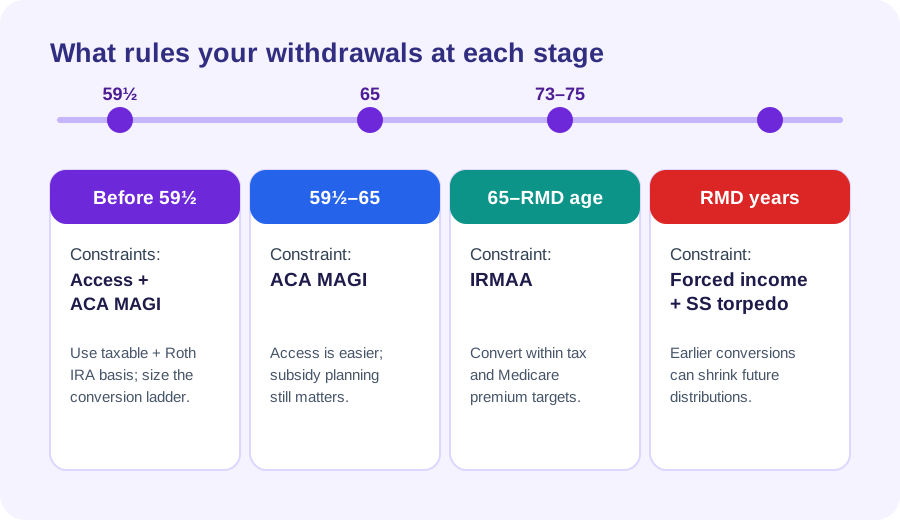
Your binding constraint — the rule that should actually drive your withdrawals — changes as you age. This table is the whole article in miniature:
| Life stage | What rules your withdrawals | The smart move |
|---|---|---|
| Before 59½ | Penalty-free access + ACA MAGI | Live on taxable + Roth IRA basis; build a subsidy-aware conversion ladder |
| 59½ to 65 | ACA MAGI (health-insurance subsidy) | Keep income low for premium tax credits; convert cautiously |
| 65 to RMD age | Medicare IRMAA + the conversion sweet spot | Convert aggressively to fill low brackets, but stop below your IRMAA tier |
| RMD years (73 or 75+) | Forced income + Social Security tax torpedo | Earlier conversions shrink the forced distributions |
Your five money buckets and how each is taxed
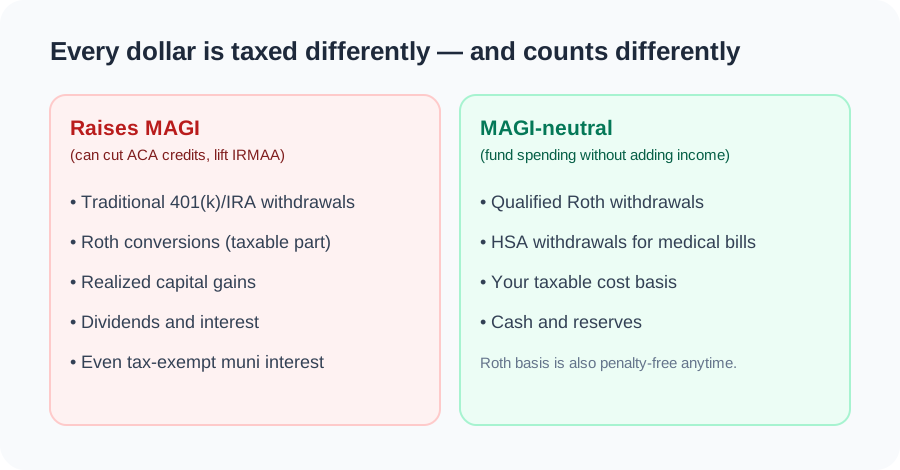
Before you can sequence anything, you need to know how each dollar is treated — not just for income tax, but for MAGI, the income figure that drives ACA subsidies and Medicare premiums. Two retirees who spend the exact same $60,000 can report wildly different MAGI depending on which buckets they tap.
| Bucket | Tax on withdrawal | Counts toward MAGI? |
|---|---|---|
| Taxable brokerage | Tax on realized gains only; long-term gains at 0/15/20% | Gains and dividends do; your original cost basis does not |
| Traditional 401(k)/IRA | Ordinary income on every dollar | Yes — fully |
| Roth IRA / designated Roth account | Tax-free when qualified | No — qualified withdrawals are MAGI-free |
| HSA | Tax-free for qualified medical at any age | No — medical withdrawals do not raise MAGI |
| Cash / reserves | None | No — the cleanest lever for hitting an income target |
This is why the order of operations matters so much. If you are still deciding how to fund each bucket while you accumulate, start with our 401(k) vs Roth IRA for FIRE guide, and for the bigger picture of why you want all four account types, read tax diversification for FIRE.
Stage 1 — before 59½: solve access without losing ACA help
A 10% early-withdrawal penalty normally applies to traditional 401(k)/IRA money and to Roth earnings before 59½. FIRE retirees get around it with a handful of legal tools:
- Taxable brokerage. No age restriction, ever. You owe tax only on the gain portion, not your basis — the most flexible bridge fund.
- Roth contribution basis. Direct Roth IRA contributions (not earnings, not conversions) come out tax- and penalty-free at any age.
- Roth conversion ladder. Convert pre-tax to Roth, pay tax in the conversion year, then withdraw the converted principal penalty-free after a five-tax-year wait. It needs roughly five years of other funds to bridge the gap. See our Roth conversion ladder deep-dive.
- Rule of 55 and 72(t). The Rule of 55 lets you tap a former employer's 401(k) if you separate in or after the year you turn 55. A 72(t)/SEPP schedule allows penalty-free IRA withdrawals at any age but is rigid once started.
The play in this stage: live on taxable basis, cash, and direct Roth IRA contribution basis while running a Roth conversion ladder each year sized to your tax and subsidy targets. Those converted dollars become your bridge five years later.
Stage 2 — 59½ to 65: ACA MAGI becomes the main constraint
At 59½ the additional tax on most retirement-account withdrawals disappears, so access gets easier. But you are still years away from Medicare, buying coverage on the ACA Marketplace, and MAGI remains a central input in your premium subsidy. Age, location, household size, and the local benchmark plan also affect the credit. Every traditional withdrawal, every Roth conversion, and every realized gain adds to MAGI; qualified Roth and HSA-medical withdrawals do not.
This matters far more in 2026 than it did from 2021 to 2025. Under current law as of June 14, 2026, the temporarily enhanced premium tax credits (in place from 2021 through 2025) have expired, and the old 400% federal-poverty-level “subsidy cliff” has returned — a household one dollar over the limit can lose its entire subsidy. This is an area of active legislative debate, so re-check the rule for your coverage year; the IRS premium-tax-credit guidance and HealthCare.gov explain how the credit scales with income and the federal poverty level. For the full playbook on managing income to the cliff, read our ACA subsidies for FIRE guide. The practical result: before 65, many FIRE households keep conversions small and lean on taxable basis, Roth basis, and cash to protect a subsidy that can be worth thousands of dollars a year.
Stage 3 — 65 to RMD age: the Roth conversion sweet spot
At 65 Medicare begins and the ACA subsidy constraint vanishes — but IRMAA, the income-related Medicare premium surcharge, takes its place. IRMAA uses your MAGI from two years prior, so income at 63 sets your premiums at 65. It is a cliff: one dollar over a threshold triggers the full surcharge, per person.
| 2026 IRMAA tier (based on 2024 MAGI) | Single MAGI | Married filing jointly | Total Part B / month | Part D surcharge / month |
|---|---|---|---|---|
| Base (no surcharge) | ≤ $109,000 | ≤ $218,000 | $202.90 | $0 |
| Tier 1 | $109,001–$137,000 | $218,001–$274,000 | $284.10 | $14.50 |
| Tier 2 | $137,001–$171,000 | $274,001–$342,000 | $405.80 | $37.50 |
| Tier 3 | $171,001–$205,000 | $342,001–$410,000 | $527.50 | $60.40 |
| Tier 4 | $205,001–<$500,000 | $410,001–<$750,000 | $649.20 | $83.30 |
| Tier 5 | ≥ $500,000 | ≥ $750,000 | $689.90 | $91.00 |
These are the full 2026 Part B and Part D surcharge tiers from the CMS 2026 Medicare Parts A & B premiums fact sheet; the first four tiers are inflation-indexed annually. This Roth conversion window — after ACA coverage ends and before RMDs and Social Security ramp up — is the classic time to convert aggressively and fill the 10%, 12%, and 22% brackets, because your income is otherwise low. The goal is to shrink the pre-tax balance before RMDs force it out at higher rates. Just stop each year's conversion below the IRMAA tier you want to stay under.
Stage 4 — RMD years: the tax torpedo
Required minimum distributions now begin at 73 for those born 1951–1959 and 75 for those born in 1960 or later, per the IRS RMD rules. Once they start, you lose control of the top of your income stack. Combined with Social Security, RMDs can push you into higher brackets, into IRMAA tiers, and into the zone where up to 85% of your Social Security becomes taxable — the reason RMD planning starts decades early.
That last effect is the “tax torpedo.” Because each extra dollar of income can make $0.50 to $0.85 of Social Security newly taxable, a couple nominally in the 12% bracket can face an effective marginal rate above 22%. The SSA guidance on benefit taxation explains the provisional-income thresholds, which have never been inflation-indexed. Roth conversions done in Stage 3 directly reduce future RMDs — Roth IRAs (and, since 2024, Roth 401(k)s) have no lifetime required distributions — which is exactly why the gap-year conversions are so valuable. Delaying Social Security toward 70, covered in our Social Security bridge guide, also keeps those gap years clear for conversions.
Three worked examples (2026 figures)
These use rounded 2026 reference numbers: the standard deduction is $16,100 single / $32,200 married filing jointly; the 12% bracket tops near $100,800 for married couples (roughly half that for single filers); and the 0% long-term-gains band runs up to $49,450 single / $98,900 joint of taxable income, per IRS Revenue Procedure 2025-32 and IRS Topic No. 409 on capital gains. They are illustrative and federal-only.
Lean FIRE couple — $40,000 spend, both 45
They fund spending with about $25,000 of taxable sales (roughly $12,000 of it gain) plus $15,000 of Roth basis and cash, and convert a small $10,000 to start the ladder. MAGI lands near $25,000–$30,000 — low enough to capture the richest ACA subsidies and cost-sharing reductions. After the $32,200 standard deduction, taxable income is near zero, so the gains sit in the 0% band and the small conversion is barely taxed. Federal tax: roughly $0. The trade-off: they keep conversions small to protect the subsidy and accept larger RMDs later.
Regular FIRE single — $55,000 spend, age 50
This person has room to run MAGI into the $40,000s and still get a partial subsidy below the ~$62,600 single cliff. They spend $55,000 from taxable and Roth basis and convert about $20,000 — filling the bottom of the bracket structure. Most of their gains stay in the 0% band, and the conversion is taxed in the low single digits. They deliberately give up themaximum subsidy to drain pre-tax money at 10–12% now instead of 22%+ on future RMDs.
Fat FIRE couple — $125,000 spend, age 52
ACA subsidies are effectively out of reach once gains and conversions stack onto six-figure spending, so the game becomes bracket management and RMD defusing. They convert $60,000– $90,000 a year to push joint taxable income toward the top of the 12% bracket ($100,800), watching two limits: the 0% capital-gains ceiling ($98,900 taxable), since conversions push gains into the 15% rate, and the future IRMAA tiers once the two-year lookback starts mattering at 63. They convert hard from 52 to 63, then taper to stay under IRMAA. Read our Fat FIRE tax planning guide for the full version of this strategy.
Common mistakes that cost FIRE retirees thousands
- Ignoring the ACA cliff. One extra dollar of gain or conversion income above 400% FPL can vaporize thousands in subsidy. Model MAGI before December.
- Wasting the gap years. Doing zero Roth conversions between retirement and RMD age leaves the 10–12% brackets unused and can create a bigger RMD tax bill later.
- Over-converting into IRMAA. A big conversion at 63–64 inflates Medicare premiums two years later. Size conversions to land just under the relevant tier.
- Draining one bucket blindly. Emptying all taxable first leaves you 100% pre-tax and exposed to a future income spike; spending Roth first wastes your most valuable tax-free, MAGI-free dollars. Blend to hit income targets.
- Forgetting that muni interest counts. “Tax-free” municipal interest still feeds ACA MAGI, IRMAA, and the Social Security torpedo.
- Paying conversion tax from the IRA before 59½. The withheld amount is itself a penalized early distribution. Pay it from cash or taxable instead.
For the broader list of plan-breaking errors, see the biggest FIRE planning mistakes.
Build the order into your FIRE number
Your FIRE target has to cover more than annual spending. It needs an accessible five-year bridge for the ladder, the conversion taxes themselves, healthcare before Medicare, and a buffer for bad early returns. Start with your spending and withdrawal rate, then stress-test the income you would actually report each year.
Tax-efficient withdrawal order FAQ
Is the standard “taxable, then traditional, then Roth” order wrong?
It is a reasonable default for a traditional retiree at 65, but it ignores the constraints that dominate early retirement: ACA subsidies, the 0% capital-gains band, and the conversion window. Most FIRE retirees do better by blending buckets to hit a yearly income target.
How much should I convert each year?
Convert up to the income target set by your binding constraint that year — the ACA cliff before 65, your IRMAA tier at 63 and beyond, or the top of a tax bracket. Re-check it every December, because the right number changes as your life stage changes.
What raises my ACA MAGI?
Traditional withdrawals, the taxable part of Roth conversions, realized capital gains, dividends, interest, and even tax-exempt muni interest. Roth IRA contribution basis, non-taxable Roth distributions, qualified HSA withdrawals, taxable-account basis, and cash do not.
When should I use my HSA?
Often late in the sequence, and for medical bills and eligible Medicare premiums. HSA medical withdrawals do not touch MAGI, IRMAA, or Social Security provisional income, which makes them unusually tax-efficient after 65. See HSA for FIRE for how to build and invest it.
What to read next
The bottom line
There is no universal withdrawal order for FIRE. The right move depends on which rule binds you this year — penalty-free access, ACA MAGI, IRMAA, or forced income. Map your buckets, project your MAGI every year before December, and use the low-income gap years to convert and harvest gains while the cost is near zero.
This article is educational and does not constitute tax, legal, or financial advice. The 2026 figures are inflation-adjusted annually and vary by filing status, birth year, household size, and state; verify current-year numbers and consider a fee-only advisor or CPA before acting.