

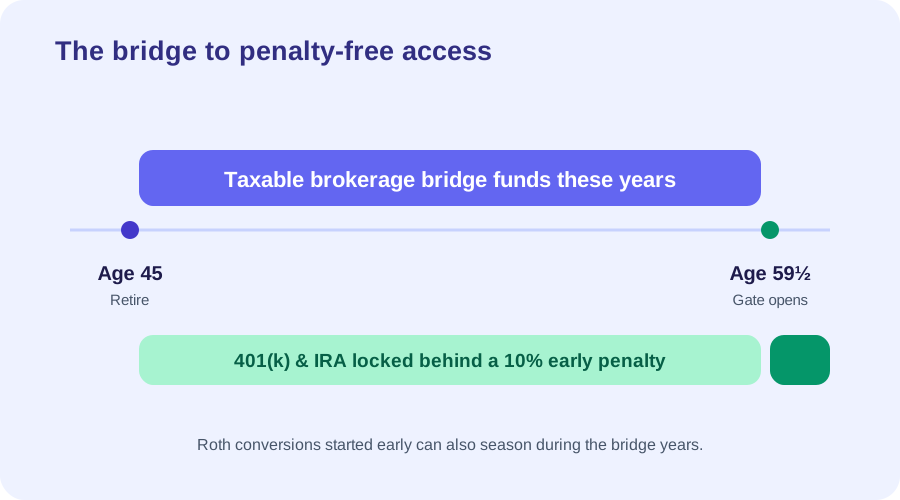
A taxable brokerage bridge is the pool of regular, non-retirement investments that funds your spending in the gap years between early retirement and age 59½. Most of your tax-advantaged money — traditional 401(k), traditional IRA, and Roth IRA earnings — is locked behind a 10% early-withdrawal penalty until then. If you retire at 45, you need roughly 15 years of cash from somewhere else first. For most FIRE plans, that somewhere else is a taxable brokerage account.
It is easy to dismiss a taxable account as the “leftover” or tax-inefficient bucket. For an early retiree it is closer to the opposite. The taxable account is the most flexible money you own: you can withdraw it at any age with no penalty, only the gain portion is taxed, and you control exactly how much income you show in any given year. That last point is what makes a Roth conversion ladder, the 0% capital gains bracket, and ACA health subsidies actually work.
Why early retirees need a bridge at all
The core problem is the age-59½ gate. The IRS generally adds a 10% additional tax on early distributions from a 401(k) or IRA taken before age 59½. Retire at 45 and you face about 15 years before that penalty disappears. There are only a few clean ways across that gap:
| Access route | How it works | The catch |
|---|---|---|
| Taxable brokerage account | Sell shares at any age, any time, no penalty | Only gains are taxed, but you must have funded it |
| Roth conversion ladder | Convert pre-tax money to Roth, withdraw after a 5-year season | Needs ~5 years of other money to bridge the seasoning window |
| 72(t) SEPP | Fixed equal IRA withdrawals before 59½ | Locked schedule; breaking it triggers retroactive penalties |
| Rule of 55 | Access one employer's 401(k) if you leave at 55+ | Too late for most FIRE retirees, and employer-specific |
Notice how the taxable account is the one that makes the others usable. The Roth conversion ladder is the most flexible penalty-free strategy, but each conversion must season for five years before you can touch the principal. During those first five years, something has to pay the bills and the conversion taxes. That something is almost always the taxable bridge. Without it, you are forced into a rigid 72(t) schedule and lose the flexibility that makes early retirement durable.
What makes the taxable account so flexible
Every other account taxes withdrawals as ordinary income or restricts them by age. A taxable brokerage account does neither. Its advantages stack up:
- Penalty-free at any age. No 59½ gate, no early-withdrawal penalty.
- Only the gain is taxed. When you sell, the cost basis — what you originally paid — comes back tax-free. A traditional IRA taxes every dollar withdrawn.
- You control the timing and size of income. You decide which lots to sell and how much gain to realize, which means you decide how much income shows up on your return.
- It feeds the 0% bracket and ACA planning. A high-basis taxable account lets you fund a large lifestyle while reporting very little income.
That control is the whole game. With a traditional 401(k), a $40,000 withdrawal is $40,000 of ordinary income, full stop. With a taxable account, a $40,000 sale might show only $2,860 of income — because most of what you sold was return of your own basis.
Basis versus gain: why a $40,000 sale is not $40,000 of income
Your basis is generally what you paid for shares, including reinvested dividends. When you sell, only proceeds minus basis is a taxable gain. Each purchase — every monthly buy, every reinvested dividend — creates a separate tax lot with its own date and price. After years of investing, one fund position can hold dozens of lots with very different basis.
This is where lot selection earns real money. Take Maria, single, retired at 42, who needs $40,000 to spend. She holds a recently bought lot of 200 VTI shares purchased at $260 each ($52,000 basis), now worth $280. If she uses specific identification to sell about 143 of those high-basis shares for roughly $40,040:
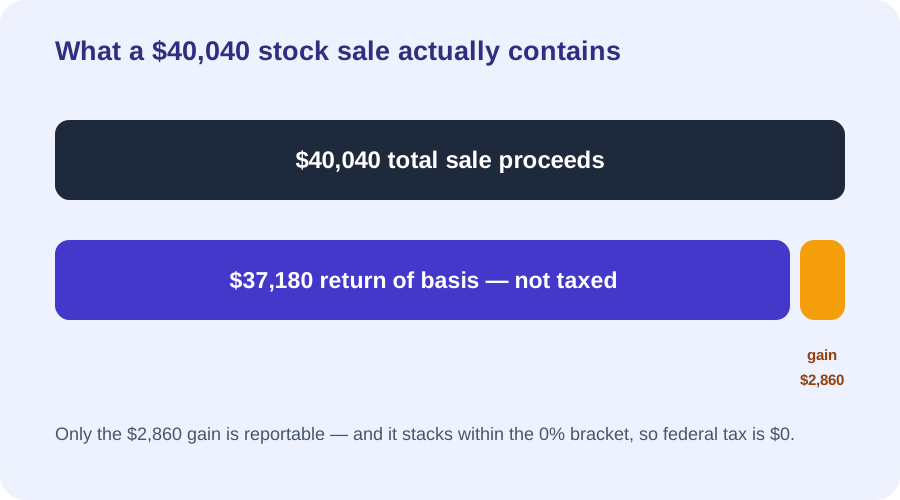
Her gain is only about $2,860 (143 shares × $20 of appreciation). The other $37,180 is tax-free return of basis. That tiny gain stacks well within her 2026 0% long-term capital gains bracket, so her federal tax on the sale can be $0. Had she instead let the broker default to FIFO and sell her oldest, lowest-basis lot bought years ago at $80, the same $40,040 sale would have produced roughly $28,600 of gain — still possibly 0% tax, but a far larger footprint on her income and her ACA subsidy.
Two practical takeaways: set your account's cost-basis method to specific identification instead of the default first-in-first-out, and prefer broad-market ETFs in taxable accounts. According to the SEC's Investor.gov glossary, cost basis is set at purchase and adjusted over time, so picking which lot you sell directly controls the gain you report.
How much should the bridge hold?
There is no single number, but a useful framing is years of spending, not a percentage of net worth. The bridge has to cover the years from your retirement date until penalty-free access opens, including the five-year seasoning window if you run a Roth conversion ladder.
| Retirement age | Years to 59½ | Bridge at $50,000/year spending |
|---|---|---|
| 40 | ~19.5 | Largest bridge; lean hard on taxable + Roth basis |
| 45 | ~14.5 | Roughly 5–10 years of taxable to start the ladder safely |
| 50 | ~9.5 | Smaller gap; a few years of taxable plus the ladder |
| 55 | ~4.5 | Rule of 55 may cover part of it from a 401(k) |
A common guideline is to keep a taxable (or Roth-contribution) balance covering at least the first five-plus years of expenses, so the early rungs of a conversion ladder have time to season. The earlier you retire, the more of your total FIRE number should sit in accounts you can actually reach. A plan that is “optimal on paper” for taxes but has no bridge money is one of the biggest FIRE planning mistakes — it looks complete until you realize you cannot touch most of it for a decade.
Building the bridge while you are still working
The funding order most FIRE savers use balances tax-advantaged growth against bridge liquidity. Our full breakdown lives in the 401(k) vs Roth IRA for FIRE guide, but the short version:
- Capture the full 401(k) employer match first — it is an immediate return no taxable account beats.
- Max tax-advantaged space that fits your plan (401(k) at $24,500 and IRA at $7,500 for 2026, plus an HSA if eligible).
- Then route remaining savings into a taxable brokerage account holding broad-market stock index ETFs — the bridge.
Holding total-market equity ETFs in taxable is close to ideal on two fronts at once. They are tax-efficient where they sit (low turnover, mostly qualified dividends, you control gain timing), and they give you the large, liquid balance the bridge needs. The old “taxable accounts are inefficient” critique mostly applies to holding bonds and REITs there, not broad equity index funds.
The bridge is also your MAGI control lever
Here is the part most people miss until they retire. Because you control how much gain you realize, the taxable account controls your ACA modified adjusted gross income. Spending from returned basis does not count as income. Spending from Roth contribution basis does not count. That means you can fund a $60,000 lifestyle while reporting far less income — which is how early retirees stay eligible for premium tax credits in 2026, when the hard 400% federal-poverty-level subsidy cliff is back under current law.
The tension to plan around: realized gains count toward ACA MAGI even when taxed at 0% federally. So in a year you need a large healthcare subsidy, you might harvest fewer gains and spend more from basis or cash. In a low-income, low-subsidy year, you might use that space for Roth conversions or tax-gain harvesting instead. The bridge gives you the dials; the rest is choosing what to do with them each year.
Common bridge mistakes
Starving the taxable account. Maxing every tax-advantaged account but building no bridge leaves you with a paper-perfect plan and no money you can spend before 59½ without penalties or a rigid 72(t).
Leaving the broker on FIFO. The default first-in-first-out method sells your lowest-basis shares first, maximizing both your gain and your MAGI. Switch to specific identification and pick lots on purpose.
Holding the wrong assets in taxable. Bonds and REITs throw off ordinary-income distributions you cannot control. Shelter those in a 401(k) or IRA and keep broad stock index funds in the bridge.
Ignoring ACA MAGI when selling. A “free” 0% gain can still push you over the subsidy cliff and cost thousands in lost premium tax credits. Model your income before large year-end sales.
Size your bridge against your FIRE number
Start with your annual spending and a withdrawal rate to find your total FIRE number, then ask a second question: how much of that needs to live in accounts you can reach before 59½? The calculator below estimates the total; the bridge is the slice that keeps the plan executable in the gap years.
If you plan to keep working part-time while investments grow, the Coast FIRE Calculator and Barista FIRE Calculator show how outside income shrinks the bridge you need.
Taxable brokerage bridge FAQ
How many years of expenses should the bridge cover?
At minimum, enough to reach penalty-free access. If you run a Roth conversion ladder, that means at least the first five-plus years of spending in taxable or Roth-contribution money so the early conversions can season. The earlier you retire, the larger the bridge.
Do I pay tax when I sell from my taxable account?
Only on the gain. Proceeds minus your cost basis is the taxable amount, and long-term gains on assets held more than a year get preferential 0%, 15%, or 20% rates. The returned basis itself is not taxed.
Is a taxable account really tax-inefficient for FIRE?
Not when it holds broad-market stock index ETFs. Those are tax-efficient where they sit and also serve the bridge function. The inefficiency critique mainly applies to holding bonds and REITs in taxable, which are better sheltered in a 401(k) or IRA.
Can I use Roth IRA contributions as bridge money?
Yes. You can generally withdraw your Roth IRA contribution basis at any age, tax- and penalty-free, and it does not count toward ACA MAGI. Roth contribution basis is a useful supplement to a taxable account, though most plans still need a larger taxable balance to cover the full gap.
What to read next
This article uses federal rules and 2026 figures for illustration. Account access rules, tax brackets, and ACA eligibility vary by household, state, and future policy changes, and many states tax investment income differently from the federal government. This content is educational and is not tax, legal, or financial advice.