

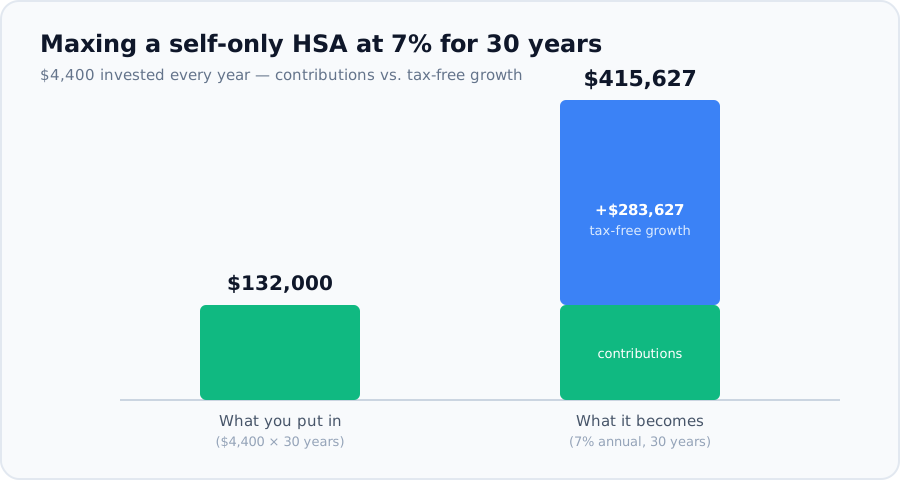
A health savings account (HSA) is the only US account with a triple federal tax advantage — you deduct the money going in, it grows tax-free, and it comes out tax-free for medical costs — which makes it one of the most tax-efficient federal accounts available to an eligible FIRE saver. Maxing the 2026 self-only limit of $4,400 a year and investing it at 7% would grow to about $415,000 in 30 years, of which only $132,000 is money you contributed. The rest is tax-free growth you never report on a return.
The catch is that an HSA is only available if you are enrolled in qualifying coverage that genuinely fits your health and cash situation. The tax advantage becomes much more useful for long-term planning when your provider offers a reasonable investment menu and you can afford to invest part of the balance instead of spending every contribution immediately.
The 2026 HSA numbers at a glance
Every HSA rule below uses the official 2026 figures from IRS Revenue Procedure 2025-19 and IRS Publication 969. These adjust most years, so confirm the current numbers before you act.
| 2026 figure | Self-only | Family |
|---|---|---|
| HSA contribution limit | $4,400 | $8,750 |
| Catch-up (age 55+) | +$1,000 | +$1,000 per spouse |
| HDHP minimum deductible | $1,700 | $3,400 |
| HDHP out-of-pocket maximum | $8,500 | $17,000 |
Two details trip people up. The $1,000 catch-up is set by statute and does not index for inflation, and each spouse's catch-up must go into that spouse's own HSA. The deductible and out-of-pocket limits above describe a traditional HSA-qualified HDHP. Starting in 2026, IRS guidance also treats Bronze and catastrophic individual-market plans as HSA-compatible even when they do not satisfy every traditional HDHP limit. Confirm the specific plan is labeled HSA-compatible rather than relying on its deductible alone.
The triple tax advantage, in plain English
Most retirement accounts give you a tax break on one end — a deduction now (traditional 401(k)) or tax-free withdrawals later (Roth). The HSA is the only account that gives you both ends plus tax-free growth in the middle.
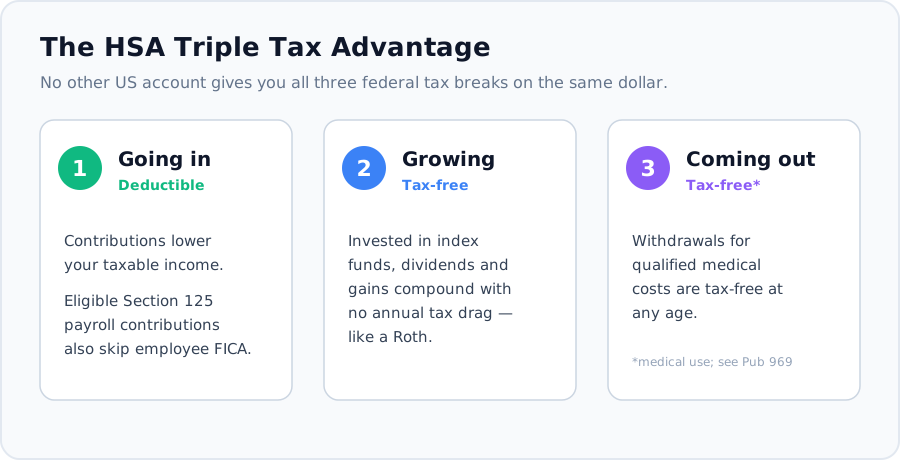
- Going in: contributions are deductible above the line on Form 8889. If you contribute through an employer's Section 125 cafeteria plan, they also skip the 7.65% employee FICA tax — about $337 a year on a $4,400 self-only contribution — which 401(k) contributions do not avoid. That makes an eligible payroll HSA dollar more tax-efficient than a 401(k) dollar.
- Growing: once invested in index funds, dividends and capital gains compound with no annual tax drag, exactly like a Roth.
- Coming out: withdrawals for qualified medical expenses — defined in IRS Publication 502 — are tax-free at any age.
One important state caveat: California and New Jersey do not conform to the federal HSA rules and may tax contributions or earnings at the state level. Residents still get the federal tax benefits, but should verify their own state's current treatment.
Why the HSA is a stealth retirement account
The HSA only becomes a wealth machine if you invest it and let it compound instead of spending it on every prescription. Here is what maxing the self-only limit and investing using a simplified 7% annual return assumption does over a FIRE-length horizon:
| Years invested | Total contributed | Balance at 7% |
|---|---|---|
| 20 years | $88,000 | $180,380 |
| 30 years | $132,000 | $415,627 |
| 40 years | $176,000 | $878,394 |
These figures assume a steady 7% annual return and a constant $4,400 contribution; real markets are lumpy, limits rise over time, and returns are never guaranteed. The point is not the exact dollar — it is that the growth can be entirely federal-tax-free when withdrawn for qualified medical expenses, which no taxable account and no traditional 401(k) can match. For a FIRE saver, that growth is earmarked against medical and Medicare costs that can otherwise put pressure on an early-retirement budget.
This is also why the HSA is the fourth pillar of tax diversification for FIRE: because qualified medical withdrawals never touch your modified adjusted gross income (MAGI), it is one of the cleanest buckets for an income-managed early-retirement plan.
The after-65 pivot that adds flexibility
The fear with any health account is over-saving: what if you stay healthy and never spend it? The HSA solves that with a built-in pivot at age 65.
- Non-medical withdrawals after 65: the 20% penalty disappears. They are simply taxed as ordinary income — exactly like a traditional IRA distribution. So the worst case is that your HSA behaves like a regular pre-tax retirement account.
- Medical withdrawals: stay 100% tax-free at any age, including for Medicare Part B, Part D, and Medicare Advantage premiums (but not Medigap).
- No required minimum distributions. Unlike a traditional IRA or 401(k), an HSA has no RMDs, so the balance can keep compounding tax-free for as long as you live.
For non-medical spending after 65 it resembles a traditional IRA; for qualified medical spending it remains tax-free. That flexibility reduces the risk of over-saving, but it does not eliminate opportunity cost or estate-planning trade-offs. If a non-spouse inherits the HSA, it loses its tax shelter and its full value generally becomes taxable income to them — a reason to actually use the money during your lifetime rather than hoard it forever.
Invest it, pay cash, and reimburse yourself later
The strategy that turns the HSA into a FIRE weapon is the “shoebox” method: pay today's medical bills out of pocket with regular cash, save the receipts, and let the HSA stay invested. Because there is no IRS deadline to reimburse yourself for an expense incurred after the account was opened, those saved receipts become tax-free withdrawal vouchers you can redeem years or decades later — after the balance has compounded. A $5,000 bill paid in cash at 35 leaves $5,000 invested that becomes about $38,061 by 65, and the original receipt still lets you pull $5,000 out tax-free whenever you want.
It is powerful but it lives or dies on documentation, and it is not for anyone with thin cash reserves. We cover the mechanics, the recordkeeping system, and the Medicare timing traps in a dedicated guide: the HSA reimbursement strategy.
When an HDHP is the wrong choice
Here is the part most HSA cheerleading skips: the tax break only matters if the coverage is right for your actual health. A traditional HSA-qualified HDHP can expose you to as much as $8,500 (self) or $17,000 (family) of in-network cost sharing in 2026; deemed-compatible Bronze and catastrophic plans can use different limits. The stealth strategy also requires paying medical bills from non-HSA cash — hard for anyone with a thin emergency fund.
The risk is not just financial. A peer-reviewed study of Massachusetts families found adults in high-deductible plans had a roughly 40% probability of delaying or forgoing care because of cost versus about 15% in traditional plans, with lower-income families at higher risk. If you have a chronic condition, ongoing prescriptions, a planned pregnancy or procedure, a large family, or limited cash reserves, a lower-deductible plan can easily cost you less and protect your health better — even though it forecloses the HSA. Treating tax optimization as more important than the right coverage is one of the biggest FIRE planning mistakes: a plan that only works if you never get sick is a fragile plan.
Who the HDHP + HSA stack fits
The combination is compelling if you are generally healthy, have strong enough cash flow to cover the plan's cost sharing from savings, and especially if your employer contributes to the HSA. To be an eligible individual who can contribute, on the first day of each month you must:
- be covered by HSA-compatible coverage;
- have no other disqualifying coverage (a general-purpose FSA, a spouse's non-HDHP plan that covers you, etc. — a limited-purpose dental/vision FSA is fine);
- not be enrolled in Medicare (any part, including Part A); and
- not be claimable as a dependent on someone else's return.
Eligibility is judged month by month. New for 2026, bronze and catastrophic ACA marketplace plans now count as HSA-compatible, the telehealth safe harbor is permanent, and certain Direct Primary Care arrangements no longer disqualify you — useful expansions if you buy your own coverage as an early retiree.
How the HSA fits your FIRE number
Healthcare is a major pressure point in an early-retirement budget, because you have to bridge from your quit date to Medicare at 65. The HSA is purpose-built for qualified medical spending. Size your overall target first, then make sure your plan funds the bridge years before Medicare and keeps your reported income low enough to qualify for subsidies.
Two cluster guides go deeper on the healthcare side of FIRE: health insurance before Medicare for early retirees shows how to estimate the finite cost of bridging to 65, and ACA subsidies for FIRE explains how the income you report — not your net worth — decides your premium. The HSA quietly helps both, because its medical withdrawals never raise your MAGI.
HSA for FIRE FAQ
Is an HSA better than a 401(k) for FIRE?
Dollar for dollar, an eligible payroll HSA contribution is one of the most tax-efficient places to save, because it skips income tax and the 7.65% employee FICA tax and can come out tax-free for medical costs. A common FIRE funding order puts the HSA right after capturing the full 401(k) employer match and ahead of finishing the 401(k). It does not replace the 401(k) — it sits alongside it.
What if I stay healthy and never have big bills?
You still win. After age 65 you can withdraw HSA money for anything with no penalty, taxed like a traditional IRA, and there are no required minimum distributions. Realistically, many retirees face medical and eligible Medicare-premium costs that an HSA can cover tax-free.
Can I keep contributing after I retire early?
Only if you stay covered by HSA-compatible coverage, have no disqualifying coverage, and are not enrolled in Medicare. Many early retirees who buy a Bronze individual-market plan can keep contributing; once you enroll in any part of Medicare, you are no longer eligible to contribute for those months (though you can still spend the balance tax-free).
What to read next
The bottom line
For a healthy early retiree who can cover the deductible from cash, the HSA can be one of the most tax-efficient accounts in a FIRE plan: a deduction now, tax-free growth, tax-free medical withdrawals, and an after-65 pivot that makes an unused balance more flexible. Invest it instead of spending it when your cash flow allows, pay small bills from cash, and you build a tax-free reserve aimed squarely at healthcare. Just never let the tax break talk you into the wrong insurance — the right coverage for your health always comes first.
This article is educational and does not constitute tax, legal, medical, or financial advice. Contribution limits, deductibles, and tax figures are 2026 values that adjust annually and vary by filing status, coverage type, and state; verify current-year numbers and your own plan's HSA eligibility before acting. Growth examples assume a fixed 7% annual return and steady contributions and are illustrations, not forecasts.