

For most FIRE savers who are eligible for both, the answer to HSA vs Roth IRA is: max the HSA first, then the Roth IRA. The HSA is the only account taxed favorably on both ends — deductible going in and tax-free coming out for medical costs — and a payroll contribution through an employer's Section 125 cafeteria plan also skips the 7.65% employee FICA tax, which the Roth does not. But the Roth IRA wins on one thing that matters enormously for early retirement: you can withdraw your contributions at any age, tax- and penalty-free, which makes it the better bridge before 59½.
It is not really an either/or. The HSA's 2026 limit is $4,400 self-only ($8,750 family) and the Roth IRA limit is $7,500 — different accounts, different jobs, and a thorough FIRE plan usually funds both. The question is which dollar to prioritize when you can't max everything, and the honest answer depends on whether you even qualify for an HSA at all. (If you're new to the HSA, start with the pillar guide: HSA for FIRE.)
HSA vs Roth IRA: side by side
| Feature | HSA | Roth IRA |
|---|---|---|
| Contributions | Pre-tax / deductible | After-tax |
| Growth | Tax-free | Tax-free |
| Qualified withdrawals | Tax-free for medical, any age | Tax-free after 59½ & 5 years |
| 2026 limit | $4,400 / $8,750 | $7,500 ($8,600 if 50+) |
| FICA savings (payroll) | Yes, through an eligible Section 125 payroll plan | No |
| Early access to contributions | Medical anytime; 20% penalty on non-medical before 65 | Contributions out anytime, tax- & penalty-free |
| Requires | HSA-compatible coverage | Earned income under phase-out |
| Lifetime RMDs | None | None |
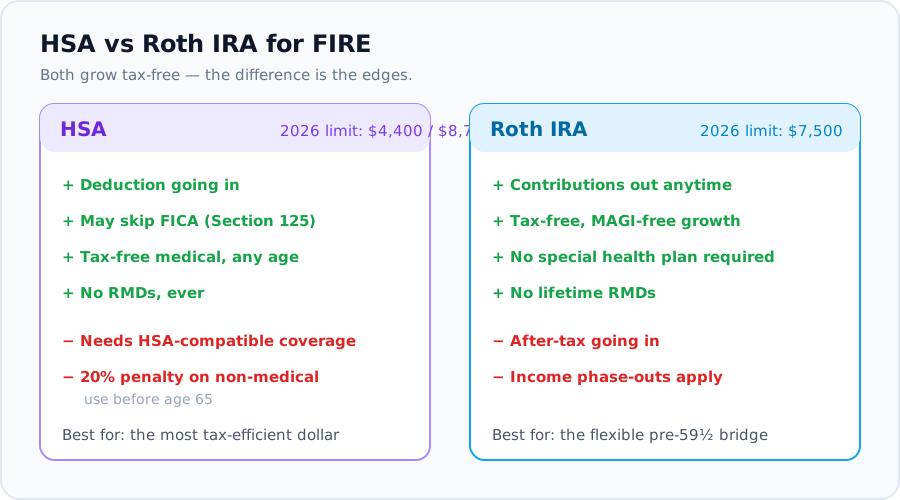
The 2026 HSA figures come from IRS Revenue Procedure 2025-19; the Roth IRA contribution limit and income phase-outs come from IRS Publication 590-A. Both adjust most years, so verify before you contribute.
Where they are identical
The middle of the sandwich is similar for both: money grows tax-free while it remains in the account. Qualified HSA medical withdrawals and non-taxable Roth IRA distributions do not count toward your MAGI, IRMAA tiers, or the income that decides your ACA subsidy. Neither has required minimum distributions during your lifetime, so both can keep compounding untouched. The differences show up mainly on the way in and the way out.
Where the HSA wins: the way in
The HSA gets a deduction the Roth never does. If you contribute the self-only limit through an eligible Section 125 payroll plan, you avoid income tax and the 7.65% employee FICA tax — roughly $337 a year on a $4,400 contribution that a Roth dollar (and even a 401(k) dollar) cannot escape. Then, on the way out, qualified medical withdrawals are tax-free at any age under IRS Publication 969. Getting both a deduction now and tax-free withdrawals later is something no other account offers, which makes the HSA one of the most tax-efficient places for a dollar that will eventually pay qualified medical expenses.
Healthcare is also a major early-retirement expense, so an account purpose-built to pay it tax-free is not a niche perk — it is aimed at a line item that worries many early retirees. And because the HSA has no deadline to reimburse yourself, you can leave the money invested for decades and cash out old receipts later. That HSA reimbursement strategy turns the account into a stealth retirement fund, not just a medical wallet.
Where the Roth IRA wins: the way out
The Roth IRA's superpower for FIRE is access. Your contributions (not earnings) can be withdrawn at any age, tax- and penalty-free, because they come out first under the ordering rules in IRS Publication 590-B. That makes the Roth a flexible bridge for the years before 59½ — money you can tap for any reason, not just medical bills.
The HSA, by contrast, is rigid before 65: take money out for a non-medical reason and you owe a 20% penalty plus tax. It is only freely flexible for medical costs (or after 65). The Roth also doesn't require HSA-compatible coverage — anyone with earned income under the phase-out can use it, while the HSA is locked behind specific coverage rules. So the Roth is the more universal, more liquid account, even though it gives up the up-front deduction.
The verdict: a funding order, not a winner
Because they do different jobs, the practical answer is a sequence rather than a single winner. A common FIRE funding order that uses both:
- Contribute to your 401(k) up to the full employer match (a 100% return you can't beat).
- Max the HSA — if you have HSA-compatible coverage — for the triple tax break and potential FICA savings.
- Max the Roth IRA (or a backdoor Roth if your income is over the limit) for the flexible bridge.
- Return to the 401(k) to fill the rest of the limit.
- Invest everything else in a taxable brokerage account.
Notice the HSA sits above the Roth here — but only if you're eligible and the HSA-compatible coverage genuinely fits your health. If that coverage would be wrong for you, skip straight to the Roth; the right insurance matters more than the tax break. The choice between traditional and Roth contributions inside your 401(k) is a separate question covered in 401(k) vs Roth IRA for FIRE, and how all of these accounts work together is the subject of tax diversification for FIRE.
Run your own number
Neither account changes how much you need to retire as much as it changes how usable that money is. Size your target first, then make sure your most accessible buckets — Roth basis and a taxable account — can actually fund the years before 59½, with the HSA earmarked against healthcare.
HSA vs Roth IRA FAQ
Should I max my HSA or my Roth IRA first?
If you're eligible and the HSA-compatible coverage suits you, max the HSA first — it's taxed favorably on both ends and an eligible Section 125 payroll contribution also skips employee FICA. Then max the Roth IRA for the flexibility of withdrawing contributions before 59½. Many FIRE plans use both each year.
Can I contribute to both in the same year?
Yes. They are separate accounts with separate limits, and contributing to one does not reduce the other. In 2026 that's up to $4,400 (self-only HSA) plus $7,500 (Roth IRA), assuming you qualify for both.
What if I can't use an HSA?
If you don't have HSA-compatible coverage, the HSA simply isn't available, so prioritize the Roth IRA after your 401(k) match. Don't switch to coverage that's wrong for your health just to unlock the HSA — the right coverage matters more than the tax break.
What to read next
The bottom line
HSA vs Roth IRA isn't a contest with one winner — it's a priority order. The HSA is the more tax-efficient dollar, so it goes first when you qualify; the Roth IRA is the more flexible dollar, so it's the bridge that makes retiring before 59½ workable. Fund both in the right sequence and you get the best of each: the lowest tax bill on the way in and the most access on the way out.
This article is educational and does not constitute tax, legal, or financial advice. Contribution limits and phase-outs are 2026 values that adjust annually and vary by filing status and income; verify current-year numbers and your own HSA eligibility before acting.