

The Rule of 55 lets you take penalty-free withdrawals from your current employer's 401(k) if you leave that job in or after the calendar year you turn 55. It waives the usual 10% early-distribution penalty up to about 4½ years before the normal age-59½ gate. For a FIRE saver who retires right around 55, that can be the simplest early-access tool there is — no five-year ladder to season, no rigid payment schedule to maintain. But it comes with a short list of conditions that, if you miss even one, quietly erase the benefit.
Per IRS Topic No. 558, distributions made to you “after you separated from service with your employer after attainment of age 55” are exempt from the 10% additional tax. Notice what the rule does not say: it does not mention IRAs, it does not mention old 401(k)s from past jobs, and it does not promise the income is tax-free. Getting those distinctions right is the whole game.
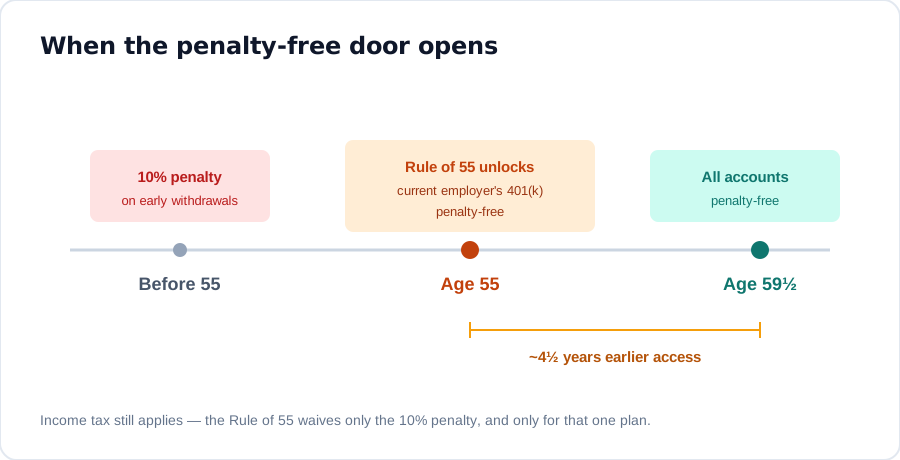
What the Rule of 55 actually allows
The 10% early-withdrawal penalty normally applies to 401(k) and IRA distributions before age 59½. The Rule of 55 is one of the IRS's named exceptions to that penalty. If you separate from service — quit, get laid off, or retire — in or after the year you reach 55, you can take distributions from that employer's plan without the penalty. You can even go work somewhere else afterward and keep pulling penalty-free, as long as the money stays in the former employer's plan.
That flexibility is what makes it attractive next to the alternatives. A Roth conversion ladder needs five years of seasoning before the first rung pays out, and a 72(t) payment plan locks you into fixed withdrawals for years. The Rule of 55 just lets you tap the plan as needed. The catch is that it only works for a narrow age band and only if your plan cooperates.
The five conditions you must meet
| Condition | What it means |
|---|---|
| Separate at 55 or later | You must leave the job in or after the calendar year you turn 55 |
| Current employer's plan only | Old 401(k)s and IRAs do not qualify |
| The plan must allow partial withdrawals | Some plans only permit a single lump sum — the “lump-sum trap” |
| Income tax still applies | The rule waives the 10% penalty, not ordinary income tax |
| Public safety: age 50 / 25 years | A lower threshold for qualified public safety employees |
Separate in or after the year you turn 55
The separation itself must happen in or after the year you turn 55. Leaving your job at 53 and then waiting until 55 to start withdrawing does not work — the penalty exception is tied to your age at separation, not your age at withdrawal. One useful nuance: because it keys off the calendar year, someone who turns 55 in December can separate any time that year and still qualify.
Current employer's plan only — IRAs do not count
The exception applies only to the plan of the employer you just left. A 401(k) from a job you left at 48 does not qualify, and neither does any IRA. There is a workaround: if your current plan accepts roll-ins, you can consolidate old 401(k) balances into your current employer's plan before you separate, bringing that money under the Rule of 55 umbrella.
The plan must allow partial distributions (the lump-sum trap)
This is the condition that catches the most people. The Rule of 55 is permission from the IRS, but your plan document decides how you can actually take the money. Many plans only allow a single lump-sum distribution after separation — and a forced lump sum dumps your entire balance into one year of taxable income, potentially pushing you into the 32% or 35% bracket. That tax hit can easily exceed the 10% penalty you were trying to avoid. Confirm that your plan permits partial or installment withdrawals in the Summary Plan Description before you rely on this strategy.
Public safety employees: age 50 or 25 years of service
Qualified public safety employees in governmental plans get a lower threshold — age 50, or 25 years of service, whichever comes first. SECURE 2.0 expanded the list of who counts to include private-sector firefighters, state and local corrections officers, federal law enforcement, customs and border protection officers, federal firefighters, and air traffic controllers. If that is you, your penalty-free door can open five years earlier than for everyone else.
The fatal mistake: rolling to an IRA too early
The single most common — and most expensive — Rule of 55 mistake is rolling your 401(k) into an IRA after you leave. It feels like the responsible move: consolidate, get better investment options, simplify. But the moment that money lands in an IRA, the Rule of 55 evaporates and you are back under the 59½ rule. Withdraw before then and the 10% penalty returns.
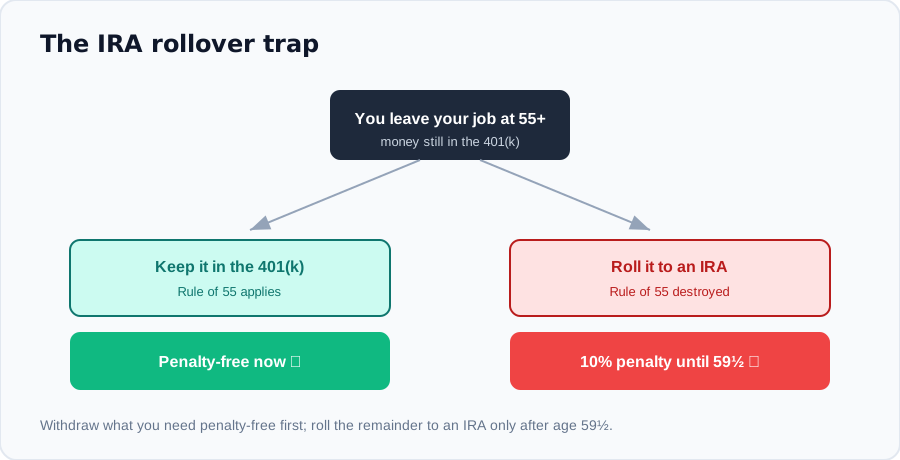
The fix is sequence. If you plan to use the Rule of 55, leave the relevant balance in the employer plan, withdraw what you need penalty-free through 59½, and only then roll the remainder to an IRA — for example, to start a Roth conversion ladder for the years beyond. Doing it in the wrong order is one of the biggest FIRE planning mistakes because it cannot be undone after the rollover.
How the Rule of 55 fits the sequencing plan
Pairing it with a taxable bridge and conversions
The Rule of 55 rarely works alone. Most retirees pair it with a taxable brokerage bridge and use the 401(k) distributions only up to a chosen tax ceiling — say, filling the 12% bracket — then cover the rest of their spending from taxable sales taxed at lower capital-gains rates. If there is still low-bracket room, some retirees layer in Roth conversions to pre-empt future required distributions. The order in which you draw each account is the subject of our tax-efficient withdrawal order guide.
When the Rule of 55 beats a 72(t) — and when it does not
For someone who retires at exactly 55 with a flexible plan, the Rule of 55 is almost always better than a 72(t)/SEPP: you keep full control over how much you withdraw each year, with no locked schedule and no recapture penalty hanging over you. A 72(t) only wins when the Rule of 55 is off the table — for example, if you retire well before 55, or your plan forces a lump sum. We compare the two penalty-free routes in depth in Roth conversion ladder vs 72(t).
Taxes still apply: managing the bracket
The Rule of 55 waives the penalty, not the tax. Every dollar you pull from a traditional 401(k) is ordinary income in the year you take it. For amounts in a Roth 401(k), the earnings can still be taxable if that designated Roth account is not yet qualified (it needs five years of participation plus age 59½ or disability). The practical implication is to size each year's withdrawal to a tax target rather than to your spending alone, the same way you would plan conversions — and to remember that, before 65, those withdrawals also raise the ACA MAGI behind your marketplace health subsidies.
Size the portfolio you retire on at 55
The Rule of 55 only helps if you actually reach 55 with enough invested. Start by sizing the portfolio your spending requires at your target withdrawal rate, then confirm enough of it sits in the employer plan you intend to tap penalty-free.
Rule of 55 FAQ
Does the Rule of 55 work if I retire at 45?
No. You must separate from your employer in or after the calendar year you turn 55. If you retire at 45, your penalty-free options are a Roth conversion ladder, a 72(t)/SEPP, or spending from a taxable account and Roth contribution basis until 59½.
Can I use the Rule of 55 on an old 401(k) from a previous job?
Only if you rolled that old balance into your current employer's plan before you left. The exception applies to the plan of the employer you separate from at 55 or later, not to plans from prior jobs and not to IRAs.
What if my plan only allows a lump-sum distribution?
Then the Rule of 55 may do more harm than good, because a lump sum forces your whole balance into one year's taxable income. In that case, many retirees skip it and use a taxable bridge plus a Roth conversion ladder, or a 72(t) on an IRA, instead. Check your Summary Plan Description for partial-withdrawal rights first.
Do I still pay income tax with the Rule of 55?
Yes. The rule only removes the 10% early-withdrawal penalty. Traditional 401(k) withdrawals are taxed as ordinary income, and Roth 401(k) earnings can be taxable if the account is not yet qualified. Plan each withdrawal against a tax bracket and your ACA income target.
Can I keep working somewhere else after using the Rule of 55?
Yes. You can take a new job and continue taking penalty-free distributions from the former employer's plan, as long as that money stays in that plan and is not rolled to an IRA.
What to read next
This article uses federal rules and 2026 figures for illustration. Plan-specific rules govern whether the Rule of 55 allows partial withdrawals, and tax brackets, account rules, and ACA eligibility vary by household, state, and future policy changes. Always confirm your plan's Summary Plan Description before relying on this strategy. This content is educational and is not tax, legal, or financial advice.