

In 2026, a married couple filing jointly can have up to $98,900 of taxable income and pay 0% federal tax on long-term capital gains and qualified dividends stacked within that band. For a single filer the 0% ceiling is $49,450. Add the standard deduction on top — $32,200 for a couple, $16,100 single — and the gross income you can earn while still paying $0 on the gain portion climbs to roughly $131,100 and $65,550. This is one of the most powerful and least understood tools an early retiree has.
It is not a loophole. The 0% long-term capital gains bracket is a permanent part of the tax code, and FIRE households are uniquely positioned to use it because they control their own income. The catch — and it is a real one — is that those same gains still count toward your ACA health-subsidy income, so the 0% federal rate does not always mean the move is free.
The 2026 capital gains brackets
Long-term capital gains apply to assets held more than one year. They get their own preferential rate schedule, separate from ordinary income, per IRS Topic No. 409 on capital gains and losses. For 2026, the thresholds (from IRS Revenue Procedure 2025-32) are measured on taxable income:
| Long-term gains rate | Single (taxable income) | Married filing jointly |
|---|---|---|
| 0% | Up to $49,450 | Up to $98,900 |
| 15% | $49,451 – $545,500 | $98,901 – $613,700 |
| 20% | Above $545,500 | Above $613,700 |
Two details make this powerful for FIRE. First, the rate structure was made permanent — the scheduled expiration of the prior tax law was removed by the One Big Beautiful Bill Act, signed July 4, 2025, so the 0% bracket is not set to sunset. Second, the 0% ceiling sits just a few hundred dollars above the top of the 12% ordinary bracket, by design. Early retirees who keep ordinary income low have enormous room to realize gains tax-free.
How income “stacking” works
The single concept that unlocks the 0% bracket is stacking. Think of your income as a stack filled from the bottom up. Ordinary income — wages, pension, traditional IRA withdrawals, Roth conversions, interest — goes in first. Long-term gains and qualified dividends sit on top. The rate on the gains is set by where the top of the stack lands.
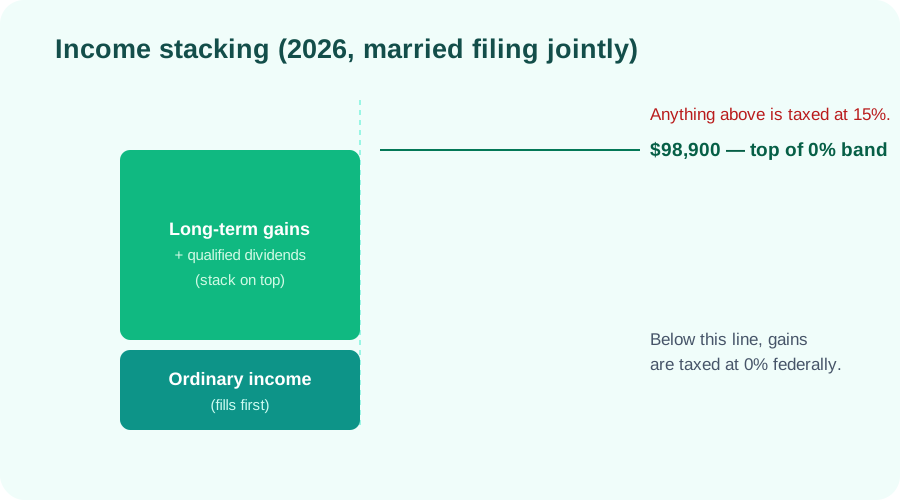
Walk through a 2026 couple with $20,000 of ordinary income (say, qualified dividends are separate, and this is interest plus a small part-time gig). The standard deduction of $32,200 wipes out that ordinary income entirely. The 0% ceiling for taxable income is $98,900. So they can realize roughly $98,900 of long-term gains and still pay $0 federal tax on them, because the gains stack from the bottom of the 0% band up to its top.
Now suppose they instead had $50,000 of ordinary income before the deduction. After the $32,200 deduction, $17,800 of taxable ordinary income fills the bottom of the stack. That leaves $98,900 − $17,800 = $81,100 of room for 0%-taxed gains. Everything above that is taxed at 15%. The lesson: every extra dollar of ordinary income — including a Roth conversion — eats into your 0% gain room.
What qualifies for the 0% rate
Not every gain or dividend gets the preferential rate. To stack inside the 0%/15%/20% schedule, income must be either a long-term capital gain or a qualified dividend:
- Long-term capital gain — the asset must be held more than one year (a year and a day). Sell at one year or less and the gain is short-term, taxed at ordinary income rates of 10%–37%.
- Qualified dividend — generally paid by a U.S. corporation or qualified foreign corporation, and you must meet a holding-period test around the ex-dividend date. REITs and many MLPs do not pay qualified dividends; their distributions are mostly ordinary income.
High earners can also owe the 3.8% Net Investment Income Tax above $200,000 (single) or $250,000 (married filing jointly), but those thresholds are far above the 0% bracket, so most early retirees harvesting in the 0% band never touch it.
The ACA catch: 0% federal is not 0% everywhere
This is the part that trips up early retirees. A long-term gain taxed at 0% federally still counts toward your ACA modified adjusted gross income. The same $98,900 harvest that costs nothing in federal income tax can raise your MAGI by $98,900 — and for a two-person household, the 2026 subsidy cliff sits around $84,600 of MAGI.
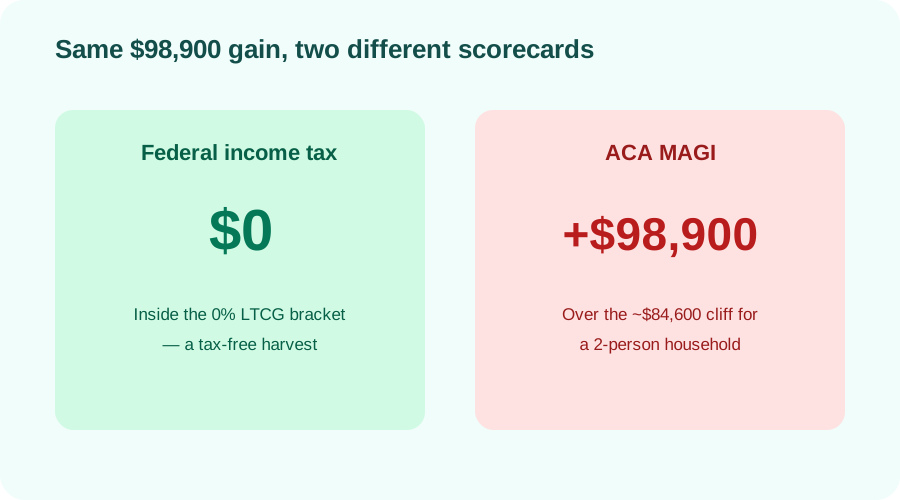
So the 0% bracket and the ACA subsidy space partly overlap and partly fight each other. In a year you do not need a healthcare subsidy — maybe you are on a spouse's plan, or under Medicaid thresholds, or simply willing to pay full premiums — the 0% bracket is pure upside. In a year you do need a large premium tax credit, you may deliberately realize far fewer gains to keep MAGI under the cliff. Our ACA subsidies for FIRE guide shows how to set a MAGI target before deciding how much to harvest.
A $0-tax year, worked through
Maria, single, retired at 42. In 2026 her only ordinary income is about $5,000 of interest. The $16,100 standard deduction more than covers it, leaving $0 of taxable ordinary income. Her 0% ceiling for long-term gains is $49,450.
She sells appreciated VTI shares to realize about $49,000 of long-term gain — just under the ceiling. Her federal income tax on that gain: $0. Because she also sold return-of-basis dollars alongside the gain, the actual cash she pulled out is far larger than $49,000. If she does not need an ACA subsidy this year, she has just moved a large chunk of her portfolio through the tax system at zero cost — and if she immediately rebuys, she has also reset her basis higher, which is the foundation of tax-gain harvesting.
For the full picture of how ordinary income and gains interact across all the brackets, see early retirement tax brackets explained.
Common 0%-bracket mistakes
Forgetting gains stack on top of ordinary income. If a Roth conversion or pension already fills your stack to $80,000, you do not have a full 0% bracket left for gains. Estimate ordinary income first.
Realizing short-term gains by accident. Selling before the one-year mark converts a 0%-eligible long-term gain into ordinary income taxed up to 37%. Track holding periods.
Spilling over the ceiling unintentionally. Gains above the 0% top are taxed at 15%. That is fine if you meant to, wasteful if a surprise dividend or fund distribution pushed you over. Leave a buffer.
Ignoring state tax. Many states tax capital gains as ordinary income with no 0% bracket. The 0% rate discussed here is federal only; check your state before assuming a sale is truly tax-free.
Treating 0% federal as free for ACA. The single most common early-retiree error: realizing a “free” gain that quietly blows past the subsidy cliff and costs thousands in lost premium tax credits.
Plan the 0% bracket into your FIRE plan
The 0% bracket is most useful when you have a large, high-basis taxable brokerage bridge to draw from. Start by sizing your overall portfolio against your spending, then plan which years to use for gain harvesting versus Roth conversions versus maximizing ACA subsidies.
0% capital gains FAQ
How much can I realize tax-free in 2026?
Up to the top of the 0% bracket measured on taxable income: $49,450 single, $98,900 married filing jointly, minus any ordinary income already filling the stack. The standard deduction raises the gross income you can have while staying in the 0% zone.
Do I have to hold shares for a year?
Yes. Only long-term gains — assets held more than one year — get the 0%/15%/20% rates. Gains on assets held one year or less are short-term and taxed at ordinary income rates.
Does a 0% gain affect my ACA subsidy?
Yes. Realized capital gains count toward ACA MAGI even when the federal capital-gains rate is 0%. A large harvest can reduce or eliminate a premium tax credit, so coordinate it with your MAGI target.
Is the 0% bracket going away?
Not on a scheduled basis. The 0%/15%/20% structure was made permanent when the 2025 tax law removed the prior sunset. Tax law can always change in the future, but there is no current expiration date built in.
What to read next
This article uses 2026 federal figures from IRS Revenue Procedure 2025-32 for illustration. Capital gains rules, ACA eligibility, and state taxes vary by household and can change with future policy. Many states tax capital gains as ordinary income with no 0% bracket. This content is educational and is not tax, legal, or financial advice.