

Social Security still matters for early retirees — it just arrives later. A “bridge” strategy means spending a bit more from your portfolio in your 60s so you can delay claiming Social Security until 70, when the monthly benefit is roughly 77% larger than claiming at 62. That is the difference between a benefit worth 70% of your full amount and one worth 124% of it — inflation-adjusted income that is paid for life and rises each year with the SSA cost-of-living adjustment.
How claiming age changes the check
Your benefit is set at your full retirement age — 67 for anyone born in 1960 or later. Claim before then and it is permanently reduced (to about 70% of your full amount at 62); delay past full retirement age and it grows with delayed retirement credits of about 8% per year until 70:
| Claiming age | Benefit vs full retirement age |
|---|---|
| 62 (earliest) | ~70% |
| 67 (full) | 100% |
| 70 (latest worth waiting for) | ~124% |
Waiting from 62 to 70 turns a $2,000 check into roughly $3,500 — for the rest of your life, adjusted for inflation. That is about $1,500 more per month, or $18,000 more per year. Over 20 years of receiving the larger check, the difference adds up to roughly $360,000 before considering future cost-of-living adjustments. The tradeoff is giving up eight years of smaller checks first, so the best claiming age depends on how long you live and what your portfolio can support.
Why early retirees build a bridge
If you retire at 50, Social Security is at least 12 years away no matter what. The bridge idea is to plan your portfolio to carry you to 70 at a higher draw, then drop your withdrawal rate once the larger benefit kicks in. If you are still working out the target portfolio behind that plan, start with how much you need to retire at 45 and the FIRE number formula.
For example, imagine retiring at 55 and spending $60,000 per year. From age 55 through 69, the portfolio covers the full $60,000. At 70, a $25,000 annual Social Security benefit begins, so the portfolio only needs to provide the remaining $35,000. The portfolio “bridges” the years before Social Security starts.
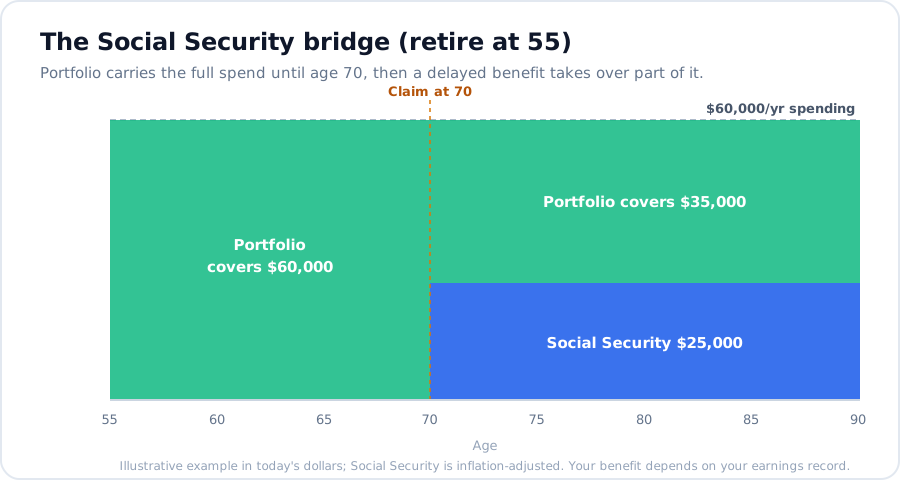
This requires more portfolio spending before 70, so it must be tested against poor early market returns — drawing heavily from a falling portfolio in the first few years is what breaks early-retirement plans. Its payoff is a lower portfolio burden and more reliable income later in retirement. Which accounts fund those higher early withdrawals matters too: see the tax-efficient withdrawal order and the taxable brokerage bridge for the accounts that usually carry the pre-70 years.
Why not claim Social Security at 62?
Claiming at 62 provides income immediately and reduces near-term portfolio withdrawals. Delaying can still be attractive for FIRE retirees who have enough assets to fund the bridge because it provides:
- Higher inflation-adjusted lifetime income if you live long enough
- A larger survivor benefit for an eligible spouse
- More protection against running short of money late in life
Social Security as longevity insurance
Longevity risk is the risk of outliving your savings. Unlike a portfolio, Social Security payments continue for life and receive cost-of-living adjustments. The longer you live, the more valuable a larger delayed benefit becomes. That makes delaying less like chasing a higher investment return and more like buying additional insurance against a very long retirement.
How to fold it into your FIRE plan
- Get your real estimate. Pull your actual benefit at 62, 67, and 70 from your my Social Security account — early-retirement years with no earnings can lower it, so don't assume the headline number.
- Treat Social Security as a reducer, not the plan. Build your FIRE number on spending first; a delayed benefit then lowers how much your portfolio must cover later in life.
- Coordinate with ACA subsidies and taxes. Drawing more from a brokerage in your 60s affects both your healthcare subsidy and your tax bracket. See the health insurance before Medicare guide and our ACA subsidies for FIRE guide before choosing which accounts fund the bridge.
When delaying may not make sense
Delaying is not automatically better. Claiming earlier may be reasonable if you have poor health or a shorter life expectancy, need immediate cash flow, or lack enough portfolio assets to fund the bridge without taking excessive withdrawal risk. Household decisions also matter: married couples often coordinate claiming ages rather than evaluate each benefit in isolation.
Common mistakes
1. Claiming at 62 by default. It feels safe, but it locks in the smallest lifetime benefit. For healthy people with portfolio assets, delaying is often the better hedge against a long life.
2. Counting on a fixed future benefit. Social Security rules can change. Treat it as a meaningful but not guaranteed-to-the-dollar layer, and keep your portfolio able to stand on its own.
Social Security bridge FAQ
What is the earliest age I can claim Social Security?
Age 62 for retirement benefits. Claiming that early locks in a permanent reduction — about 70% of your full benefit if your full retirement age is 67. The bridge strategy is built around the opposite choice: spending your portfolio first so you can delay and let the benefit grow.
Does retiring early lower my Social Security benefit?
It can. Your benefit is based on your highest 35 years of earnings, so years with no income after you retire early can pull down the average and replace once-counted zeros only if you keep working. Because of this, the SSA estimate that assumes you keep earning until you claim can overstate what an early retiree will actually receive. Check the estimate against your real earnings record.
Are Social Security benefits taxed?
Often, yes. Depending on your “combined income,” up to 50% or 85% of your benefit can be subject to federal income tax, per the SSA rules on taxation of benefits. That is one more reason to coordinate the bridge years with the order you draw from each account and any Roth conversions you run while income is low.
Should married couples both delay to 70?
Not always. Couples usually coordinate rather than copy each other: it often makes sense for the higher earner to delay, because that benefit also sets the survivor benefit the surviving spouse keeps for life, while the lower earner may claim earlier for cash flow.
Is delaying to 70 always worth it?
No. Delaying wins if you live well past your break-even age, which usually lands in your early-to-mid 80s. If you have poor health, a shorter life expectancy, or not enough portfolio to fund the bridge without taking on sequence-of-returns risk, claiming earlier can be the better call.
What to read next
Social Security figures are approximate and depend on your earnings record and current law, which can change. Use SSA.gov for your personal estimate. This article is educational and does not constitute financial advice.