

Required minimum distributions (RMDs) force money out of pre-tax retirement accounts starting at age 73 or 75 — and even though that is decades away for a 30-year-old, the size of that future tax bill is being set right now by how much you pour into traditional 401(k)s versus Roth and taxable accounts. A $2,000,000 pre-tax balance triggers a first-year RMD of roughly $75,000, taxed as ordinary income on top of Social Security, whether you need the money or not. The FIRE planner's job is to stop that balance from getting so large that RMDs push them into the 24% or 32% bracket in their 70s.
This is the counterintuitive part: RMDs are a problem you mostly solve in your accumulation years and in the low-income window right after you retire — not at 73, when your options have nearly run out. Let's walk through the rules, the trap, and the fix.
Why a 30-year-old should care about RMDs
It is tempting to ignore a rule that will not touch you until the 2060s. The catch is compounding. A traditional 401(k) that grows untouched for 40 years becomes an enormous pre-tax balance, and the entire balance is taxable on the way out. RMDs as a percentage of that balance start small but climb every year, and on a multi-million-dollar account those forced withdrawals can stack on Social Security and push you into high brackets in retirement — the exact opposite of the low brackets you could have used in early retirement. The mix you choose between pre-tax and Roth dollars today is what determines how big that wave gets.
The RMD rules under SECURE 2.0
Age 73 (born 1951–1959) vs 75 (born 1960 or later)
Under the SECURE 2.0 Act, the age at which RMDs begin depends on your birth year: 73 for those born 1951–1959 and 75 for those born in 1960 or later. Your first RMD can be delayed to April 1 of the year after you reach that age, but doing so forces two RMDs into one tax year — usually a bad idea. The amount is your prior year-end balance divided by a life-expectancy factor from the IRS required minimum distribution tables, and the percentage rises as you age.
| Age | RMD as ~% of balance | On a $2,000,000 pre-tax balance |
|---|---|---|
| 73 | ~3.8% | ~$75,000 |
| 80 | ~5% | ~$100,000 |
| 90 | ~8% | ~$160,000 |
Those are illustrative percentages on a fixed balance; in reality the balance keeps growing, so the dollar RMD often climbs even faster than the rate alone suggests.
Roth IRAs and (since 2024) Roth 401(k)s have no lifetime RMDs
Roth IRAs have never required lifetime RMDs for the original owner. As of 2024, SECURE 2.0 also eliminated lifetime RMDs from designated Roth accounts inside 401(k), 403(b), and governmental 457(b) plans. That is a structural advantage: every dollar you hold in Roth at 73 is a dollar the IRS cannot force out and tax. This is precisely why a Roth conversion ladder and good accumulation-era Roth contributions do double duty — early access now, and RMD relief later.
The 25% (or 10%) missed-RMD penalty
Missing an RMD is expensive. SECURE 2.0 cut the excise tax on a shortfall from 50% to 25%, dropping to 10% if you correct it within the correction window. It is still a penalty worth avoiding entirely by tracking the deadline once RMDs begin.
The tax-compression problem
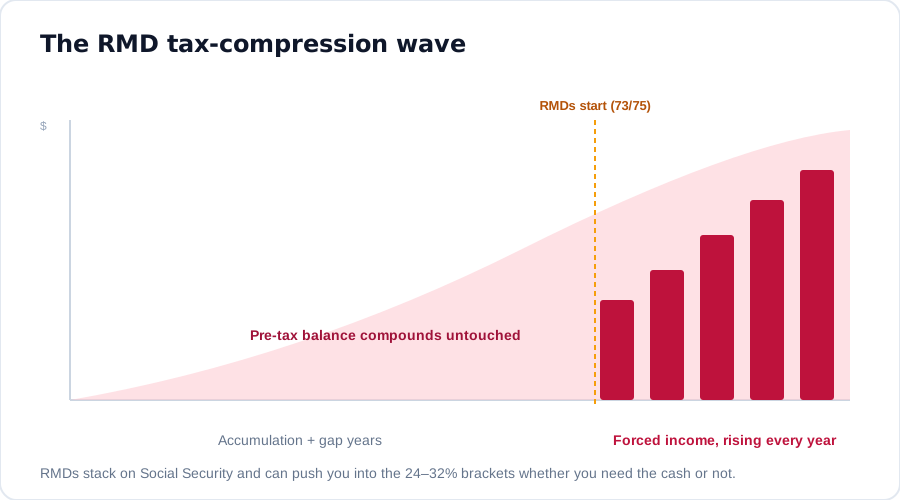
How decades of pre-tax compounding create a forced-income wave
The problem is not the RMD rule itself — it is a pre-tax balance allowed to grow unchecked. Money that could have been converted cheaply in early-retirement gap years instead compounds into a balance whose RMDs arrive in the 70s at far higher rates. The retiree ends up with more taxable income than they want or need, with no way to turn it off.
RMDs stacking on Social Security
RMDs do not arrive in a vacuum. They land on top of Social Security, and that interaction makes more of the benefit taxable through the provisional-income rules described by the Social Security Administration. The result is the “tax torpedo,” where an extra $1,000 of RMD can make hundreds of dollars of Social Security newly taxable, producing unusually high effective rates. Our Social Security bridge guide explains why coordinating claiming age with conversions matters so much.
The widow/widower single-filer penalty
Here is the cruelest twist. When one spouse dies, the survivor files single the following year, and the 2026 single brackets and standard deduction are roughly half the married figures: the 12% bracket ends at $48,475 (single) versus $96,950 (married filing jointly), and the standard deduction is $16,100 versus $32,200. The same RMDs and Social Security that fit comfortably in joint brackets get crushed into single brackets — often a $5,000–$20,000+ annual tax increase on lower household income, plus a single IRMAA Medicare threshold that drops to $109,000. A note for balance: some academic research (Edward McQuarrie, Journal of Financial Planning, 2023) argues the widow-penalty case for aggressive conversions is overstated when the survivor does not actually need the averted income. The underlying single-filer bracket compression, however, is not in dispute.
The fix: Roth conversions in the gap years
The most reliable defuser is converting pre-tax money to Roth during the low-income years between retirement and age 73 — the Roth conversion window. Every dollar moved to Roth at 12% during those years (a) never triggers a future RMD, (b) never counts toward Medicare IRMAA or Social Security provisional income, and (c) never lands in a surviving spouse's compressed single brackets.
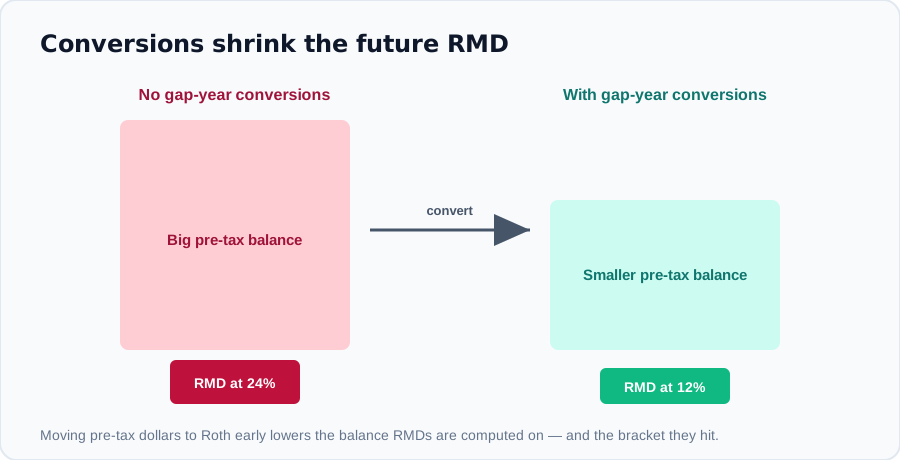
Conversions are not the only lever — the order in which you spend each account also shapes the eventual RMD, which is why the tax-efficient withdrawal order deliberately draws down pre-tax balances in low-income years before RMDs would otherwise force the issue.
What to do in your 20s and 30s to defuse the bomb
Traditional vs Roth mix and tax diversification
High earners in the 24%+ bracket generally favor traditional contributions (deduct now, convert later at 12%). But putting everything pre-tax is how you build the RMD bomb. Roth contributions create the tax-free bucket that dodges RMDs, IRMAA, provisional income, and the widow's penalty all at once. The goal is tax diversification — meaningful balances in all three buckets (pre-tax, Roth, and taxable) so future-you has dials to turn. Our 401(k) vs Roth IRA for FIRE guide works through the trade-off in detail. For 2026, the 401(k) employee deferral limit is $24,500 and the IRA limit is $7,500, per the IRS 2026 contribution-limit announcement, with an extra $8,000 catch-up at 50+ and an $11,250 super catch-up at ages 60–63.
Building the taxable bridge
After capturing the full employer match and maxing tax-advantaged space, route surplus savings into a taxable brokerage bridge. It funds the gap years and the conversion-ladder seasoning window, gets preferential capital-gains treatment, and gives you the income control that makes cheap conversions possible. The mental model: you are pre-positioning which buckets exist so that decades from now you have a bridge to live on, a pre-tax balance to convert cheaply, and a growing Roth that never gets taxed again.
Size the balance that creates your future RMD
Your projected pre-tax balance at 73 is what sets your RMD. Estimating the portfolio your spending needs — and how it splits across account types — is the first step to keeping that future forced income inside low brackets.
RMDs and FIRE FAQ
At what age do RMDs start?
It depends on your birth year. RMDs begin at age 73 for those born 1951–1959 and at age 75 for those born in 1960 or later, under the SECURE 2.0 Act. Roth IRAs and, since 2024, designated Roth 401(k) accounts have no lifetime RMDs for the owner.
Why do RMDs matter if I plan to retire early?
Because early retirement gives you a long, low-income window to convert pre-tax money cheaply before RMDs begin. If you ignore that window, your pre-tax balance keeps compounding and the eventual RMD lands in a much higher bracket, stacked on Social Security. Retiring early is the opportunity to defuse the RMD, not a reason to ignore it.
Do Roth conversions reduce RMDs?
Yes. Every dollar converted to Roth leaves the pre-tax balance that RMDs are calculated on, so future required distributions are smaller. Conversions done in low-income gap years move that income to a lower rate and out of the RMD base entirely.
What is the penalty for missing an RMD?
SECURE 2.0 reduced the excise tax on a missed RMD from 50% to 25% of the shortfall, dropping to 10% if you correct it within the IRS correction window. Track the deadline each year once RMDs begin to avoid it.
What to read next
This article uses federal rules and 2026 figures for illustration. RMD ages, life-expectancy factors, tax brackets, contribution limits, and IRMAA thresholds change over time and vary by birth year, household, and filing status, and many states tax retirement income differently from the federal government. This content is educational and is not tax, legal, or financial advice.