

Tax diversification for FIRE means holding your savings across four different tax buckets — taxable, pre-tax, Roth, and an HSA — so you can choose how much taxable income to report in any given year. Asset diversification protects you from a bad investment. Tax diversification protects you from a bad tax year. For early retirees, the second one is arguably more important, because the income you report drives your ACA health-insurance subsidy, your Medicare premiums, and how much tax you pay on every withdrawal.
A saver with $1 million entirely inside a traditional 401(k) has no simple, flexible way to spend before 59½ and faces a tax bill on every distribution. A saver with the same $1 million split across four buckets can fund a $40,000 year with almost no reported income — or deliberately report more to fill a low tax bracket. Same net worth, completely different flexibility. That flexibility is what the rest of your tax-efficient withdrawal order depends on.
The four FIRE tax buckets
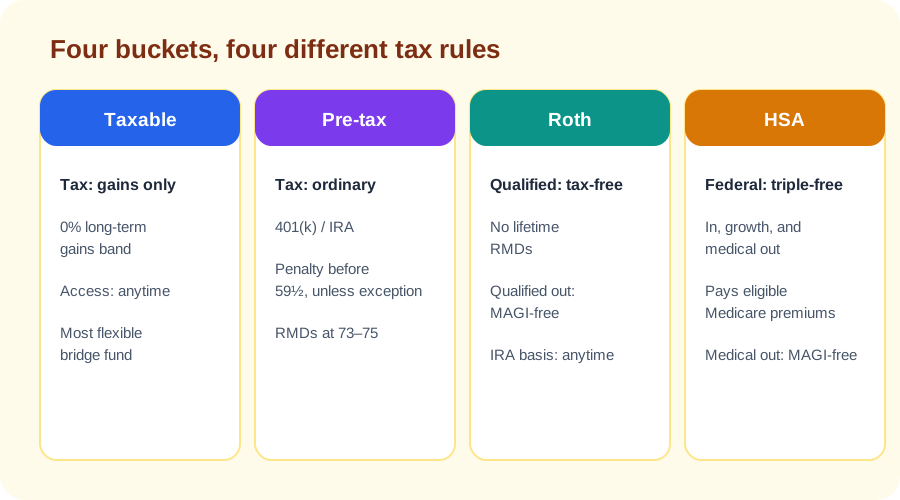
Each bucket is taxed under a different rule. The point of holding all four is that they give you different “levers” to pull when you assemble a year of spending:
| Bucket | How it is taxed | Why FIRE needs it |
|---|---|---|
| Taxable brokerage | Gains only; long-term gains at 0/15/20% | Accessible at any age; cost basis returns tax-free; a 0% gains band |
| Pre-tax 401(k)/IRA | Ordinary income on every dollar | Fuels Roth conversions in low-income years; cuts today's tax bill |
| Roth IRA / designated Roth account | Tax-free when qualified | MAGI-free qualified withdrawals; no lifetime RMDs; Roth IRA basis accessible anytime |
| HSA | Triple tax-free for medical costs | Pays healthcare and Medicare premiums without raising income |
The sections below cite the IRS rules behind each bucket.
Why a single bucket is fragile
Imagine two early retirees, each with $1 million, who both want to spend $40,000 in their first year at age 45.
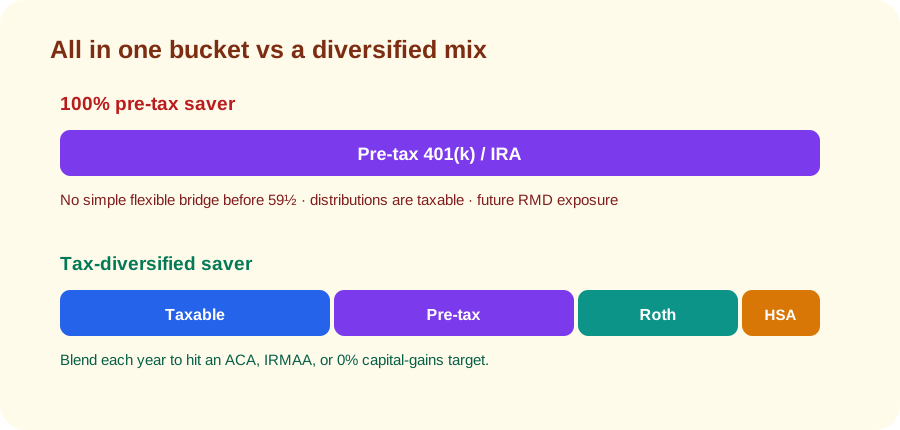
The all-pre-tax retiree has everything in a traditional 401(k). To spend $40,000 before 59½, they either pay a 10% penalty or set up a rigid 72(t) schedule, and every withdrawal is fully taxable income. Every dollar they spend raises MAGI, so they have little room to target the lowest ACA premium-credit and cost-sharing bands — their subsidy depends entirely on how that fixed income compares with the poverty level for their household. And in their 70s, required minimum distributions force money out whether they need it or not.
The tax-diversified retiree holds, say, $400,000 taxable, $400,000 pre-tax, $150,000 Roth, and $50,000 in an HSA. They fund the same $40,000 with taxable basis, a slice of long-term gains taxed at 0%, and some Roth basis — reporting only a few thousand dollars of MAGI. That low income qualifies them for generous ACA premium tax credits, and it leaves the entire 10%–12% bracket open for a Roth conversion they choose to do on purpose.
What each bucket does for you
Taxable brokerage — the flexible bridge
A taxable account has no early-withdrawal penalty, so it is the bridge that funds the years before 59½. Only the gain portion is taxed, and long-term gains are taxed at 0/15/20% under IRS Topic No. 409 — the 0% rate applies when taxable income is low, which for 2026 means up to $49,450 single or $98,900 married filing jointly per IRS Revenue Procedure 2025-32. It also enables tax-loss harvesting and a step-up in basis for heirs. The trade-off is annual dividends and realized gains that count toward MAGI, so it needs to be managed, not ignored. For how to size and use it, see the taxable brokerage bridge guide.
Pre-tax 401(k)/IRA — the conversion fuel
Pre-tax accounts give you a deduction while you are working and a big balance to convert during low-income retirement years. The risk is letting that balance grow untouched until RMDs force it out at high rates. The pre-tax bucket is what feeds a Roth conversion ladder, which turns it into penalty-free, tax-managed income. For 2026, the employee deferral limit is $24,500 (plus catch-ups), and the IRA limit is $7,500.
Roth accounts — the MAGI-free dollars
Roth is the most valuable bucket for FIRE precisely because qualified withdrawals are tax-free and do not count toward MAGI, IRMAA, or Social Security provisional income. That lets you fund a big one-off expense without blowing past an ACA cliff or an IRMAA tier. Direct Roth IRA contribution basis is also accessible at any age, and Roth IRAs and designated Roth plan accounts have no lifetime required distributions, as set out in IRS Publication 590-B. The catch: it takes years to build, which is why you want to start early.
HSA — the most tax-efficient dollar you own
A health savings account is triple tax-free: deductible going in, growing tax-free, and tax-free coming out for qualified medical expenses at any age. After 65 you can also use it for non-medical spending taxed like an IRA (no penalty), and it can pay Medicare Part B, D, and Advantage premiums — the rules are detailed in IRS Publication 969. Because qualified medical withdrawals never touch MAGI, the HSA is the cleanest bucket of all for an income-managed FIRE plan. The 2026 contribution limits are $4,400 self-only and $8,750 family, plus a $1,000 catch-up at 55+. We cover HSA-specific strategy in the HSA for FIRE pillar, the “shoebox” receipt method in its own guide, and how it stacks up against a Roth IRA when you can only max one in HSA vs Roth IRA for FIRE.
How to build tax diversification while you accumulate
You do not get a balanced set of buckets by accident — the default of maxing only a traditional 401(k) leaves you all pre-tax. A common funding order that builds all four buckets:
- Contribute to the 401(k) at least up to the full employer match.
- Max the HSA if you have a qualifying high-deductible health plan.
- Max a Roth IRA (or do a backdoor Roth if income is too high).
- Return to the 401(k) to fill the rest of the limit.
- Invest everything else in a taxable brokerage account — your pre-59½ bridge.
The exact split between traditional and Roth depends on your current vs. expected future tax rate — that is the core question in our 401(k) vs Roth IRA for FIRE guide. The 2026 limits cited above follow the annual IRS 401(k) contribution limits and the HSA rules in IRS Publication 969; these figures adjust each year, so verify the current ones.
Common tax-diversification mistakes
- Going all pre-tax. Maxing only a traditional 401(k) feels efficient but leaves you with no bridge before 59½ and a future RMD problem.
- Skipping the taxable account. Without it, early retirement forces penalties or rigid 72(t) withdrawals. The taxable bridge is what makes FIRE workable.
- Treating the HSA as a spending account. Paying current medical bills out of pocket and letting the HSA grow invested turns it into a powerful tax-free reserve.
- Building Roth too late. Roth balances need years to grow; starting in your 40s leaves little time for the MAGI-free bucket to matter.
Put it into your FIRE number
Tax diversification does not change how much you need in total nearly as much as it changes how usable that money is. Size your target first, then make sure the accessible buckets — taxable and Roth basis — can actually cover your spending before 59½.
Tax diversification FAQ
What is tax diversification?
Holding savings in accounts that are taxed differently — taxable, pre-tax, Roth, and HSA — so you can control how much taxable income you report each year instead of being forced into one tax treatment.
Do I really need all four buckets?
The taxable, pre-tax, and Roth buckets are the core three that make early retirement flexible. The HSA is a powerful fourth if you have access to HSA-compatible coverage, because its medical withdrawals never raise your income.
What is the best ratio between buckets?
There is no single answer, but FIRE retirees generally want enough taxable and Roth basis to bridge the years before 59½, a pre-tax balance large enough to convert during low-income years, and an HSA for healthcare. The right pre-tax vs. Roth split depends on your current and expected future tax rates.
What to read next
The bottom line
Tax diversification is the foundation every other FIRE tax move stands on. Build all four buckets while you accumulate, and you give your future self the ability to choose a low-income year for ACA subsidies, a bracket-filling year for Roth conversions, or a tax-free year from Roth and HSA dollars. One bucket gives you one option. Four buckets give you a plan.
This article is educational and does not constitute tax, legal, or financial advice. Contribution limits and tax figures are 2026 values that adjust annually and vary by filing status and state; verify current-year numbers before acting.