

The Roth conversion ladder and a 72(t)/SEPP are the two main ways to pull money from retirement accounts before age 59½ without the 10% early-withdrawal penalty — and they sit at opposite ends of the flexibility spectrum. The ladder is flexible and cheap but needs a five-year bridge before the first dollar is available. A 72(t) gives you penalty-free income at any age starting immediately, but it locks you into fixed payments for the longer of five years or until 59½, with a harsh penalty for breaking the schedule.
For most FIRE retirees, the ladder wins. The 72(t) is best understood as the option of last resort — the one you reach for when you retire well before 55 and do not have a taxable bridge large enough to cover the ladder's seasoning years. This guide walks through how each one works, then compares them head to head so you can see which fits your retirement age.
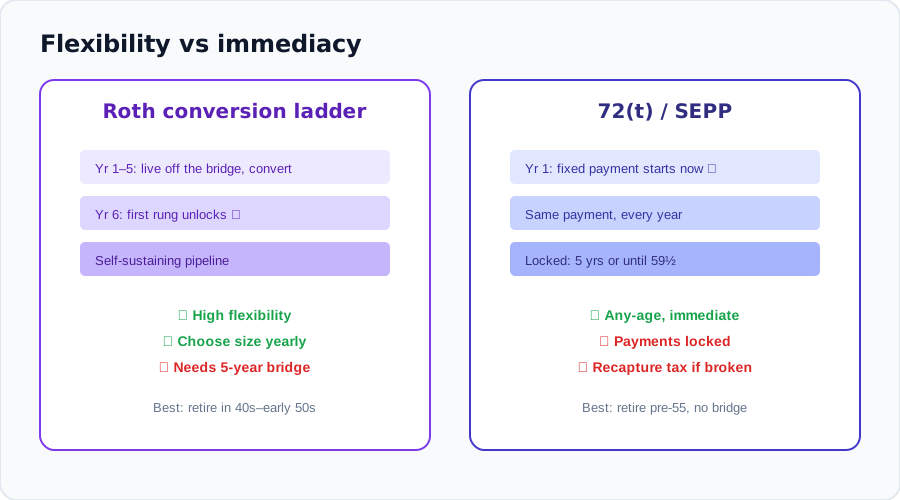
Two ways to crack the age-59½ wall
Both methods exist because the IRS normally adds a 10% additional tax to retirement-account withdrawals before 59½. Here is the quick comparison before we get into the mechanics.
| Dimension | Roth conversion ladder | 72(t) / SEPP |
|---|---|---|
| Penalty-free access age | Any age, 5 years after each conversion | Any age, starting immediately |
| Flexibility | High — choose the conversion size each year | Very low — payments are locked |
| Needs a 5-year bridge? | Yes | No |
| Main risk | Record-keeping errors | Recapture tax if you modify the plan |
| Best retirement age | 40s to early 50s | Pre-55 with no bridge |
Roth conversion ladder — how it works
A ladder is a rolling pipeline. Each year you convert a chunk of a traditional IRA or pre-tax 401(k) into a Roth IRA and pay ordinary income tax on the converted amount. After that conversion seasons for five tax years, you can withdraw the converted principal penalty-free — at any age. A conversion done in 2027 unlocks in 2032, 2028's unlocks in 2033, and so on, each rung maturing like a bond ladder. There is no dollar limit on conversions, so the only real constraint is the tax cost. Our full Roth conversion ladder guide walks the mechanics step by step.
The catch is the bridge requirement. Because the first conversion is locked for five years, you need five years of living expenses — plus the conversion taxes — from other sources before the ladder delivers its first rung. If you spend $50,000 a year, that is roughly $250,000 in bridge assets, typically a taxable brokerage account and prior Roth contributions. The upside is total control: you choose each year's conversion size, you can dial it up or down with your tax and ACA subsidy situation, and the worst execution risk is sloppy record-keeping rather than a tax penalty.
72(t)/SEPP — how it works
A 72(t), formally a series of substantially equal periodic payments (SEPP), lets you tap an IRA before 59½ at any age — but on a fixed schedule. It is governed by IRS rules on substantially equal periodic payments (Notice 2022-6), which define three calculation methods.
The three methods and the 5% rate rule
- Required minimum distribution method — balance divided by a life-expectancy factor, recalculated yearly; the payment floats with the balance and is the smallest.
- Fixed amortization method — amortizes the balance over your life expectancy at a fixed rate; level payments; the largest.
- Fixed annuitization method — uses an annuity factor; level payments; slightly below amortization.
The interest rate used for the fixed methods can be any rate up to the greater of 5% or 120% of the federal mid-term rate for one of the two months before payments begin. With the January 2026 120% federal mid-term rate at 4.57%, the effective maximum is 5%. To put numbers on it: a $1,000,000 IRA for someone age 53 using the fixed amortization method at 5% produces roughly $62,190 a year, while the RMD method on the same account might produce closer to $29,000–$37,000. You pick the method that delivers the income you need — but once chosen, you are committed.
The 5-years-or-59½ lock and the recapture tax
Payments must continue, unchanged, for the longer of five years or until age 59½. Start at 52 and you are committed to 59½; start at 58 and you are committed until 63. If you “modify” the series before that point — by changing the payment, adding money to or rolling funds into the account, or taking an extra withdrawal — the 10% penalty you avoided in every prior year comes back retroactively, plus interest. That recapture can be a six-figure surprise, which is why a 72(t) demands precision.
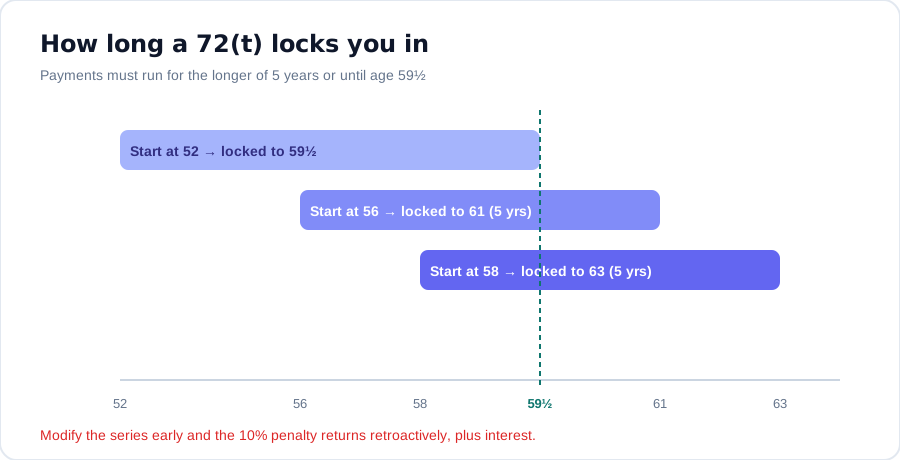
Account-splitting and the one-time RMD-method switch
Two features soften the rigidity. First, because the payment is based on the balance of the specific account you designate, a common technique is to split one IRA into two before starting — run the SEPP on a sub-account sized to produce exactly the income you need, and leave the other untouched for emergencies. Second, the rules permit a one-time switch from a fixed method to the RMD method, a one-way relief valve that lowers payments if your account is shrinking. You cannot switch back, and any addition to the SEPP account is still a modification.
Head-to-head: flexibility, risk, complexity, irreversibility
| Factor | Roth conversion ladder | 72(t) / SEPP |
|---|---|---|
| Flexibility | Change conversion size every year | Payments locked once started |
| Risk | Low — mostly record-keeping | High — modification triggers retroactive penalty + interest |
| Complexity | Medium — track each conversion and its 5-year clock | High — strict calculation and compliance |
| Irreversibility | Reversible year to year | Largely locked until 5 years / 59½ |
| Income-tax cost | Ordinary income on conversions (you control the size) | Ordinary income on payments (fixed) |
Which one fits your retirement age?
72(t) as the no-bridge last resort
The 72(t) earns its keep in one specific situation: you retire well before 55, most of your money is locked in pre-tax accounts, and you do not have a taxable bridge big enough to cover a ladder's five-year seasoning window. In that case, the 72(t) is the only way to turn on penalty-free income immediately. If you also have a governmental 457(b), that is even better — distributions from it after separation skip the 10% penalty at any age with none of the 72(t) rigidity.
Why most FIRE retirees prefer the ladder
If you have a bridge, the ladder is simply more forgiving. You can shrink conversions in a year you need a big ACA subsidy, push them harder in a low-subsidy year, and never face a recapture penalty. The ladder also coordinates with the rest of the plan — the cheap conversion years, the Roth conversion window, and the tax-efficient withdrawal order all assume you control your taxable income, which the 72(t) takes away. Retiring closer to 55? The Rule of 55 may beat both, with no seasoning and no locked schedule.
Can you use both?
Yes, and some retirees do. You can run a 72(t) on one IRA to generate income now while simultaneously building a Roth conversion ladder behind it on other accounts, so that when the 72(t) commitment ends, the seasoned ladder rungs are ready to take over with full flexibility restored. It is more moving parts, but it can bridge a long gap for someone who retired early without a large taxable account. Treat any plan that depends on flawless 72(t) compliance as fragile, though — it is exactly the kind of single-point-of-failure setup that shows up in the biggest FIRE planning mistakes.
Size the income your portfolio can support
Both methods are really about turning a portfolio into sustainable income before 59½. Before you choose one, sanity-check how much your portfolio can pay out each year without running dry — that withdrawal rate, not the access mechanism, is what makes early retirement durable.
Roth ladder vs 72(t) FAQ
Which is cheaper on taxes?
Both create ordinary income, but the ladder lets you choose the size each year, so you can keep conversions inside a low bracket. A 72(t) payment is fixed by formula, so in a year you wanted less income you cannot dial it down without breaking the plan. For tax control, the ladder usually wins.
Can I stop a 72(t) if I go back to work?
Not without consequences. Stopping, changing, or adding to the payments before the later of five years or age 59½ is a modification that triggers the retroactive 10% penalty plus interest on every prior year. The only built-in relief is a one-time switch to the lower RMD method. This rigidity is the main reason the ladder is preferred when you have a bridge.
Do I need a bridge for a 72(t)?
No — that is its advantage. A 72(t) pays out immediately, so it suits someone who retired early without enough taxable savings to fund a ladder's five-year seasoning window. If you do have a bridge, the ladder's flexibility usually makes it the better choice.
What interest rate can I use for a 72(t) in 2026?
Up to the greater of 5% or 120% of the federal mid-term rate for one of the two months before payments begin. With the January 2026 figure at 4.57%, the effective ceiling is 5%. A higher rate produces a larger permitted payment.
What to read next
This article uses federal rules and 2026 figures for illustration. The 72(t) figures are rough magnitudes, not a quote for your account, and SEPP rules, interest rates, and tax brackets change over time and vary by household and state. A 72(t) has irreversible consequences and warrants a CPA or fee-only planner. This content is educational and is not tax, legal, or financial advice.