

If you retire before 65, you bridge the gap to Medicare yourself — usually with an ACA Marketplace plan that runs around $12,000 a year before subsidies for a couple. For someone retiring at 50, a 15-year finite bridge is roughly $140,000 in present value at the calculator's default real return. Healthcare, not spending, is what trips up many early-retirement plans.
Why healthcare is the hard part of early retirement
Medicare starts at 65. Retire at 50 and you have 15 years to cover on your own, with no employer plan. Your main option is the ACA Marketplace, where premiums depend on your age and location and — crucially — your household income, because premium tax credits phase out as income rises.
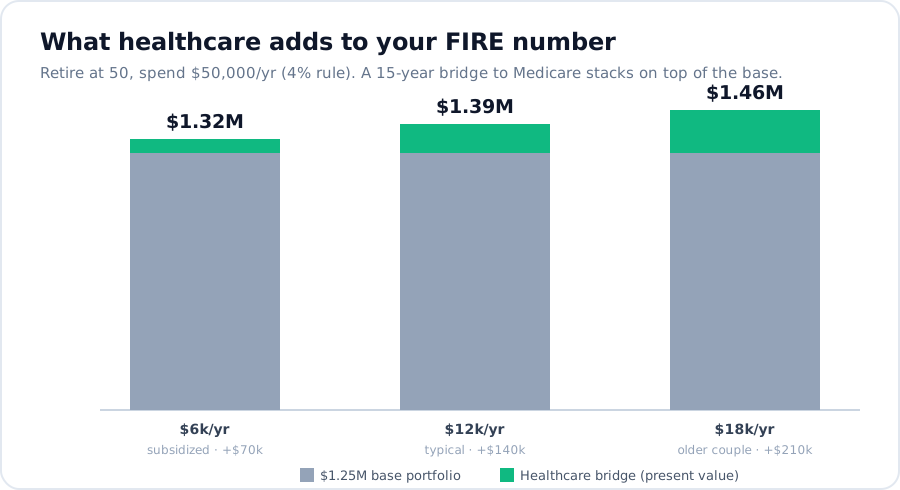
| Annual healthcare cost | Approx. 15-year bridge present value |
|---|---|
| $6,000 (subsidized) | +$70,000 |
| $12,000 (typical pre-subsidy) | +$140,000 |
| $18,000 (older couple) | +$210,000 |
A retiree spending $50,000 a year needs a $1,250,000 base portfolio at 4%. Retiring at 50 with a $12,000 annual healthcare estimate raises the target to roughly $1,390,000, because the calculator funds only the finite bridge through 65.
The ACA subsidy lever
Marketplace premium tax credits are based on your modified adjusted gross income (MAGI), not your net worth. MAGI is not the same as taxable income — it adds back things like tax-exempt interest and the untaxed part of Social Security, so a withdrawal that looks “tax-free” can still raise it. An early retiree living partly off a taxable brokerage and Roth contributions can keep MAGI low and qualify for large premium credits — sometimes cutting a $12,000 premium to a few thousand. Managing your income to control healthcare cost is a core early-retirement skill. Our ACA subsidies for FIRE guide and what counts toward ACA MAGI walk through exactly how to size that income target.
Ways to bridge to 65
- ACA Marketplace plan with income managed for subsidies — the most common route.
- A Barista FIRE job with benefits. Part-time work that includes employer coverage removes the healthcare line entirely.
- COBRA for up to 18 months after leaving a job — a stopgap, usually more expensive than a subsidized ACA plan.
- An HSA built up while working — triple-tax-advantaged money earmarked for medical costs.
Common mistakes
1. Leaving healthcare out of the FIRE number. A plan that ignores a finite healthcare bridge isn't really funded. It is one of the fixed costs a durable Lean FIRE number has to cover before the budget can be called lean.
2. Ignoring the income–subsidy link. Realizing a big capital gain in one year can wipe out your ACA subsidy and spike your premium. Plan withdrawals with that in mind.
Pre-Medicare healthcare FAQ
How much does pre-Medicare coverage actually cost?
It depends entirely on your age, state, and income. A full-price Marketplace plan for an older couple can run $12,000–$18,000 a year, but premium tax credits tied to your MAGI can cut that to a few thousand. Treat the figures in this article as illustrative planning estimates, not quotes — price actual plans for your ZIP code and ages.
Does a Roth withdrawal affect my ACA subsidy?
Qualified Roth IRA distributions don't count toward MAGI, which is part of why Roth balances are useful in a bridge. But before age 59½ only your contribution basis comes out tax- and penalty-free; earnings and recently converted amounts follow different rules. Don't assume every dollar from a Roth account is invisible to the subsidy formula — confirm the source of the withdrawal first.
What changes at 65 when Medicare starts?
At 65 you move from the Marketplace to Medicare, and the income game flips. Standard Part B and Part D premiums are flat, but high earners pay an income-related surcharge called IRMAA, based on the MAGI you reported two years earlier. So a year of large Roth conversions or capital gains at 63 can raise your Medicare premiums at 65 — worth modeling if you do aggressive Roth conversions during the bridge.
Can I still use an HSA after 65?
Yes — you can spend HSA funds on qualified medical costs at any age, including Medicare premiums and out-of-pocket costs. You just can't contribute to an HSA once you enroll in Medicare. See the HSA for FIRE guide for how to build one, and the HSA reimbursement strategy for how to let the balance grow and cash out old receipts later.
What to read next
Healthcare costs and ACA rules vary by state, age, and income, and can change. Figures here are illustrative estimates, not quotes. This article is educational and does not constitute financial or medical advice.