

An emergency fund and a FIRE portfolio are two different jobs, and counting one as the other quietly breaks a plan. Your emergency fund is cash set aside for surprises — a job loss, a $4,000 car repair, a medical bill — held somewhere safe and instantly available. Your FIRE portfolio is the invested engine, usually around 25 times your annual spending, whose growth and withdrawals are meant to fund the rest of your life. The first is money you hope to keep; the second is money you plan to spend down.
The mistake is treating the cash inside your net worth as if it were both. If your FIRE number is $1.25 million and $25,000 of that is your emergency fund, then spending the emergency fund on a new roof drops the engine to $1.225 million — and your 4% withdrawal falls from $50,000 to about $49,000. The emergency fund was never extra; it was load-bearing for a different reason. Keep the two buckets labeled separately.
Emergency fund vs FIRE portfolio at a glance
| Feature | Emergency fund | FIRE portfolio |
|---|---|---|
| Job | Absorb surprises without selling investments | Generate long-term retirement income |
| Where it lives | HYSA, money market, short Treasuries | Stocks and bonds (index funds), tax-advantaged accounts |
| Typical size | 3–6 months of expenses while working | ~25× annual spending (a 4% withdrawal rate) |
| Goal for the money | Stay stable and accessible — you hope not to touch it | Grow, then be drawn down over decades |
| Volatility you accept | Near zero | High — equities swing 30%+ in bad years |
Why mixing them breaks the math
The 4% rule and the FIRE number formula assume the whole portfolio is invested and working. When you fold an emergency fund into that number, you are double counting: the same dollars are supposedly both an untouchable safety net and part of the income engine. They cannot be both.
Holding too much cash inside the FIRE number causes the opposite problem. Cash earning 4% in a high-yield savings account lags a diversified portfolio over decades, so an oversized cash position is a real drag on long-run growth and on the size of portfolio you can build. The answer is not “more cash” or “less cash” in the abstract — it is giving each pile a defined job and sizing it for that job.
It is really three buckets, not two
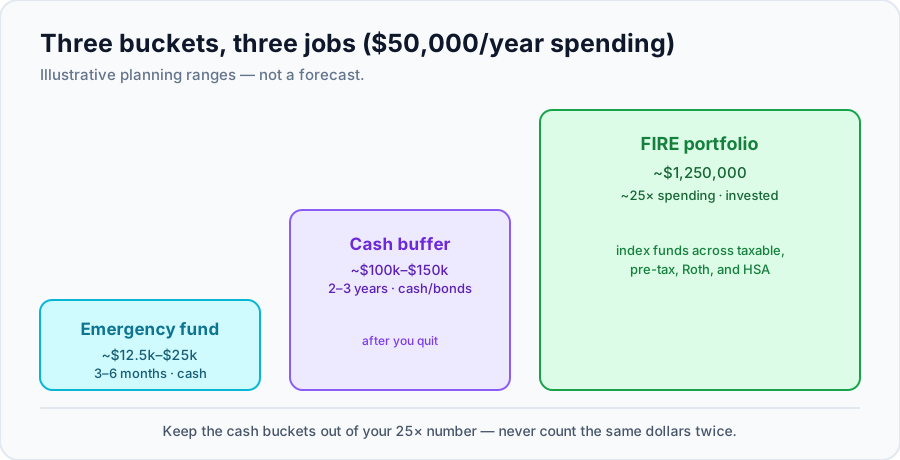
While you are still working, the picture is simple: an emergency fund of cash, plus an invested portfolio you are growing toward your FIRE number. Once you quit, a third job appears, because there is no paycheck to refill the emergency fund.
1. Emergency fund (cash for surprises)
Three to six months of expenses in a high-yield savings or money-market account, as the Consumer Financial Protection Bureau describes it. Its only job is to absorb a shock — a layoff, a busted transmission — without making you sell investments at a bad time. While you have earned income, this is your first priority, ahead of aggressive investing.
2. Cash buffer (cash for bad markets)
After you retire, you need a second cash layer for a different threat: sequence of returns risk. A FIRE cash buffer of 2 to 3 years of spending lets you stop selling stocks during a downturn and spend from cash instead. The order of returns in the first decade matters far more than the average, which is why this buffer exists separately from your emergency fund. See sequence of returns risk for the mechanics.
3. FIRE portfolio (the invested engine)
The big, invested piece — index funds across taxable, pre-tax, Roth, and HSA accounts — that grows and is drawn down over decades. This is the number the 4% rule describes, and it should stay mostly invested so it can do its job.
In retirement, the emergency fund and the cash buffer often blur together — both are short-term cash you can reach without selling. The key is that this cash sits outside or is clearly earmarked within your plan, never silently counted twice in your 25× number.
How much belongs in each
Numbers below assume a household spending $50,000 a year. They are illustrative planning ranges, not a forecast, and they ignore taxes and your personal risk tolerance.
| Bucket | Rule of thumb | At $50,000/year spending |
|---|---|---|
| Emergency fund (while working) | 3–6 months of expenses | ~$12,500–$25,000 |
| Cash buffer (after quitting) | 2–3 years of spending | ~$100,000–$150,000 |
| FIRE portfolio (invested) | ~25× spending at a 4% rate | ~$1,250,000 |
Notice the cash buffer is much larger than the working-years emergency fund. That is the part people miss: a safety net sized for a working household with a paycheck is not big enough to protect a portfolio that now has to survive a bear market with no new income coming in.
Common mistakes
- Double-counting cash in the FIRE number. If your emergency fund is part of your 25×, spending it shrinks the engine. Keep it labeled separately.
- Quitting with only a working-years emergency fund. Three to six months of cash does not protect against a multi-year downturn early in retirement. Build the larger cash buffer before you resign.
- Holding too much cash for too long. An oversized cash pile is a real drag on growth. Size each bucket for its job rather than hoarding cash out of anxiety.
- Investing the emergency fund for yield. Putting your safety net in stocks defeats the purpose — it may be down exactly when you need it.
Emergency fund vs FIRE portfolio FAQ
Is my emergency fund part of my FIRE number?
Treat it as separate. The FIRE number assumes the whole portfolio is invested and being drawn down. If you count an emergency fund inside it, spending that cash shrinks the income engine and quietly raises your effective withdrawal rate.
Should I keep an emergency fund after reaching FIRE?
Yes, but its role shifts. In retirement, the cash you hold is mostly a sequence-of-returns buffer of 2 to 3 years of spending, which is far larger than the 3 to 6 months you held while working. The job changes from “cover a job loss” to “avoid selling stocks in a downturn.”
Where should I keep the cash?
Somewhere stable and accessible: a high-yield savings account, a money-market fund, or short Treasuries. The point of this money is availability and stability, not return, so it should not sit in stocks.
How much cash is too much?
There is no single number, but cash well beyond your emergency fund plus a 2 to 3 year buffer is usually a long-term drag on growth. Size each bucket for its job, then keep the rest invested.
What to read next
This article is educational and does not constitute financial, tax, or investment advice. Illustrative dollar figures assume a fixed spending level and ignore taxes and market paths. Verify current details before making decisions.