

Hitting your FIRE number is step one, not the finish line. Most people who run into trouble in early retirement do not fail because their portfolio was too small. They fail because they quit before building a healthcare bridge, a way to reach retirement money before age 59½, a written withdrawal plan, and a cash buffer for a bad first few years. This FIRE checklist before quitting your job walks through the five things that actually have to be in place.
Do not hand in your notice until you can check all five: (1) a real health-insurance quote at your planned income, (2) a funded bridge to age 59½, (3) a written order for which account funds which year, (4) no high-interest debt, and (5) at least 2 to 3 years of spending held in cash and bonds. If even one is missing, you have a number — not yet a plan.
The five-gate FIRE checklist before you quit
Think of these as gates, not a wish list. Each one closes off a specific way an early retirement can break. If you cannot clear a gate, that is the work to finish before your last day, not after.
| Gate | What “done” looks like | What breaks if you skip it |
|---|---|---|
| 1. Healthcare | A real marketplace quote at your projected retirement-year income | An unbudgeted $10,000–$25,000/year premium shock |
| 2. Account access | A funded bridge to age 59½ from accessible money | Forced 10% early-withdrawal penalties |
| 3. Withdrawal plan | A written, year-by-year source and target income | Ad-hoc decisions that wreck subsidies and tax brackets |
| 4. Debt | No high-interest (credit-card / personal-loan) balances | A guaranteed negative return no safe withdrawal rate beats |
| 5. Cash buffer | 2–3 years of spending in cash / short bonds | Selling stocks low into an early bear market |
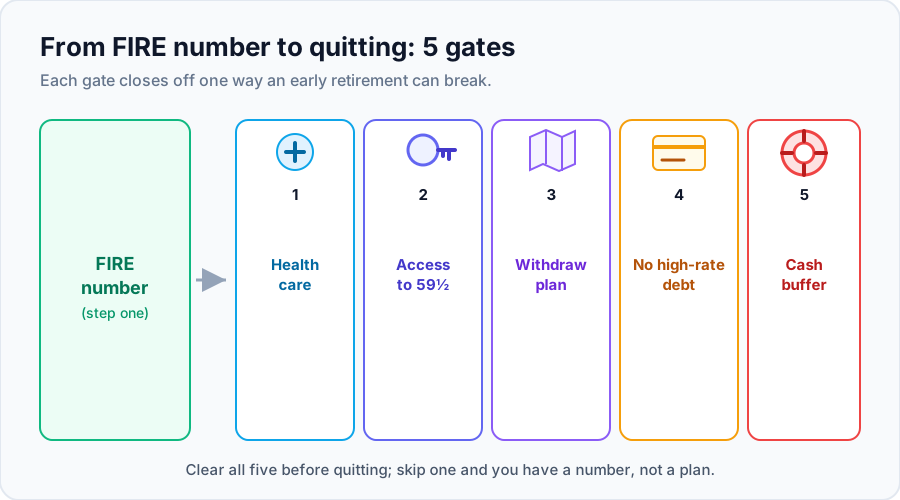
This checklist sits one level below your target. If you have not finalized that target yet, the FIRE number formula is the place to start, and the broader list of biggest FIRE planning mistakes explains why a single number is never the whole plan.
Gate 1: Price your health insurance for real
In 2026, healthcare is the highest-stakes line item on the whole checklist, and it changed. The enhanced premium tax credits enacted in 2021 expired on December 31, 2025 and, as of June 2026, have not been renewed. For 2026 marketplace coverage that means the old 400% of the federal poverty level subsidy cliff is back under current law: earn one dollar over the threshold and you can lose the entire premium tax credit. The Affordable Care Act’s sliding-scale credit and the return of the cliff are described in KFF’s 2026 marketplace premium analysis.
For an early retiree, modified adjusted gross income (MAGI) is now a number you actively manage, because it sets your subsidy. The fix is not guesswork. Before you resign, go to HealthCare.gov or your state exchange, use the “see plans and prices” preview, and enter your projected retirement-year MAGI — not your current salary. Premiums are age-rated and vary a lot by county, so a national average tells you almost nothing about your actual cost.
Get two quotes: one at your planned income, and one a dollar over the cliff, so you can see exactly what the downside looks like. If you are leaving a job, losing employer coverage is a qualifying event that opens a special enrollment window on the marketplace and on a spouse’s plan — which is often the cheapest bridge of all. For the full picture of bridging the gap from your quit date to age 65, see our guide on health insurance before Medicare and the deeper look at the 2026 ACA subsidy cliff.
Remember that Medicare at 65 is not free and not automatic if you are not yet claiming Social Security. You must enroll during your initial enrollment period or face lifelong late penalties, and per the CMS 2026 fact sheet, the standard Part B premium is $202.90 per month for 2026.
Gate 2: Build a bridge to age 59½
Most retirement money sits in accounts you cannot freely tap before 59½. Withdraw early from a traditional 401(k) or IRA and you generally owe ordinary income tax plus an additional 10% tax, unless a specific exception applies. The IRS list of exceptions to the early-distribution tax is the rulebook here. Quit at 45 and you have a 14-year access gap to solve before that money is freely available.
There are five common tools, and most plans use more than one:
- Taxable brokerage. The simplest bridge — no age limits, no penalties, only capital-gains tax on realized gains. This usually funds the early years.
- Roth IRA contribution basis. Your direct Roth contributions (not earnings, not conversions) can be withdrawn anytime, tax- and penalty-free. This is your emergency liquidity layer.
- Roth conversion ladder. Each converted amount becomes penalty-free after five tax years. The catch: you must fund years one through five from somewhere else while the ladder seasons. See our Roth conversion ladder walkthrough.
- Rule 72(t) / SEPP. Substantially equal periodic payments let you tap an IRA before 59½, but you are locked in for the longer of five years or until 59½, and modifying the schedule triggers retroactive penalties.
- Rule of 55. If you separate from service in or after the year you turn 55, you can withdraw from that employer’s 401(k) penalty-free — but it does not apply to IRAs and vanishes if you roll the 401(k) out, so leave the money in the plan if you will use it.
The red flag here is having all your money in pre-tax accounts with no accessible bridge. A conversion ladder takes five years to season and 72(t) locks you in, so if you cannot cover the gap years from taxable or Roth-basis money, you will be forced into penalties.
Gate 3: Write down your withdrawal plan
The years between quitting and the start of Social Security and required minimum distributions are usually the lowest-income years of your life. That window is valuable: it is where 0% long-term capital-gains harvesting and low-bracket Roth conversions live. But you can only use it on purpose if you have written down which account funds each year and what your target MAGI is.
There is a real conflict to resolve here. The same low MAGI that maximizes your ACA subsidy also limits how much you can convert to Roth in that year — you usually cannot do both aggressively at once. So plan which years are “subsidy years” and which are “conversion years.” A common pattern for couples is to keep MAGI low for subsidies until both reach Medicare at 65, then convert aggressively in the 65-to-73 window before RMDs begin. Our guide to the tax-efficient withdrawal order for early retirement shows why the textbook “taxable, then traditional, then Roth” order often costs money, and how MAGI, IRMAA, and conversions reshape it.
If you cannot state which account pays for year one and roughly what your target income is, you do not yet have a plan — you have a balance.
Gate 4: Clear high-interest debt
Carrying credit-card or other high-rate debt into early retirement is a guaranteed negative return that no safe withdrawal rate can outrun. A balance charging 22% interest is a far more certain drag than a stock portfolio is a certain gain. Clear it before your last paycheck, while you still have earned income to throw at it.
A low fixed-rate mortgage is a different question with no universal answer. Paying it off lowers your required spending, which lowers both your FIRE number and your MAGI — a real advantage for an ACA-optimizing early retiree. Keeping a cheap mortgage preserves liquidity and can be mathematically optimal if the rate is below your expected portfolio return. Decide deliberately; just do not confuse a 3% mortgage with 22% credit-card debt.
Gate 5: Fund a 2 to 3 year cash buffer
The real portfolio killer for early retirees is not low average returns — it is the order of returns. Michael Kitces’ analysis of safe withdrawal rates found a correlation of about 0.79 between real stock returns in the first decade of retirement and the rate a portfolio can sustain — the early years matter far more than the long-run average. Hit a bear market in years one and two while you are selling shares to live on, and those shares never participate in the recovery.
The front-line defense is a cash buffer: 2 to 3 years of spending in cash, short Treasuries, or a money-market fund, so you can pause selling stocks during a downturn and spend from cash instead. With short-term rates near 4% in early 2026, the cost of holding that buffer is modest. Pair it with a written bear-market plan — which bucket you draw from in a 30% drawdown, what discretionary spending you cut — decided in calm markets, before you need it. Our deep dives on sequence of returns risk and the right size for a FIRE cash buffer cover the tradeoffs.
The 30/60/90-day pre-quit timeline
Once the five gates are within reach, the last 90 days are about sequencing, so there is zero gap in coverage and cash on your last day.
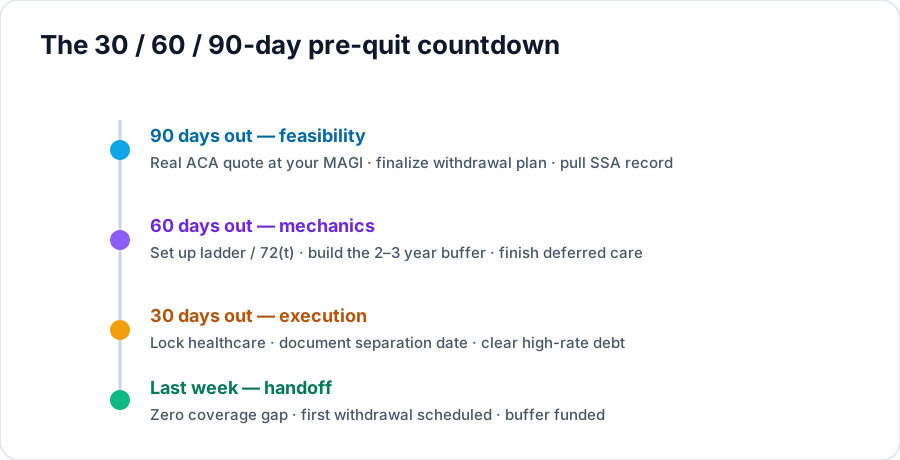
- 90 days out: Run a real ACA quote at your projected MAGI and price the cliff. Finalize the written withdrawal plan. If you are 55+ and will use the Rule of 55, do not roll your 401(k) to an IRA. Pull your Social Security earnings record and re-estimate with zero-income years. Verify the cash buffer. Max this year’s 401(k) and HSA while you still have earned income.
- 60 days out: If using a conversion ladder, plan your first conversion for early in the first full retirement year so the five-year clock starts. If using 72(t), split your IRA so only the needed slice is committed. Get deferred medical, dental, and vision care done while still on employer insurance. Rebalance to your retirement allocation and set up the buckets.
- 30 days out: Lock the healthcare decision — marketplace plan ready to elect, COBRA as a backup, or a spouse’s plan. Confirm the exact last day of employer coverage. Document your separation date in writing (it matters for the Rule of 55). Settle any high-interest debt. Bank any final bonus, RSU, or PTO payout and account for it in this year’s MAGI.
- Last week: Elect or schedule coverage so there is no gap. Confirm the first withdrawal is set up and the buffer is funded. Update beneficiary designations. Re-read your written bear-market plan, and take a breath.
Do not quit yet if…
These are the red flags that mean the plan is not ready, even if your portfolio balance hit the target. They line up with the deeper FIRE planning mistakes that sink otherwise solid plans:
- No healthcare quote. In 2026, an unpriced healthcare line can be $20,000+ a year you never budgeted. This is the most common 2026 failure mode.
- No accessible bridge to 59½. If you cannot fund the gap years from taxable or Roth-basis money, you will be forced into penalties.
- No written withdrawal plan. Ad-hoc decisions wreck subsidies and bracket management.
- High-interest debt remaining. Clear it first.
- A dependent with no contingency plan. Kids, a non-working spouse, or an aging parent without a funded plan turns one surprise into a portfolio crisis.
- The plan only works on optimistic returns. If your spreadsheet needs 8 to 10% to survive, stress-test it at 0% real for the first decade instead.
- No cash buffer. Without 2 to 3 years in cash, an early bear market forces you to sell stocks low.
The opposite trap is just as real: if every gate above is green and you still keep adding “one more year,” you may be paying for certainty you already have. See one more year syndrome for how to tell a genuine gap from fear.
Stress-test your number before you resign
Before committing, rebuild your target with healthcare, taxes, and a lower withdrawal rate in view, then test it against a weak first decade. The point is not a perfect forecast — it is to find which assumptions actually control whether you can quit.
FIRE pre-quit checklist FAQ
What should I check before quitting my job for FIRE?
Confirm five things: a real health-insurance quote at your projected income, a funded way to reach retirement money before 59½, a written year-by-year withdrawal plan, no high-interest debt, and 2 to 3 years of spending in cash or short bonds. Reaching your number is necessary but not sufficient.
How much cash should I have before early retirement?
A common range is 2 to 3 years of spending held in cash, short Treasuries, or a money-market fund. The goal is to avoid selling stocks during an early downturn, which is the most damaging thing an early retiree can do.
Can I retire before 59½ without penalties?
Yes, using tools like a taxable brokerage account, Roth contribution basis, a Roth conversion ladder, Rule 72(t) payments, or the Rule of 55. Each has rigid rules, and the conversion ladder and 72(t) require you to fund the first several years from other accessible money.
Why is healthcare the biggest 2026 FIRE risk?
The enhanced ACA premium tax credits expired at the end of 2025 and, as of June 2026, have not been renewed, so the 400%-of-poverty subsidy cliff is back under current law. An early retiree who lets income drift over the cliff can lose the entire premium tax credit, which can mean thousands of dollars in a single year. Always re-verify the current rules before you act.
What to read next
This article is educational and does not constitute financial, tax, or investment advice. Tax and healthcare rules — especially 2026 ACA subsidy rules — can change, so verify current details with HealthCare.gov, the IRS, and a licensed advisor before making decisions.