

Sequence of returns risk is the danger that the order of your investment returns — not just their long-run average — decides whether your money lasts. Contributions can soften its effect while you are saving, but withdrawals reverse that advantage the moment you retire and start selling shares to live on. A bad first decade can break a FIRE plan whose average return would have been more than enough.
For early retirees the stakes are higher than for a traditional 65-year-old, because the 4% rule was built for a 30-year retirement, not the 50 or 60 years a 35-year-old needs. The fix is not a perfect withdrawal number. It is structure and flexibility: a modestly conservative starting rate, spending you can cut after bad years, a bond tent around your retirement date, and the option of part-time income.
Why the order of returns matters when you withdraw
While you are contributing, continued purchases during a crash buy more shares cheaply and can improve the eventual recovery. Once you retire and flip from buying to selling, the logic inverts. Now a crash can force you to sell shares to cover spending, permanently reducing how many shares participate in the rebound.
With no withdrawals, order is irrelevant. A portfolio that earns +15%, −10%, and +25% ends at the same value no matter which year comes first, because multiplication is commutative. Add a fixed withdrawal each year and that symmetry collapses. The same average return can leave one retiree comfortable and another running out of money.
Here are two portfolios that start at $1,000,000, withdraw $50,000 every year, and earn the exact same six annual returns — just in opposite order. One gets the good years first; the other gets them last. The average return is identical.
Same returns, same withdrawals, opposite order — $1M start, $50k/yr
After only six years the bad-first portfolio is about $85,000 behind, despite earning the same average return and taking the same withdrawals. Stretch that over a 40- or 50-year retirement and a bad start can be the difference between dying with a surplus and running out at 80.
The portfolio-size effect: why early losses are permanent
The mechanism has a name — the portfolio-size effect. A percentage decline does the most damage early in retirement, when the portfolio is at its largest. Suppose you retire on $1,000,000 and plan to spend $40,000 a year, a textbook 4% withdrawal. A 30% drop in year one takes the portfolio to $700,000. Your planned $40,000 has not changed, but it is now a much bigger bite of a smaller pie.
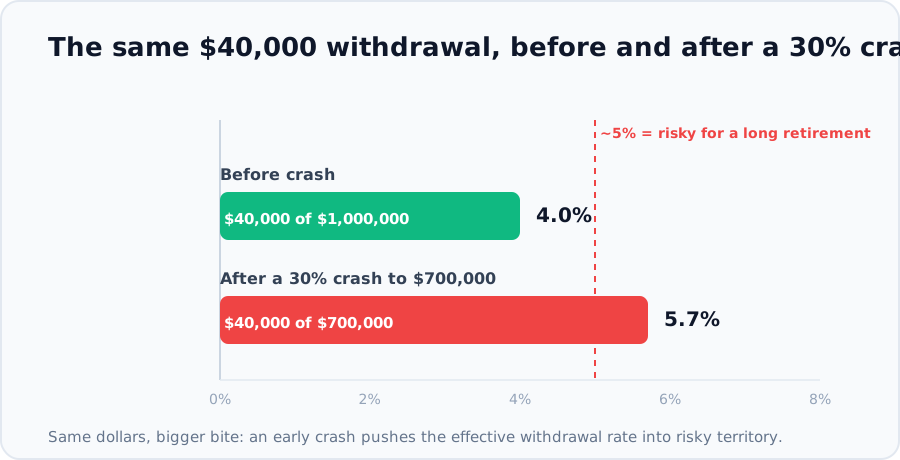
That same $40,000 is now roughly 5.7% of $700,000 instead of 4% of $1 million — a rate the research considers risky even for a 30-year retiree, let alone a 50-year one. (The exact figure shifts slightly depending on whether you withdraw before or after the drop, but the lesson is identical.) If a rigid plan holds you to $40,000 plus inflation regardless, you keep selling an elevated fraction of a depressed portfolio. In year one you might sell 100 shares at $400; two years later, at a lower price, you must sell far more to raise the same $40,000. Fewer shares remain to ride the recovery.
Why the first ten years decide everything
Researchers who study withdrawal rates have found that the first decade of retirement is the most decisive window. Michael Kitces' analysis found a correlation of about 0.79 between first-decade real stock returns and the safe withdrawal rate. In plain terms: one bad year can be survivable, but a bad decade at the start is what puts a plan under sustained pressure.
That is why advisors talk about the retirement red zone — roughly the five years before and five years after your retirement date. Your portfolio is at its largest, and you have the least time to earn your way out of a hole. Everything in your defensive toolkit is aimed at this window.
Why early retirees are more exposed
The 4% rule comes from William Bengen's 1994 research and the Trinity Study, both of which tested a 30-year retirement — appropriate for someone retiring at 65, but not for a 40-year-old who may need 50 years of income. Three forces stack against the early retiree:
- More chances for a bad sequence. A longer horizon means more withdrawals taken against the original base and more opportunities for an early crash to do permanent damage.
- A lower safe withdrawal rate. Kitces found that stretching the horizon from 30 to 45 years pushes the safe rate down from about 4.1% toward a 3.5% floor. Early Retirement Now argues for 3.25%–3.5% over 50–60 years.
- The first decade dominates. A longer retirement gives a bad early sequence more time to compound against you before the good years arrive.
The numbers are sobering. Vanguard's FIRE research found that a fixed 4% inflation-adjusted withdrawal on a US-only 50/50 portfolio succeeded about 82% of the time over 30 years but only 36% over 50 years. The same modeling showed that global diversification alone lifted the 50-year success rate to 56.3%, and layering a dynamic spending rule on top pushed it to 90.3%. For the deeper dive on the rule itself, read whether the 4% rule is still safe and the 4% rule explained.
There is a silver lining unique to early retirees, though: they are young, employable, and adaptable. That is exactly why flexibility is so powerful for them.
Six ways to fight sequence of returns risk
No single trick neutralizes sequence risk. The durable plans layer several defenses, almost all of which work by the same logic — sell fewer shares when prices are low.
| Defense | How it fights sequence risk | Main trade-off |
|---|---|---|
| Conservative starting rate | 3.25%–3.5% leaves a buffer so early losses don't blow past safe levels | Requires a larger portfolio (≈29–31× spending) |
| Flexible spending | Withdrawals fall automatically after bad years, preserving shares | Income is volatile; you need expenses you can cut |
| Bond tent | More bonds during the red zone shields the largest-balance years | Counterintuitive; you own more stocks as you age |
| Cash buffer | Spend cash instead of selling stocks in a downturn (mostly behavioral) | Too much cash creates return-killing drag |
| Global diversification | Adds sources to draw from when US stocks are down | You may underperform a hot US-only run |
| Part-time income | Every dollar earned is a share you don't sell low — the strongest lever | Depends on finding reliable work, ideally with healthcare |
Part-time income deserves special mention. For a young retiree it is arguably the most powerful defense of all, because earning even $15,000–$20,000 in a down year can eliminate portfolio withdrawals exactly when selling would hurt most. That is the core idea behind Barista FIRE.
Lean FIRE is more fragile than Fat FIRE
The same sequence risk hits both, but resilience depends on the gap between what you spend and what you must spend. A Lean FIRE budget is mostly essentials — housing, food, healthcare — so there is little discretionary "fat" to trim in a downturn. A flexible strategy only helps if you can actually flex. A Fat FIRE retiree spending $120,000 can absorb a 30% cut and still live comfortably on $84,000; a Lean retiree at $35,000 cannot. Our Lean FIRE vs Fat FIRE comparison explains why the same portfolio carries very different real-world risk depending on your fixed-cost ratio.
Worked example: a 30% crash in year one
Start with $1,000,000 and a planned $40,000 (4%) withdrawal. Stocks fall 30% early, taking the portfolio to about $700,000.
| Response | Withdrawal | Rate on $700,000 | What it does |
|---|---|---|---|
| Hold the plan | $40,000 | ≈ 5.7% | Sells the most depressed shares; deepest sequence-risk trap |
| Cut spending 10% | $36,000 | ≈ 5.1% | Leaves $4,000+ invested to recover; preserves shares for the rebound |
A 10% cut sounds painful, but it is temporary and it directly attacks the problem. Repeated across a multi-year downturn, the preserved shares are exactly the ones that participate in the recovery. This is the entire logic behind guardrails and dynamic spending — and it is why Morningstar's retirement-income research found that retirees willing to tolerate some fluctuation in spending could start near 6% instead of the fixed-rate 3.9%.
Common mistakes that amplify sequence risk
- Treating the 4% rule as guaranteed. It was tested on 30-year retirements with US data from an unusually strong century — not a 50-year plan.
- Refusing to cut spending early. Small, temporary cuts in the first bad years beat large forced cuts after the damage is done.
- Holding a giant cash pile "just in case." Beyond a modest buffer, cash drag usually hurts more than it helps. See our cash buffer guide.
- Ignoring the red zone. Retiring with 90% equities into an expensive market maximizes exposure right when you can least afford a crash.
- Building a plan that only works on average. A plan that survives the bad sequence is the one worth having — this is one of the biggest FIRE planning mistakes.
Stress-test your withdrawal rate
Don't run only a 4% scenario. Compare 4%, 3.5%, and 3.25% and see how much extra portfolio each conservative rate demands — that margin is your first line of defense against a bad sequence.
Frequently asked questions
What is sequence of returns risk in simple terms?
It is the risk that the order of your returns — not just the average — determines whether your money lasts. It only matters while you are withdrawing, because selling shares during an early downturn permanently shrinks the base that later recoveries act on.
Why does it matter more for early retirees?
The 4% rule was tested on 30-year retirements. A 40- or 50-year FIRE horizon gives a bad early sequence far more time to compound against you, which is why research points to a lower starting rate near 3.25%–3.5% for very long retirements.
How do I protect against sequence risk?
Layer defenses: start at a conservative rate, keep spending flexible so it falls after bad years, build a bond tent around your retirement date, hold a modest cash buffer, diversify globally, and line up part-time income before you need it.
Does the very first year matter most?
Not as much as the first decade. A single bad year is survivable; research shows the first ten years of real returns are the strongest predictor of whether a withdrawal plan succeeds.
Is a cash buffer enough on its own?
No. A modest cash reserve helps you avoid panic-selling, but studies find large cash buffers usually hurt long-run outcomes through cash drag. Pair a small buffer with flexible spending and asset allocation instead.
What to read next
This article is educational and does not constitute financial advice. The reversed-sequence example is illustrative and not a forecast. Modeled success rates depend entirely on their assumptions, rest on historical or simulated data, and do not predict future results.