

ACA MAGI for FIRE is your adjusted gross income plus a few add-backs: tax-exempt interest, the non-taxable part of Social Security, and excluded foreign income. For an early retiree, this number is a central input in the Marketplace premium tax credit; age, location, household size, and the local benchmark plan also affect the result. Two households can both spend $60,000 a year, yet one reports an ACA MAGI of $30,000 and the other $90,000, simply because of which accounts they withdraw from.
That is the whole game before age 65. You bridge to Medicare on your own, you buy a Marketplace plan, and the price you actually pay turns on a number you can largely steer. This guide defines ACA MAGI precisely, shows what raises it and what does not, and explains the levers a FIRE household uses to keep it in a chosen range.
What ACA MAGI actually means
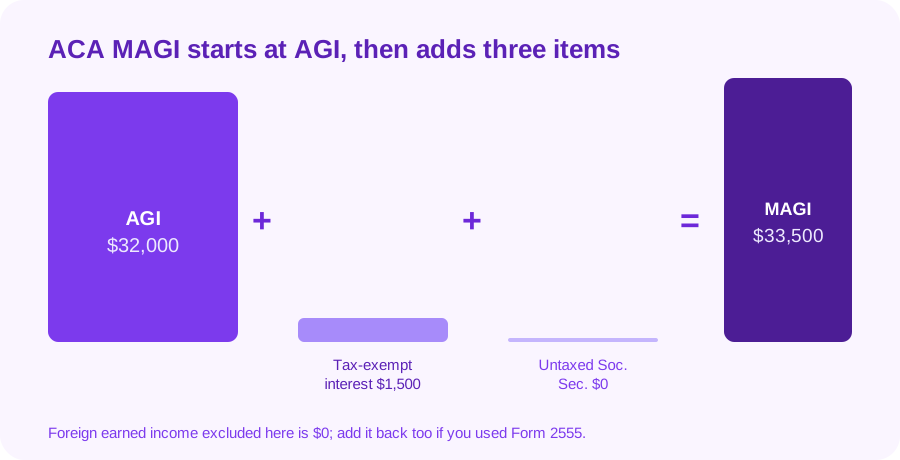
Modified adjusted gross income is not a line on your tax return. It is a calculation that starts with adjusted gross income (AGI, line 11 of Form 1040) and adds back three items. According to HealthCare.gov's income guidance and the IRS MAGI worksheet for the premium tax credit, the formula is:
For most FIRE households who are not earning abroad and not yet collecting Social Security, ACA MAGI is nearly identical to AGI. The add-backs only bite in specific situations — for example, municipal-bond interest you thought was "tax-free," or the portion of Social Security that escapes income tax but is still counted in full for the Marketplace.
This is not the same MAGI used for Roth or IRA rules
A common and expensive mistake: assuming there is one MAGI. There is not. The IRS uses different MAGI definitions for Roth IRA contribution limits, traditional IRA deductibility, the net investment income tax, and education credits — each adds back a different set of items. The ACA premium tax credit has its own definition, fixed in 26 U.S.C. § 36B. When you read about "MAGI" in a Roth article, do not assume it transfers to your Marketplace application.
What counts toward ACA MAGI, and what does not
The practical skill is sorting your cash sources into two buckets: dollars that raise MAGI and dollars that usually do not. This cheat sheet covers the sources a FIRE household typically draws on.
| Usually raises ACA MAGI | Usually does not raise ACA MAGI |
|---|---|
| Traditional 401(k) and IRA withdrawals | Cash savings you spend down |
| Taxable Roth conversions | Cost basis returned from a taxable sale |
| Capital gains, short- and long-term (the gain only) | Qualified Roth IRA and Roth 401(k) withdrawals |
| Dividends and interest, including tax-exempt interest | Qualified HSA reimbursements for medical costs |
| Net rental, royalty, and self-employment income | Gifts, inheritances, and loan proceeds |
| Social Security, including its non-taxable portion | SSI, child support, and veterans' disability |
Two of these surprise people. First, automatically reinvested dividends still count — you never saw the cash, but you still receive a 1099-DIV and it still enters MAGI. Second, HealthCare.gov states explicitly that qualified distributions from a designated Roth account are not counted — which is what makes Roth money so powerful in early retirement.
From a taxable brokerage sale, only the gain counts
This is the most useful detail for FIRE. If you sell $15,000 of an index fund and $13,000 of that was your original cost basis, only the $2,000 gain enters MAGI — the $13,000 is a tax-free return of money you already paid tax on. The capital-gains line on Form 1040 is the net of all realized gains and losses, so harvesting a loss elsewhere can shrink it further.
The trap sits next to it: even a long-term gain taxed at the federal 0% rate counts in full toward ACA MAGI. You can owe $0 in capital-gains tax and still lose thousands in subsidies from the same sale. Treating "low tax" as "low MAGI" is one of the costliest errors in early-retirement healthcare planning. For the full ordering of which account to tap first, see our tax-efficient withdrawal order guide.
Same spending, very different MAGI
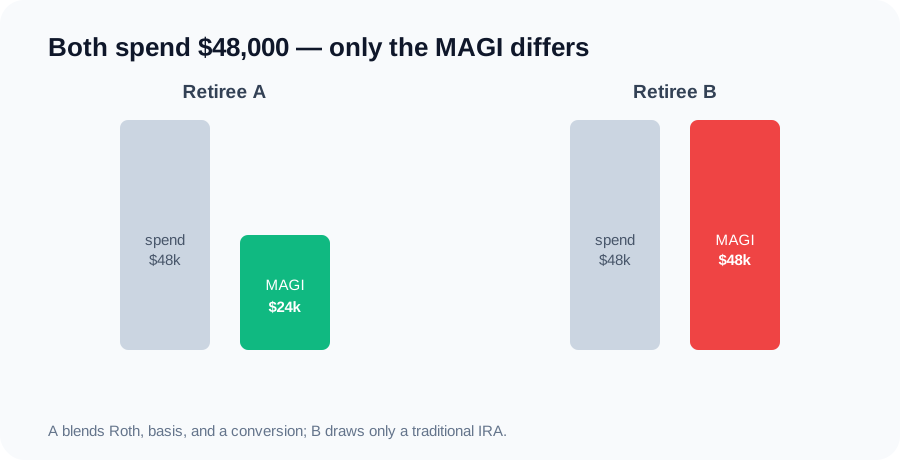
Here is why account mix matters more than total spending. Two single early retirees each need $48,000 of cash this year. Their MAGI lands in completely different places.
| Cash source | Retiree A: cash flow | A: MAGI | Retiree B: cash flow | B: MAGI |
|---|---|---|---|---|
| Traditional IRA withdrawal | $10,000 | $10,000 | $48,000 | $48,000 |
| Roth conversion (not spent) | $0 | $10,000 | $0 | $0 |
| Taxable sale: cost basis | $14,000 | $0 | $0 | $0 |
| Taxable sale: long-term gain | $4,000 | $4,000 | $0 | $0 |
| Qualified Roth withdrawal | $20,000 | $0 | $0 | $0 |
| Total | $48,000 | $24,000 | $48,000 | $48,000 |
Same lifestyle, same $48,000 spent. But Retiree A reports about $24,000 of MAGI — roughly 153% of the 2026 federal poverty level for one person — while Retiree B reports $48,000, or about 307% FPL. Retiree A may qualify for strong cost-sharing reductions on a Silver plan, while Retiree B does not. The difference is not wealth. It is which buckets they built before retiring.
The levers that move ACA MAGI
Once you know what counts, the strategy is straightforward: build the accounts in advance, then choose your withdrawal mix each year to hit a MAGI target.
Roth money lowers MAGI; Roth conversions raise it
Roth IRA contribution basis can fund spending without touching MAGI. Other Roth IRA distributions also avoid MAGI to the extent they are not taxable, but conversion and earnings access rules still matter. The catch is the conversion itself: a Roth conversion is taxable income in the year you do it, so it adds to MAGI dollar for dollar. The classic Roth conversion ladder is how FIRE households reach pre-tax money before 59½ — but every dollar converted competes with your ACA subsidy that year. That tension is the core trade-off of the whole strategy.
Above-the-line deductions cut MAGI directly
HSA contributions and pre-tax retirement contributions reduce AGI directly, so they reduce MAGI too. For a FIRE household with some self-employment or part-time income, maxing an HSA (a triple-tax-advantaged account) is one of the few ways to lower MAGI after the year is underway. It is a rare lever that helps both your taxes and your subsidy at the same time.
Cost basis and loss harvesting shrink the gain
Because only the gain counts, keeping accurate cost-basis records and harvesting losses lets you raise cash from a taxable account with minimal MAGI impact. Tax-loss harvesting offsets realized gains and up to $3,000 of ordinary income per year, with the rest carried forward. Years of carried-forward losses can let you sell appreciated shares while adding little or nothing to MAGI. Sloppy basis records do the opposite — if you cannot prove what you paid, more of the sale can be treated as gain.
Why a MAGI target, not just low income, is the goal
The aim is not to report the lowest possible income. It is to land your MAGI in the band that fits your situation, because both ends carry risk:
- Too high — above 400% FPL in 2026, you can lose the entire premium tax credit at once. This is the 2026 subsidy cliff, and a single year-end mutual-fund distribution can push you over it.
- Too low — below roughly 138% FPL in a Medicaid-expansion state, you may be routed to Medicaid instead of a subsidized Marketplace plan. If you want to keep a Marketplace plan, a deliberate Roth conversion can raise MAGI back into the ACA range.
- Just right — under 250% FPL unlocks cost-sharing reductions, and under 200% FPL unlocks the strongest tier. For many FIRE households, holding MAGI here beats squeezing in an extra Roth conversion.
Each November or December, simulate your full-year MAGI with last year's tax software, then decide how much to convert or harvest before December 31. The KFF Health Insurance Marketplace Calculator lets you price the subsidy at different MAGI levels with your real age and ZIP code.
ACA MAGI for FIRE FAQ
Is MAGI a line on my tax return?
No. MAGI for the premium tax credit is a calculation: start with AGI from Form 1040, then add tax-exempt interest, the untaxed portion of Social Security, and any excluded foreign earned income. The Marketplace and Form 8962 use that result.
Do Roth IRA withdrawals raise ACA MAGI?
Roth IRA contribution basis does not raise ACA MAGI. Other Roth IRA distributions avoid MAGI only to the extent they are not taxable under the Roth rules. A Roth conversion is different — the taxable converted amount raises AGI and therefore MAGI in the year you convert.
Does selling stock add my whole sale to MAGI?
No. Only the realized gain counts. If you sell $15,000 and $13,000 was your cost basis, just the $2,000 gain enters MAGI. The capital-gains figure is also netted against any realized losses for the year.
Why does non-taxable Social Security still count?
ACA MAGI specifically adds back the portion of Social Security benefits that is not subject to income tax. So even benefits you do not pay tax on still reduce the room you have for Roth conversions or capital gains before hitting a target.
Can I lower MAGI after the year has started?
A few levers still work mid-year or even after year-end: HSA contributions (until the tax deadline), deductible IRA or solo-401(k) contributions if you have earned income, and harvesting capital losses to offset gains. Most other moves must be planned before December 31.
What to read next
This article uses federal MAGI rules and 2026 Marketplace guidelines. Actual eligibility, plan costs, and poverty-level thresholds vary by household, state, county, and future policy changes, and Alaska and Hawaii use higher guidelines. This content is educational and is not tax, legal, medical, or financial advice.