

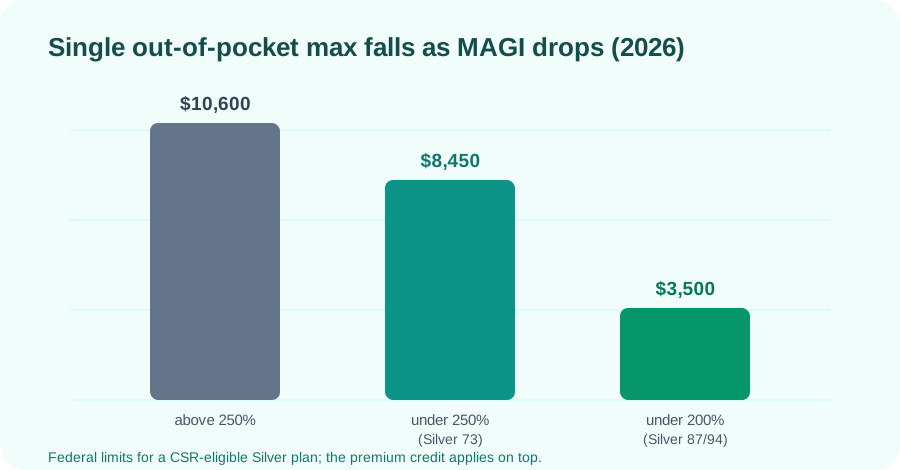
Cost-sharing reductions are a second ACA discount that early retirees routinely overlook: they cut your deductible, copays, and out-of-pocket maximum — but only on a Silver plan, and only when your income falls under 250% of the federal poverty level. For a single FIRE household, that ceiling is about $39,125 of MAGI in 2026. Stay under it and a Silver plan's out-of-pocket max can fall from $10,600 to as low as $3,500.
Most ACA coverage focuses on premium tax credits — the help that lowers your monthly premium. Cost-sharing reductions (CSR) are different and easy to miss because they work quietly, lowering what you pay when you actually use care. For a FIRE household with the flexibility to control MAGI, CSR can be worth more than squeezing in one more Roth conversion. And unlike the enhanced premium credits, CSR did not expire.
What cost-sharing reductions actually do
A standard Silver plan has an actuarial value (AV) of about 70%, meaning it covers roughly 70% of the average enrollee's costs. CSR quietly upgrades that Silver plan to a richer one at no extra premium. According to HealthCare.gov's definition of cost-sharing reductions, the boost scales with income:
| Income (MAGI) | Silver plan becomes | Roughly covers | vs. standard Silver (70%) |
|---|---|---|---|
| 100–150% FPL | Silver 94 (CSR) | ~94% of costs | Better than a Platinum plan |
| 150–200% FPL | Silver 87 (CSR) | ~87% of costs | Roughly Gold-level |
| 200–250% FPL | Silver 73 (CSR) | ~73% of costs | A modest bump |
| Above 250% FPL | Standard Silver | ~70% of costs | No CSR |
Notice the two cliffs inside this table. Crossing 250% FPL ends CSR entirely. Crossing 200% FPL drops you from the strong Silver 87 to the modest Silver 73. Those breakpoints are where MAGI control pays off the most.
The out-of-pocket maximum is where it shows up
The clearest way to see CSR's value is the out-of-pocket maximum — the most you can pay in a bad health year before the plan covers 100% of covered in-network essential health benefits. Under the final CMS 2026 Marketplace rule, the standard maximum is $10,600 for one person and $21,200 for a family. CSR-eligible Silver plans cap it far lower:
| Income (MAGI) | 2026 out-of-pocket max (single) | 2026 out-of-pocket max (family) |
|---|---|---|
| 100–200% FPL (Silver 94/87) | $3,500 | $7,000 |
| 200–250% FPL (Silver 73) | $8,450 | $16,900 |
| Above 250% FPL (standard) | $10,600 | $21,200 |
For a single early retiree, dropping from above 250% FPL to under 200% FPL cuts the worst-case year from $10,600 to $3,500 — a $7,100 swing in downside protection, with no change in premium beyond the usual credit.
Where the CSR income lines fall in 2026
Because CSR is tied to FPL, the dollar thresholds depend on household size. Using the 2025 poverty guidelines that apply to 2026 coverage in the contiguous states, here are the key single and couple lines:
| Threshold | 1 person | 2 people |
|---|---|---|
| 200% FPL (Silver 87 ceiling) | $31,300 | $42,300 |
| 250% FPL (CSR ceiling) | $39,125 | $52,875 |
So a single FIRE household choosing between a $40,000 and a $31,000 MAGI year is really choosing between standard Silver and Silver 87 — a decision worth thousands in a high-cost year. To see exactly which cash sources you can use to land under these lines, read what counts toward ACA MAGI.
Silver loading: why Silver, Bronze, and Gold prices look strange
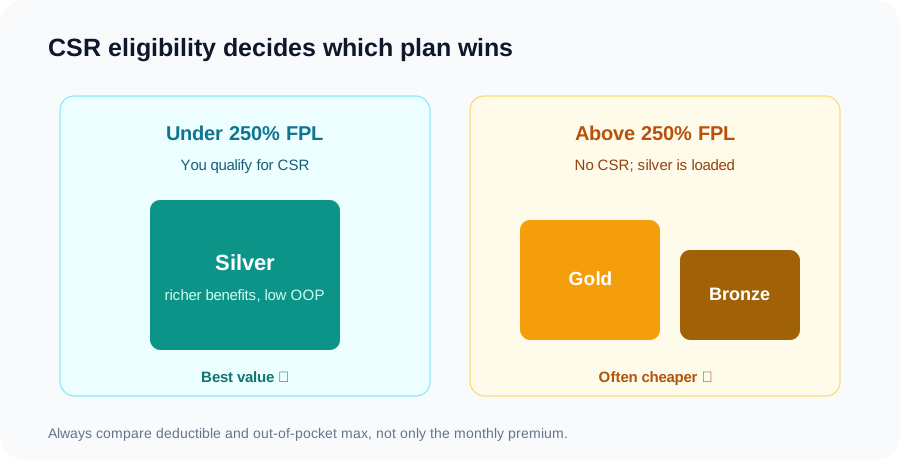
There is a quirk worth understanding before you pick a plan. Since 2017, the federal government stopped directly reimbursing insurers for CSR, so insurers "load" the cost of CSR onto Silver premiums. Because premium tax credits are calculated from the benchmark (second-lowest-cost) Silver plan, loading those Silver premiums also inflates the credit — which can make Bronze and even Gold plans unusually cheap after the credit applies.
The practical rule for a FIRE household:
- If you qualify for CSR (under 250% FPL, especially under 200%), a Silver plan is usually the best value — you keep the richer benefits.
- If you do not qualify for CSR (above 250% FPL), Silver loading often makes a Gold or Bronze plan a better deal, so compare them carefully.
How CSR changes FIRE withdrawal strategy
CSR adds a second target to the MAGI decision. It is no longer just "stay under 400% FPL to keep the premium credit." For a FIRE household that can shape its income, holding MAGI under 250% — or under 200% — can be worth more than the marginal Roth conversion you might otherwise do that year.
That does not make a low MAGI automatically correct. Converting Roth money during low-income years has real long-term value, and a Roth conversion ladder needs those conversions to function. The point is that the CSR breakpoints belong in the math. In a year where you expect heavy medical use, protecting a Silver 87 plan may beat a conversion; in a healthy year, the conversion may win. Either way, the deductible and out-of-pocket max — not just the premium — should drive the plan choice, which is the same lesson in our healthcare before Medicare guide.
Cost-sharing reductions FIRE FAQ
What are cost-sharing reductions?
CSR are extra ACA discounts that lower your deductible, copays, coinsurance, and out-of-pocket maximum. They generally apply to eligible Marketplace Silver plans up to 250% FPL. In Medicaid-expansion states, many adults below 138% FPL are directed to Medicaid instead, so the practical Silver CSR band often starts above that line.
Did cost-sharing reductions expire with the enhanced credits?
No. The enhanced premium tax credits expired at the end of 2025, but CSR is a separate program and remains in place. The income limit for CSR is still 250% FPL.
Should a FIRE household choose Bronze or Silver?
If your MAGI qualifies you for CSR (under 250% FPL), Silver is usually the best value because you keep the richer benefits. If you are above 250% FPL, silver loading often makes Bronze or Gold cheaper — compare deductibles and out-of-pocket maximums, not just premiums.
Is staying under 250% FPL worth skipping a Roth conversion?
Sometimes. In a year you expect significant medical costs, protecting CSR can be worth more than a conversion. In a healthy year, the conversion may win. Weigh the out-of-pocket difference against the long-term tax value of converting.
What to read next
This article uses 2026 Marketplace cost-sharing rules and the 2025 poverty guidelines that apply to 2026 coverage in the contiguous states; Alaska and Hawaii differ. Out-of-pocket figures are federal limits and vary by plan, and CSR availability depends on income, state Medicaid rules, and plan selection. This content is educational and is not tax, legal, medical, or financial advice.