

The HSA reimbursement strategy — often called the “shoebox” method — is simple: pay your medical bills out of pocket with regular cash, save every receipt, and reimburse yourself from the HSA years or even decades later. Because there is no IRS deadline to reimburse a qualified expense, the money you don't pull out stays invested and compounds tax-free in the meantime. A $5,000 bill you pay in cash at age 35 leaves $5,000 invested that grows to about $38,061 by 65 — and the original receipt still lets you withdraw $5,000 tax-free whenever you choose.
This is the tactic that turns the HSA from a glorified medical checking account into a stealth retirement account. It's the engine behind the broader case in the HSA for FIRE pillar guide. The trade-off: it only works if you can comfortably pay medical bills from non-HSA cash and keep airtight records for a very long time.
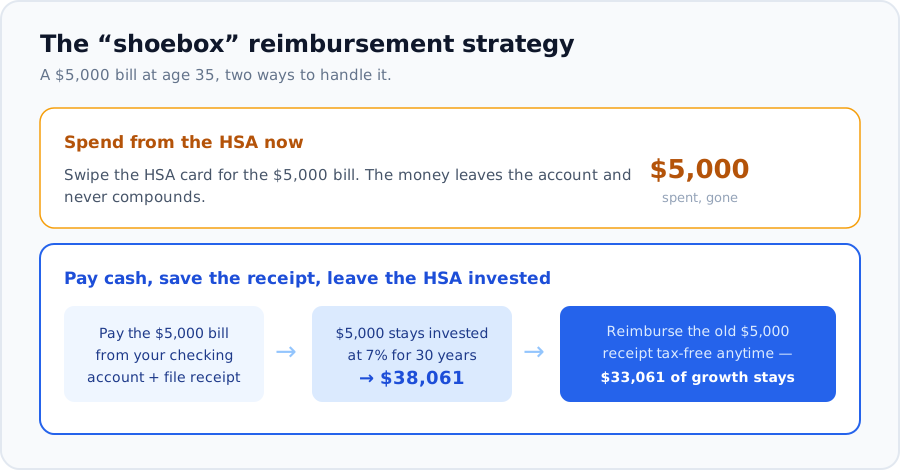
How the no-deadline rule works
The strategy rests on a long-standing rule in IRS Publication 969: there is no time limit on when you reimburse yourself for a qualified medical expense. You can pay a bill today and pull the matching amount out of your HSA tax-free 1 year or 30 years later. To stay valid, an expense must meet three conditions:
- It was incurred after you established the HSA.
- You have not already been reimbursed for it from the HSA (no double-dipping).
- You did not take it as an itemized medical deduction on Schedule A.
“Qualified” means the expenses listed in IRS Publication 502 — doctor visits, prescriptions, dental, vision, and so on. As long as those three boxes are checked, your saved receipts function like a stack of tax-free withdrawal vouchers you can cash in at any moment, including in early retirement when you may want tax-free income that doesn't raise your MAGI.
Why leaving the money invested pays off
Every dollar you spend straight from the HSA is a dollar that stops compounding. Leaving it invested and paying from cash instead lets that dollar keep growing tax-free until you redeem the receipt. Here is what a single $5,000 expense, paid in cash and left invested at 7%, is worth at the moment you finally reimburse it:
| Years you wait to reimburse | HSA value of that $5,000 | Tax-free growth you keep |
|---|---|---|
| 10 years | $9,836 | $4,836 |
| 20 years | $19,348 | $14,348 |
| 30 years | $38,061 | $33,061 |
It compounds across many small bills too. If you pay roughly $300 of out-of-pocket medical costs from cash each year and leave the equivalent invested, that habit alone adds about $28,338 of tax-free balance over 30 years at 7%. These figures assume a steady 7% return and are illustrations, not guarantees — but the direction is the whole point: the longer the receipt sits, the more the deferred withdrawal is worth.
The receipt system that makes it work
The strategy lives or dies on documentation, and your HSA custodian will not track the bills you paid from your checking account — that is entirely on you. For each expense, keep:
- an itemized receipt or bill showing the service and date;
- proof of payment (card statement, canceled check, or bank record); and
- the insurance explanation of benefits (EOB) when there is one.
A box of fading paper will not survive 20–40 years, so store everything in durable digital form — scanned PDFs in a backed-up folder or a dedicated spreadsheet logging date, amount, provider, and a link to the scan. The running total is your tax-free withdrawal capacity. When you redeem, withdraw the matching amount and keep the records with your tax files in case the IRS ever asks you to substantiate it.
The Medicare timing trap
The one place this strategy collides with a hard deadline is Medicare. You are no longer HSA-contribution eligible for any month you are enrolled in Medicare — though you can still spend the existing balance and redeem old receipts tax-free.
The trap is the lookback: if you enroll after 65, Part A can be backdated up to six months (but never before your 65th-birthday month), and applying for Social Security automatically enrolls you in Part A. Contributions made during those retroactive months become excess contributions subject to a 6% excise tax. The practical rule, consistent with IRS Publication 969 and Medicare's enrollment timing guidance: if you apply six or more months after turning 65, stop all HSA contributions — yours and your employer's — six months before the application month. If you enroll during or soon after your initial enrollment period, stop before the month Part A becomes effective. Redeeming receipts is not affected; only new contributions are.
When not to use this strategy
The shoebox method assumes you can pay medical bills from cash without strain. If your emergency fund is thin, or a high-deductible plan would push you toward delaying care you actually need, don't force it — use the HSA the normal way and spend it on bills as they come. The tax-deferred growth is a bonus, not a reason to skip necessary treatment or drain your reserves. This works best for healthy savers with a comfortable cash cushion, which is the same profile that should choose an HDHP in the first place.
Put it in your FIRE plan
A growing pile of unreimbursed receipts is effectively a tax-free cash reserve you can tap in any early-retirement year without raising your reported income — useful for funding part of the healthcare bridge before Medicare. Size your overall target first, then treat the HSA as one of the buckets that funds it.
HSA reimbursement strategy FAQ
Is there really no deadline to reimburse myself?
Correct — IRS Publication 969 sets no time limit, as long as the expense was incurred after you opened the HSA, you haven't already been reimbursed for it, and you didn't deduct it on Schedule A. It is long-standing IRS practice rather than a coded statute of limitations, so keep your records and reimburse accumulated receipts before any future rule change.
What records do I actually need to keep?
An itemized receipt, proof that you paid it, and the insurance EOB if one exists — ideally scanned and backed up digitally. Your custodian doesn't track out-of-pocket spending, so the documentation is entirely your responsibility.
Can I reimburse old expenses after I retire early?
Yes — that's the point. Receipts from your working years can be redeemed tax-free in early retirement, giving you income that doesn't count toward MAGI. Just stop contributing before you enroll in Medicare; redeeming receipts is never restricted.
What to read next
The bottom line
The HSA reimbursement strategy can be valuable for a healthy FIRE saver with strong cash reserves: pay small bills from cash, let the HSA stay invested, and keep the receipts. Each one becomes a tax-free withdrawal voucher worth more the longer it waits. It costs you only discipline — a comfortable cash cushion and a reliable filing habit — and in exchange it quietly builds a tax-free reserve aimed at one of the largest variable costs in an early-retirement budget.
This article is educational and does not constitute tax, legal, medical, or financial advice. HSA and Medicare rules and tax figures adjust over time and depend on your specific plan and circumstances; verify current IRS and Medicare guidance before acting. Growth examples assume a fixed 7% annual return and are illustrations, not forecasts.