

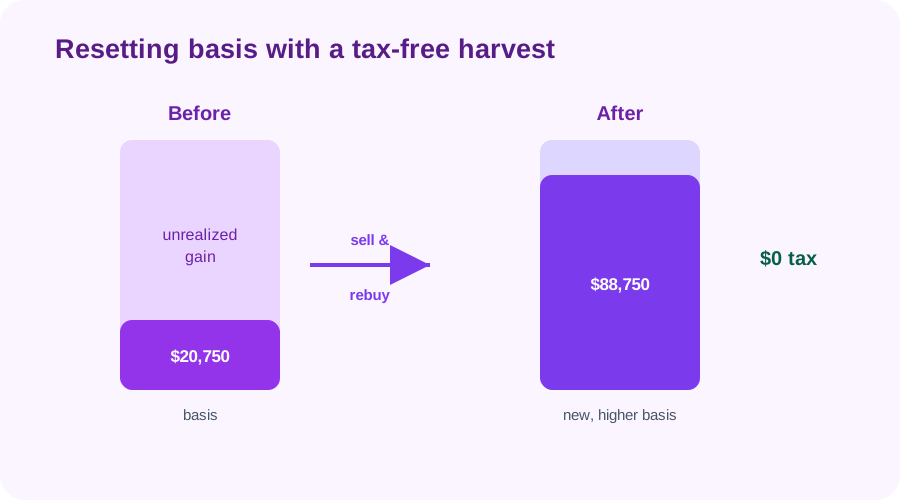
Tax-gain harvesting means deliberately selling appreciated long-term investments in a low-income year, realizing the gain inside the 0% capital gains bracket, and immediately rebuying to lock in a higher cost basis — all at $0 federal tax. In 2026, the 0% long-term-gains ceiling is $98,900 of taxable income for married couples filing jointly and $49,450 for single filers under IRS Revenue Procedure 2025-32. Your actual gain-harvesting room depends on other income and deductions. The reward is a higher cost basis that shrinks future taxable gains.
Unlike tax-loss harvesting, which works in down markets, tax-gain harvesting is a low-income-year move. Early retirees may be well placed for it because they can often control their income — and because the wash-sale rule, which blocks an immediate rebuy after a loss, simply does not apply to gains.
The mechanics: three steps
The strategy builds directly on the 0% capital gains bracket. In a year when your taxable income sits below the 0% ceiling:
- Sell appreciated long-term shares to realize gain up to — but not over — the top of the 0% bracket.
- Pay $0 federal tax on that gain, because it stacks inside the 0% band.
- Immediately rebuy the same security. Your new, higher basis is locked in.
That third step is the whole point. You did not change your portfolio — you own the same shares you did five minutes ago. But your cost basis just jumped, so the next time you sell to fund spending, the taxable gain is much smaller.
Why you can rebuy instantly
The wash-sale rule disallows a loss if you buy a substantially identical security within 30 days before or after selling. Per the SEC's description of wash sales, the rule exists to stop investors from claiming a tax loss while keeping their position. The key fact for harvesting: it applies only to losses, not to gains. When you sell for a gain and rebuy the identical fund the same day, there is no wash-sale problem at all. The rebuy is instantaneous and unrestricted.
That is what makes tax-gain harvesting so clean. There is no 31-day waiting period, no “substantially identical” substitute fund to juggle. Sell VTI, buy VTI back, done.
Why bother harvesting at all?
If you are not selling anyway, why create a taxable event? Three reasons:
- It raises your basis at a 0% federal gains rate. Future spending sales generate smaller taxable gains, which keeps later years inside the 0% bracket and lowers ACA MAGI when you actually need the cash. State tax and lost ACA subsidies can still make the harvest costly.
- It builds dry powder for down markets. A higher basis means more room for tax-loss harvesting if markets later drop, because the gap between price and basis is smaller.
- It is repeatable. Every low-income year is a fresh 0% bracket. Harvest a little each year and you can move large amounts of unrealized gain through the tax system at zero cost over time.
Some FIRE bloggers have documented years of this. One well-known example from the Go Curry Cracker “Never Pay Taxes Again” series describes harvesting tens of thousands of dollars of gains per year across multiple years, all at $0 federal tax, by keeping taxable income inside the 0% band and rebuying after each sale.
A worked 2026 harvest
A married couple, both 38, retired and living partly off cash. In 2026 their only income is $20,000 of qualified dividends. They have no ordinary income, so the full $32,200 standard deduction offsets the bottom of their dividends-and-gains stack. They hold a large VTI position with deep unrealized gains.
| Step | Amount | Federal tax |
|---|---|---|
| Qualified dividends (already received) | $20,000 | $0 (inside 0% band) |
| Long-term gain realized by selling VTI | ~$78,000 | $0 |
| Taxable income after $32,200 standard deduction | ~$65,800 | Comfortably under the $98,900 0% ceiling |
| Rebuy VTI immediately | Basis steps up by ~$78,000 | No wash-sale restriction |
They realized roughly $78,000 of gain, paid $0 federal tax, and stepped up their basis by the same amount. Because the 0% ceiling is measured on taxable income, the $32,200 standard deduction means they were not even at the limit — they could have harvested closer to $111,000 of gain before crossing into the 15% rate. They stopped at $78,000 here for a different reason: their ACA MAGI, not their taxable income after the standard deduction, drives the healthcare math below. The mechanics are the same ones covered in our 0% capital gains for FIRE guide — harvesting is just using that bracket on purpose, year after year.
The ACA tension: harvest or subsidy, rarely both
Here is the constraint that decides whether you should harvest in a given year. A realized gain counts toward ACA MAGI even at 0% federal tax. In the example above, the couple's ~$98,000 of income blows well past the 2026 subsidy cliff for a two-person household, which sits around $84,600 of MAGI. So in any year they need a large ACA premium tax credit, harvesting that much would cost them their subsidy.
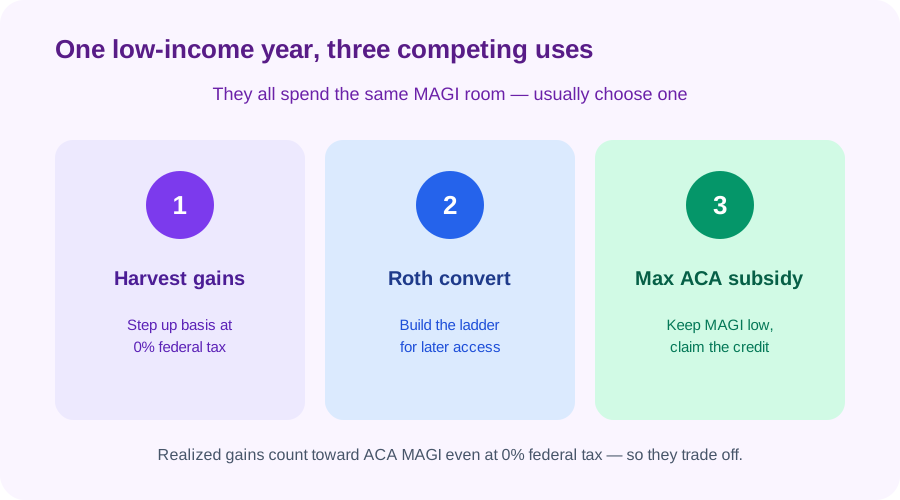
Many FIRE households therefore give each low-income year a main priority. Some years they run Roth conversions to build the ladder. Some years they harvest gains. And some years they keep MAGI deliberately low to capture a larger ACA subsidy. These moves interact, but they use different meters: tax brackets use taxable income, while ACA subsidies use ACA MAGI. Model both before deciding how much room to use for each move.
Common harvesting mistakes
Harvesting in a subsidy year. Realizing a “free” 0% gain that pushes MAGI over the ACA cliff can cost thousands in lost premium tax credits — far more than the harvest was worth. Model your MAGI first.
Over-harvesting past the 0% ceiling. Gains above the top of the 0% band are taxed at 15%. Leave a buffer for surprise dividends and year-end mutual-fund distributions so you do not spill over by accident.
Forgetting ordinary income fills the stack first. A Roth conversion, pension, or part-time wages already occupy the bottom of your bracket. Subtract them before deciding how much gain fits in the 0% room.
Confusing it with loss harvesting. The wash-sale rule only blocks an immediate rebuy after a loss. After a gain you can rebuy instantly — but if you are tax-loss harvesting in a different account, watch reinvested dividends that could trigger the rule.
Ignoring state tax. The 0% rate is federal. Many states tax capital gains as ordinary income, so a federally free harvest may still owe state tax. Check before you sell.
Put harvesting into your yearly plan
Tax-gain harvesting works best as one tool inside a multi-year plan: a large high-basis taxable bridge, a clear ACA MAGI target, and a year-by-year decision about whether to harvest, convert, or maximize subsidies. Start by sizing the portfolio your spending needs, then map which years are best for which move.
Tax-gain harvesting FAQ
Can I really rebuy the same fund immediately?
Yes. The wash-sale rule applies only to losses. After realizing a gain, you can buy the identical security back the same day with no waiting period and no restriction.
How much can I harvest tax-free in 2026?
Up to the top of the 0% bracket on taxable income — $49,450 single, $98,900 married filing jointly — minus any ordinary income already in your stack. The standard deduction raises the gross income you can have while staying in the 0% zone.
Should I harvest gains or do a Roth conversion?
Both use the same low-income room and both raise MAGI, so you usually pick one per year. Many FIRE households prioritize Roth conversions because the long-term ladder benefit is larger, and harvest gains only in years they do not need that room for conversions or ACA subsidies.
Does harvesting help if I plan to hold forever?
It can, by resetting basis higher at a 0% federal gains rate and creating future tax-loss-harvesting room. But if you genuinely never sell and your heirs would receive a step-up in basis at death, the benefit is smaller. State tax and ACA effects may also erase the benefit, so weigh the move against your actual spending plan.
What to read next
This article uses 2026 federal figures for illustration. Capital gains rules, ACA eligibility, and state taxes vary by household and can change with future policy. Many states tax capital gains as ordinary income with no 0% bracket. This content is educational and is not tax, legal, or financial advice.