

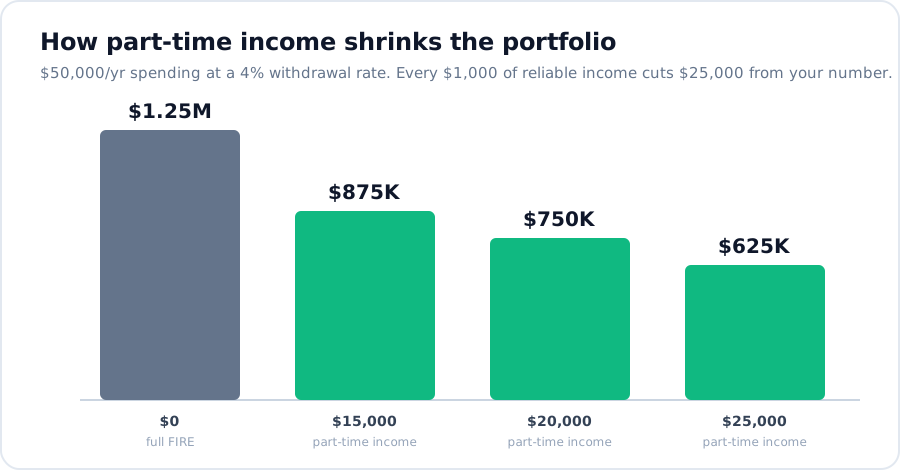
Barista FIRE is semi-retirement: you leave your high-stress career but keep part-time or lower-paying work that covers part of your spending — so you need a much smaller portfolio than full FIRE. If you spend $50,000 a year and earn $20,000 part-time, your investments only have to cover $30,000, which is about $750,000 at the 4% rule instead of $1,250,000. In other words, it is one branch of the broader FIRE path map, not a separate formula.
How Barista FIRE works
Barista FIRE uses income leverage: your part-time income covers part of your annual spending, and your portfolio covers the rest using withdrawals. The bigger and more reliable your side income, the smaller the portfolio you need.
| Part-time income | Portfolio must cover | Barista FIRE number (4%) |
|---|---|---|
| $0 (full FIRE) | $50,000 | $1,250,000 |
| $15,000 | $35,000 | $875,000 |
| $20,000 | $30,000 | $750,000 |
| $25,000 | $25,000 | $625,000 |
Every $1,000 of reliable part-time income removes $25,000 from your FIRE number at a 4% withdrawal rate. That is the leverage Barista FIRE gives you.
Why is it called Barista FIRE?
The term became popular because coffee-shop chains such as Starbucks historically offered health insurance and other benefits to eligible part-time workers. The goal is not literally to become a barista. It is to replace a stressful full-time career with flexible, lower-pressure work that covers part of your expenses and may provide valuable benefits.
The Barista FIRE formula
For $50,000 of spending, $20,000 of part-time income, and a 4% rate: ($50,000 − $20,000) ÷ 0.04 = $30,000 ÷ 0.04 = $750,000. That is $500,000 less than the full FIRE number — years of saving you can skip.
How much smaller is a Barista FIRE portfolio?
At a 4% withdrawal rate, every dollar of reliable annual income has a 25× effect:
- $5,000 of annual income reduces your FIRE number by $125,000.
- $10,000 of annual income reduces your FIRE number by $250,000.
- $20,000 of annual income reduces your FIRE number by $500,000.
This is the core appeal of Barista FIRE: a modest amount of ongoing income can replace a large amount of invested capital. Use conservative, after-tax income when estimating your number.
Healthcare is often the real prize
Health insurance can be one of the largest and least predictable expenses before Medicare eligibility. Costs vary substantially by age, location, household, plan, and subsidy eligibility. A part-time job with employer health coverage may therefore be worth much more than its wage alone. Read our guide to health insurance before Medicare before building this benefit into your plan.
Barista FIRE vs. Coast FIRE vs. full FIRE
| FIRE path | Keep saving for retirement? | Keep working? | Primary leverage |
|---|---|---|---|
| Coast FIRE | No | Yes, to cover current spending | Time and compounding |
| Barista FIRE | Usually no | Part-time or flexible work | Ongoing income |
| Full FIRE | No | No | Portfolio withdrawals |
Coast FIRE means your existing investments may grow to fund retirement later while your job covers today's expenses. Barista FIRE starts portfolio withdrawals sooner, but part-time income keeps those withdrawals smaller. Full FIRE relies on the portfolio alone. For the deeper comparisons, see Coast FIRE vs Barista FIRE and Regular vs Coast vs Barista FIRE.
When Barista FIRE may not work
Barista FIRE may be difficult or risky when:
- Your spending is high or hard to reduce.
- Your healthcare costs are unpredictable.
- Your part-time income is seasonal, unstable, or difficult to replace.
- Your plan relies on an aggressive withdrawal rate.
- You do not want work commitments during semi-retirement.
Stress-test the plan as if your income stops for a year. A cash buffer, conservative income estimate, and flexible spending can keep a temporary job loss from becoming a permanent portfolio problem.
Which FIRE path fits you?
| Your goal | Potential best fit |
|---|---|
| Stop retirement contributions but keep working | Coast FIRE |
| Leave full-time corporate work early | Barista FIRE |
| Stop relying on earned income | Full FIRE |
Barista FIRE FAQ
Is Barista FIRE actually retirement?
It is better described as semi-retirement. You leave full-time career work, but earned income still covers part of your lifestyle.
How much income do I need for Barista FIRE?
There is no fixed amount. Start with annual spending, subtract the amount your portfolio can sustainably provide, and use the difference as your part-time income target.
Can Social Security count as Barista FIRE income?
Social Security can reduce the withdrawals you need after benefits begin, but it does not replace income needed during the years before you claim it. Model each period separately.
Is Barista FIRE safer than full FIRE?
Ongoing income can reduce portfolio withdrawals and sequence-of-returns risk, but Barista FIRE also adds job and income risk. Its safety depends on how reliable the income is and how flexible your spending can be.
What jobs are common in Barista FIRE?
Common choices include consulting, freelancing, seasonal work, tutoring, retail, and part-time roles with employer benefits. The best fit is work that is sustainable, flexible, and reliably covers the amount in your plan.
What to read next
All projections assume a fixed annual return and inflation rate and no withdrawals. Past market returns do not guarantee future results. This article is educational and does not constitute financial advice.