

A bond tent is a strategy where you hold more bonds right around your retirement date, then spend those bonds down so your stock allocation rises over the first decade of retirement. Plotted over time, the bond allocation looks like an upside-down V — a tent — that shelters you during the most dangerous years.
It directly targets sequence of returns risk: the danger that a market crash early in retirement, when your portfolio is at its largest, forces you to sell shares low and permanently damages the plan. A bond tent lowers your stock exposure exactly when a crash would hurt most, then rebuilds it once you are past the danger.
How a bond tent works
Most retirement advice assumes a falling equity glide path — lots of stocks when young, steadily more bonds as you age. The bond tent flips the second half of that. Pioneered by researchers Wade Pfau and Michael Kitces in their 2013 work on rising equity glide paths, the idea has three phases:
- Approach (the years before retirement): drift down from a stock-heavy portfolio toward roughly 40% equities by your retirement date, building up bonds.
- Red zone (the first decade): live partly off those bonds, spending them down so the equity share climbs back up.
- Recovery (10–15 years in): arrive back at a normal 60%+ stock allocation, now well past the most dangerous window.
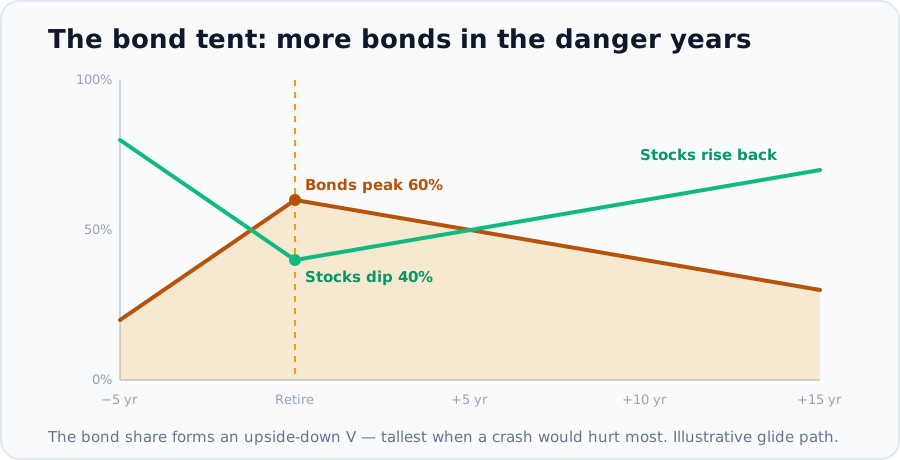
Here is a practical version of that glide path, centered on the retirement red zone:
| Years from retirement | Stocks | Bonds |
|---|---|---|
| 5 years before | 80% | 20% |
| Retirement date | 40% | 60% |
| 5 years after | 50% | 50% |
| 10 years after | 60% | 40% |
| 15 years after | 70% | 30% |
Notice the bond column: 20% → 60% → 30%. That rise-then-fall shape is the "tent." It is tallest exactly when your portfolio is largest and a crash would do the most permanent damage.
Why the tent fights sequence risk
The danger is the portfolio-size effect: a percentage drop hurts most early in retirement, when the balance is biggest. If a 30% crash hits a $1,000,000 portfolio in year one, a fixed $40,000 withdrawal jumps from 4% to about 5.7% of the smaller balance, and you are forced to sell depressed shares.
A bond tent blunts this two ways. First, with only ~40% in stocks at the retirement date, the same 30% stock crash shrinks the total portfolio far less. Second, you can fund early withdrawals from the bond sleeve instead of selling stocks low — leaving more shares to ride the recovery. Pfau and Kitces' research found that a rising equity glide path could reduce both the probability and the magnitude of failure compared with a flat allocation.
The honest caveats
A bond tent is not a free lunch, and reasonable experts disagree on how much it helps.
- It is counterintuitive. Owning more stocks as you age feels wrong, and it takes discipline to keep buying equities in the rebuild phase after a scary start.
- The edge can be modest. Later research by Pfau and Kitces using mean-reverting historical data found that a simple fixed 60% stock allocation sometimes did just as well. The tent helps most in the worst sequences, not on average.
- It can lower lifetime spending. Holding more bonds means lower expected returns, so in good markets a tent can leave you with less than a stock-heavy portfolio would have.
- It only addresses one risk. A bond tent does nothing for taxes, healthcare, or overspending — see the biggest FIRE planning mistakes.
Because of those caveats, many early retirees treat the bond tent as one layer rather than the whole plan. It pairs naturally with flexible spending and a conservative starting rate, which is why whether the 4% rule is still safe depends so much on what defenses sit behind it.
How to build a bond tent in practice
- Start a few years out. In the 1–2 years before your retirement date, drift toward roughly 30–40% equities by adding bonds — don't sell everything at once.
- Use the bonds as your early-spending source. Fund the first years largely from the bond sleeve, especially in any year stocks are down.
- Rebuild deliberately. As you spend bonds, let the stock share rise back toward 60%+ over the first 10–15 years — through your written plan, not market timing.
- Keep costs low. Use broad, low-cost bond and stock index funds; fees compound against a long retirement just like returns compound for you.
Size the plan behind the tent
A bond tent shapes how you hold your portfolio; the withdrawal rate sets how big it must be. Compare conservative rates against the 4% rule to see the target your glide path has to support.
Frequently asked questions
What is a bond tent?
A bond tent is a glide path that raises your bond allocation around your retirement date, then spends those bonds down so your stock allocation rises again over the first decade. The bond share forms an upside-down V — the "tent" — that shelters the riskiest years.
Why would I hold more stocks as I age?
Because sequence risk is concentrated in the first decade. Once you survive that window with a lower stock allocation, raising equities again improves long-run growth without exposing the largest-balance years to a crash.
How many bonds should the tent hold?
A common practical version drifts to about 60% bonds (40% stocks) at the retirement date, then falls back toward 30–40% bonds over 10–15 years. The exact mix depends on your spending flexibility, other income, and risk tolerance.
Is a bond tent better than a cash buffer?
They overlap. A cash buffer is a small, behavioral reserve; a bond tent restructures your whole allocation. A tent gives more sustained protection through the red zone, while cash is simpler. Many plans use a modest buffer plus a higher bond weight early on.
What to read next
This article is educational and does not constitute financial advice. Allocation examples are illustrative; the right mix depends on your situation, and past results do not predict future returns.