

One more year syndrome is the habit of staying at a job you could leave — you have hit your FIRE number — because quitting feels too risky. It is rarely about math. The first extra year often does lower your risk in a real way: a portfolio that grows from $1.25 million to roughly $1.38 million while you keep saving drops your starting withdrawal rate from 4.0% to about 3.6%. The trouble is that the same fear that justified year one justifies year two, then year three, and the goalposts never stop moving.
The cure is not to ignore the fear. It is to convert it into specific, checkable conditions. If your plan already clears the pre-quit checklist and survives a bad first decade, then “one more year” is buying comfort, not safety — and comfort bought with your finite years gets expensive fast.
The math of one more year
Once you are at your number, each extra working year does two things: your portfolio keeps compounding, and you add another year of savings. Together they push your withdrawal rate down. The table below starts at a $1.25 million portfolio with $50,000 of spending, assumes a fixed 7% return, and adds $40,000 of savings each year. It is an illustration, not a forecast — real markets do not deliver a smooth 7%.
| Extra years worked | Approx. portfolio | Withdrawal rate on $50,000 |
|---|---|---|
| 0 (you hit the number) | $1,250,000 | 4.00% |
| 1 | ~$1,377,500 | ~3.63% |
| 2 | ~$1,513,900 | ~3.30% |
| 3 | ~$1,659,900 | ~3.01% |
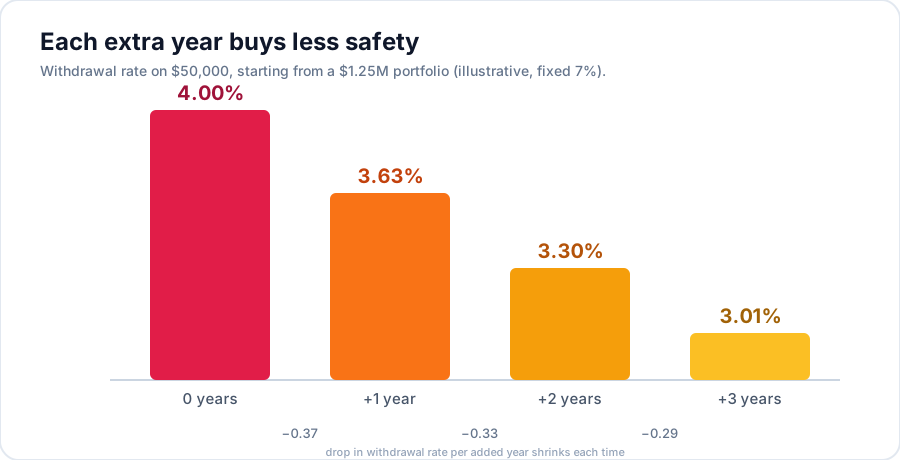
The pattern is the point: the first extra year cuts your withdrawal rate by about 0.37 points, the next by 0.33, the next by 0.29. The safety you buy shrinks each year while the cost — another year of your life spent working — stays the same. That is the trap. One more year can be a rational, one-time risk reduction. As a permanent default, it is just fear with a spreadsheet attached.
Why one more year syndrome happens
Smart, financially literate people fall into this, which tells you it is not an information problem. A few forces drive it:
- Loss aversion. The pain of running out of money looms far larger than the joy of an extra free year, so the brain keeps voting to pad the portfolio.
- Sequence-of-returns fear. The worry about a bad first decade is legitimate — it is the real portfolio killer — but it is better answered with a cash buffer and flexible spending than with indefinite extra work. See sequence of returns risk.
- Identity and routine. A career provides status, structure, and social ties. “One more year” can be a way to avoid the harder question of what you retire to.
- Golden handcuffs. A bonus, vesting RSUs, or a promotion always seems to be just ahead, so there is always a reason the next exit date is better than today.
When one more year is actually rational
Sometimes working longer is the right call — the difference is whether it is tied to a specific, finishable condition. One more year is rational when:
- Your withdrawal rate is still above what you are comfortable with for a 40- to 50-year retirement (many early retirees prefer 3.25% to 3.5%).
- You have not yet cleared a concrete gap — an unfunded healthcare bridge, high-interest debt, or no cash buffer.
- Markets just fell sharply right before your planned exit, and another year lets you rebuild the buffer instead of selling low.
- A near-term, dated event — vesting, a pension cliff, Medicare eligibility for a spouse — materially changes the plan.
The common thread: each of these has a finish line. When you cannot name the specific condition that would let you quit, the extra year is fear-driven, not plan-driven. A plan that needs perpetual extra padding may have a deeper problem — one of the biggest FIRE planning mistakes is building a number that only works if everything goes right, then trying to patch it with more time on the job.
How to break the loop and decide
Replace the vague worry with a written test. Before each “one more year,” ask whether the real reason is a checkable gap or just discomfort:
- Write your real exit conditions down. Run them through the FIRE checklist before quitting your job — healthcare priced, a funded bridge to 59½, a written withdrawal plan, no high-rate debt, and a 2 to 3 year cash buffer. If all five are clear, the fear is no longer about readiness.
- Stress-test instead of padding. Test the plan at a lower withdrawal rate and a weak first decade. If it survives, more money mostly buys comfort, not survival.
- Price the year in life, not just dollars. A year of work in your 40s or 50s is a year you do not get back. Put that on the scale opposite the shrinking safety gain.
- Consider a middle path. Part-time or seasonal work can cover part of your spending and ease sequence risk without a full extra year of the job you wanted to leave.
One more year syndrome FAQ
What is one more year syndrome?
It is the tendency to keep working past the point where you could retire, because quitting feels risky. Each year you tell yourself just one more will make you safe, but the goalposts keep moving and the extra safety shrinks each year.
Is working one more year worth it for FIRE?
The first extra year can meaningfully lower your withdrawal rate — for example from about 4.0% to 3.6% — which is real risk reduction. But each additional year reduces your rate by less, so the value of working longer falls while the cost in time stays the same.
How do I know if I am ready or just scared?
Tie the decision to checkable conditions. If your healthcare is priced, you have an account bridge to 59½, a written withdrawal plan, no high-interest debt, and a 2 to 3 year cash buffer, and the plan survives a bad first decade, then staying longer is buying comfort, not safety.
What is an alternative to one more year?
A middle path such as part-time or seasonal income can cover part of your spending and reduce sequence-of-returns risk, letting you leave the full-time job without padding the portfolio indefinitely.
What to read next
This article is educational and does not constitute financial, tax, or investment advice. Portfolio figures assume a fixed 7% return and level savings and ignore taxes and real market paths. Verify current details before making decisions.