

A practical cash-buffer range to test for FIRE is roughly 6 to 18 months of expenses — not automatically three or four years. On a $40,000-a-year budget, that is about $20,000 to $60,000 in a high-yield savings account. Its real job is behavioral: it lets you spend cash instead of selling stocks in a downturn, so you avoid panic-selling at the bottom.
Here is the trade-off people miss: a large cash buffer can make the plan worse through cash drag, because money parked in savings misses years of market growth. The buffer is partly peace-of-mind insurance against panic selling — sized deliberately and refilled by a written rule.
What a cash buffer actually does
The threat a cash buffer addresses is sequence of returns risk: when stocks fall early in retirement, selling shares to fund spending locks in losses and permanently shrinks the base that future recoveries act on. If you can cover a year or two of expenses from cash instead, you give the portfolio time to recover before you sell.
That sounds like a clean fix, but the evidence is nuanced. Research on cash-reserve distribution strategies finds they help when the benefit of avoiding depressed sales, taxes, and transaction costs outweighs the lower expected return on cash. Ordinary rebalancing can accomplish much of the same portfolio work. The clearest benefit is behavioral: a cash cushion can keep a nervous retiree from bailing out at the bottom.
How much cash is enough?
Size the buffer in months of spending, not as a percentage of your portfolio. For a household spending $40,000 a year:
| Buffer size | Cash held ($40k/yr spend) | Verdict |
|---|---|---|
| 6 months | $20,000 | Lean cushion — fine if you also have flexible spending |
| 12 months | $40,000 | A common, sensible FIRE buffer |
| 18 months | $60,000 | Upper end — good for peace of mind near the red zone |
| 36 months | $120,000 | Usually too much — meaningful cash drag |
A range worth testing is 6 to 18 months, with the upper end most useful around the retirement red zone — the years around your retirement date when sequence risk is most dangerous. Keep it in a competitive high-yield savings account or short-term Treasury bills so the cash earns a current short-term rate while it waits.
Why too much cash quietly costs you
Cash drag is the opportunity cost of money that could have been compounding. Picture a retiree who keeps an extra $120,000 (three years of spending) permanently in cash rather than invested. Over 30 years, cash at about 4% grows to roughly $389,000, while the same $120,000 in a 7% portfolio grows to about $913,000.
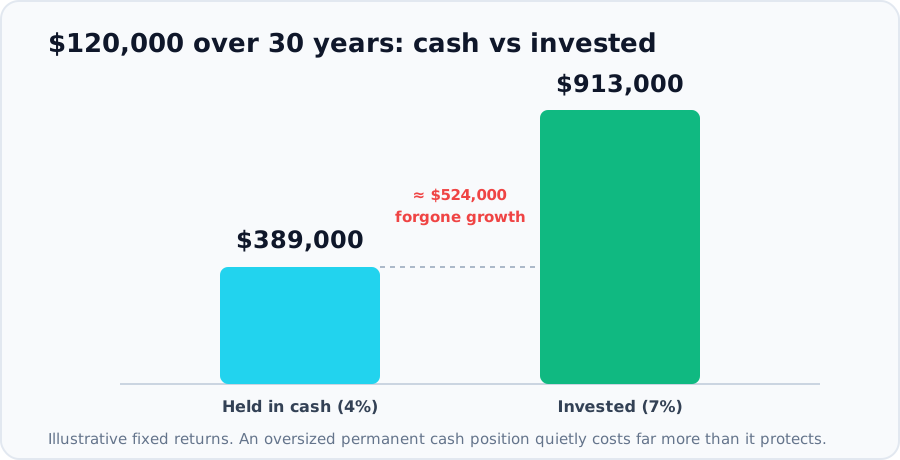
That is more than half a million dollars of forgone growth on a single oversized cash pile — and it is exactly the kind of slow leak that doesn't show up in a bad year, so it never triggers an alarm. A three-year cash bucket also doesn't buy three years of safety; it buys roughly the same behavioral benefit as a one-year buffer at three times the cost. This is why a giant emergency fund is one of the biggest FIRE planning mistakes hiding inside an otherwise careful plan. It also helps to keep the roles straight: an emergency fund and a FIRE portfolio do different jobs, and the post-retirement cash buffer is a third thing again.
How to use a cash buffer in practice
- Hold 12–18 months of spending in a high-yield savings account or short Treasury bills, separate from your invested portfolio.
- Spend from cash in down years instead of selling depressed shares, then refill it from your portfolio after markets recover.
- Count it inside your asset allocation, not on top of it. If your plan is 60/40, a big cash pile quietly makes you more conservative than you think.
- Pair it with flexible spending. A buffer plus the ability to cut spending after bad years is far stronger than cash alone.
- Resist the urge to grow it. When markets feel scary, the instinct is to raise cash. That is the moment the drag does the most damage.
Size your buffer against your real number
How many months of cash you can comfortably carry depends on your total portfolio and spending. Start by pinning down your FIRE number, then layer a modest buffer on top rather than letting an oversized cash position inflate the target.
Frequently asked questions
How much cash should a FIRE retiree hold?
Roughly 6 to 18 months of expenses is a useful range to test around the retirement red zone. On $40,000 of annual spending that is about $20,000 to $60,000. Larger reserves create more cash drag, so compare that cost with the spending flexibility and other income you already have.
Is a cash buffer even worth it?
Yes, but mostly for behavioral reasons. The research shows large cash buckets rarely improve the math, yet a modest buffer helps you avoid panic-selling in a crash — which is a genuine, if psychological, defense against sequence risk.
Where should I keep the buffer?
A competitive high-yield savings account or short-term Treasury bills, so the cash earns something while it waits. Keep it separate from invested assets so you are not tempted to spend it down for non-emergencies.
Cash buffer or bond tent — which is better?
They solve the same problem differently. A modest cash buffer is simple and behavioral; a bond tent restructures your whole allocation around the retirement date. Many plans use a small buffer and a higher bond weight in the red zone rather than choosing one.
What to read next
This article is educational and does not constitute financial advice. The cash-drag example assumes fixed 4% and 7% annual returns for illustration only; real returns vary and past results do not predict the future.