

Flexible spending is one of the clearest ways to help a FIRE plan survive a bad start. Instead of withdrawing the same inflation-adjusted dollar amount no matter what the market does, you cut spending after poor years so you sell fewer shares while prices are low — and you allow yourself a raise after strong years.
The payoff is large. Vanguard found that layering a dynamic spending rule onto a globally diversified portfolio raised a 50-year FIRE success rate from 56.3% to 90.3%. Morningstar found that retirees willing to tolerate some spending fluctuation could start near 6% instead of the fixed-rate 3.9%. Flexibility itself buys a higher sustainable withdrawal rate.
Why flexibility beats a fixed withdrawal
The classic 4% rule takes the same real dollars every year regardless of markets, which makes it the strategy most exposed to sequence of returns risk. When stocks fall early, a fixed withdrawal becomes a larger and larger share of a shrinking portfolio, forcing you to sell depressed shares that never recover.
Flexible rules attack that directly. Consider a $1,000,000 portfolio with a planned $40,000 (4%) withdrawal that crashes 30% to about $700,000:
| Response | Withdrawal | Rate on $700,000 | Effect |
|---|---|---|---|
| Fixed (take the plan) | $40,000 | ≈ 5.7% | Sells the most depressed shares |
| Flexible (cut 10%) | $36,000 | ≈ 5.1% | Leaves $4,000+ invested to recover |
A 10% cut for one or two years is rarely life-altering, but repeated across a downturn the shares you didn't sell are exactly the ones that ride the rebound. That is the entire logic behind every flexible rule below.
Four flexible spending rules, simplest to most structured
1. Skip the inflation raise after a down year
The simplest rule of all: in any year following a portfolio loss, don't give yourself the normal inflation increase. Morningstar found that this single tweak meaningfully raises the sustainable starting rate, because it stops you from automatically spending more while the portfolio is under stress. It requires no spreadsheet and no formula — just a once-a-year decision.
2. Spend a fixed percentage of the current balance
Instead of a fixed dollar amount, withdraw a set percentage of whatever the portfolio is worth each year. Spend 4% of $1,000,000 and you take $40,000; if it falls to $700,000, you take $28,000. Taking only a percentage avoids a fixed-dollar withdrawal exhausting the account on schedule, but spending can still collapse to an unusably low level. Income swings hard with markets, so it works best when a stable income floor — Social Security, a pension, or part-time work — covers your essentials.
3. Variable Percentage Withdrawal (VPW)
VPW, developed by the Bogleheads community, is a refined percentage-of-portfolio method that raises the percentage as you age and adjusts it for your stock/bond mix. A 45-year-old with an 80/20 portfolio might start around 4.6%. Because the percentage is tied to remaining years, VPW is designed to avoid depleting the portfolio before its target horizon — but in a bad sequence the spending cuts can be significant and long-lived, which again argues for an income floor underneath it.
4. Guyton-Klinger guardrails
Guardrails let you start higher — often 5% to 5.5% — by setting tripwires. If your withdrawal rate climbs 20% above the starting rate (because the portfolio fell), you cut spending 10%. If it falls 20% below (because the portfolio grew), you give yourself a 10% raise. The bands keep spending inside a safe corridor automatically.
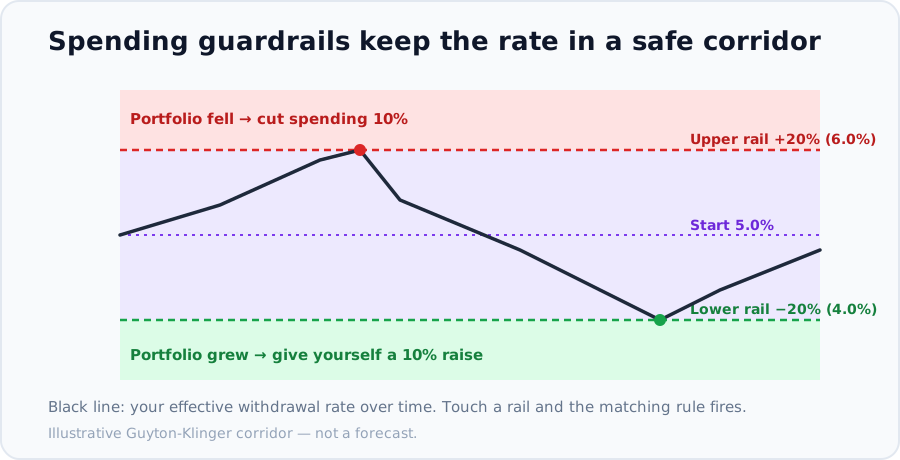
Guardrails are powerful but not free. Michael Kitces warns that in a deep downturn the rules can demand spending cuts large enough to be unfeasible for some households, and that they often over-correct — leaving money unspent that you could have safely enjoyed. They work best when you genuinely have discretionary spending to flex.
| Strategy | Starting rate | Income stability | Best for |
|---|---|---|---|
| Fixed real (4% rule) | ≈ 3.9% | Very stable | Predictable spending, shorter horizon |
| Skip-the-raise | ≈ 4%+ | Mostly stable | Anyone wanting one easy rule |
| Percentage / VPW | ≈ 4.6%+ | Volatile | Plans with an income floor |
| Guardrails | ≈ 5%–5.5% | Moderate, with cuts | Households with discretionary spending |
You can only flex if you have room to flex
Every flexible rule shares one requirement: spending you can actually cut. A budget that is almost entirely essentials — housing, food, healthcare — has little to trim, which is why a thin Lean FIRE plan is more fragile than a Fat FIRE one. A Fat FIRE retiree spending $120,000 can absorb a 30% cut and still live on $84,000; a Lean retiree at $35,000 cannot. Our Lean FIRE vs Fat FIRE comparison shows why the same portfolio carries different real-world risk depending on how much of your spending is optional.
So before you rely on flexibility, separate needs from wants. A household spending $60,000 with $15,000 of discretionary expenses has a real lever; one with $60,000 of fixed bills does not. Building that discretionary cushion is part of why the 4% rule can still work for some early retirees — read whether the 4% rule is still safe for the full picture.
Common mistakes with flexible spending
- Assuming you'll cut when you never can. If your budget is all essentials, "I'll just spend less" is a plan on paper only.
- Starting too high on guardrails without a floor. A 5.5% start needs real discretionary spending and ideally other income to absorb the cuts.
- Ignoring the upside rule. Flexibility runs both ways. After strong years you have usually earned a raise — underspending forever is its own failure.
- Reacting to headlines instead of rules. Review once a year against your actual balance, not every time the market moves.
- Confusing flexibility with a giant cash pile. A modest cash buffer helps behaviorally, but cutting spending is what actually preserves shares.
Compare a flexible rate against a fixed one
Flexibility lets you start at a higher withdrawal rate — but only if you commit to the cuts. Compare a steady 3.5% against a higher flexible rate and see how the required portfolio changes for your spending.
Frequently asked questions
What is flexible spending in FIRE?
It is any withdrawal method that adjusts spending to market conditions — cutting after losses and raising after gains — instead of taking the same inflation-adjusted amount every year. It directly reduces sequence of returns risk.
Does flexibility let me withdraw more?
Yes. Because you agree to cut spending in bad years, research from Morningstar and Vanguard shows flexible methods can support meaningfully higher starting rates than a fixed 4% — at the cost of less predictable income.
What's the simplest flexible rule?
Skip the inflation raise in any year that follows a portfolio loss. It needs no formula and still meaningfully improves how long the money lasts.
Are guardrails better than the 4% rule?
For households with discretionary spending, guardrails can support a higher starting rate with similar success. But they can demand large cuts in a deep downturn, so they are not a fit for a tight, all-essentials budget.
What to read next
This article is educational and does not constitute financial advice. Modeled success rates and sustainable rates depend entirely on their assumptions and do not predict future results.