Lean FIRE vs Fat FIRE: Two Different Risk Systems
Lean FIRE vs Fat FIRE is more than $30,000 versus $100,000 of spending. Compare their failure risks and FIRE numbers at 4%, 3.5%, and 3.25% with real examples.

Lean FIRE vs Fat FIRE is more than $30,000 versus $100,000 of spending. Compare their failure risks and FIRE numbers at 4%, 3.5%, and 3.25% with real examples.

The biggest FIRE planning mistakes go beyond saving too little. Learn how spending, healthcare, taxes, account access, and bad early returns can break a plan.
The 4% rule still works as a starting point, but a 40- or 50-year FIRE plan needs more margin. See the research, risks, and practical withdrawal ranges.
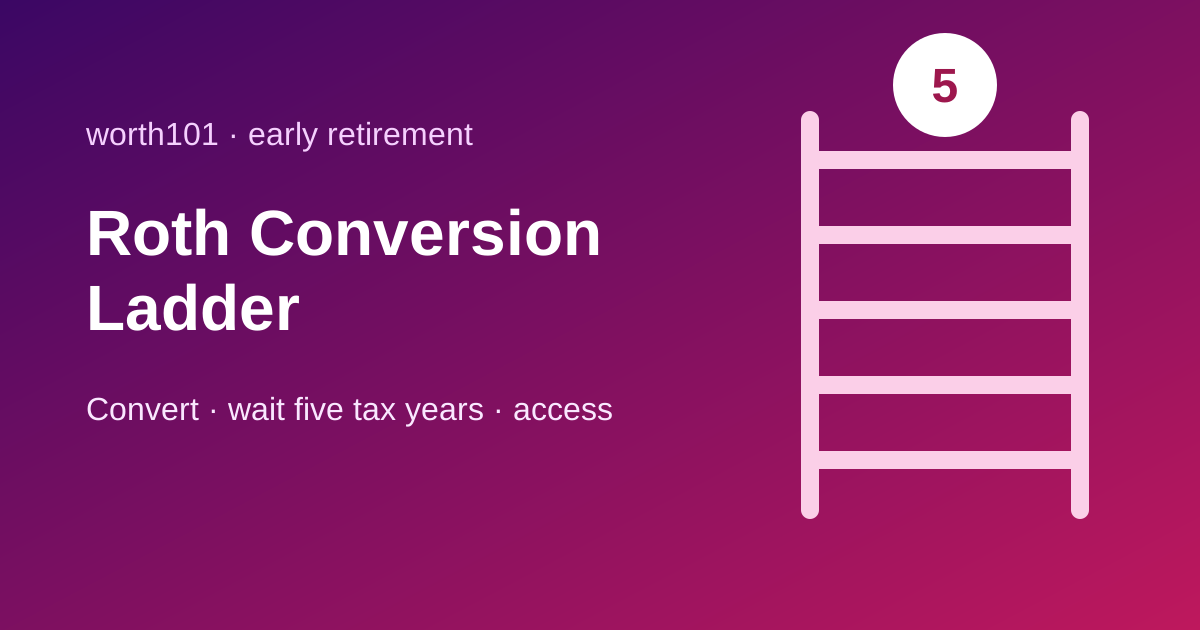
A Roth conversion ladder can unlock pre-tax retirement money before age 59½. Learn the five-year rule, bridge-account math, taxes, and common FIRE mistakes.

ACA subsidies depend on income, not spending or net worth. Learn how taxable basis, Roth withdrawals, conversions, and the 2026 subsidy cliff affect FIRE.

Coast FIRE is when your investments are big enough to grow into full retirement on their own. At 30 with a $1.25M goal you need about $329,000 — here is the math.

Barista FIRE lets part-time income cover part of your spending, so you need a smaller portfolio. $20k of side income can cut a $1.25M FIRE number to $750,000.
Your FIRE number is annual spending divided by your withdrawal rate — 25× spending at 4%. $50,000 of spending means $1,250,000. See the formula and the variations.

Retire before 65 and you bridge to Medicare yourself. See how to estimate the finite present value of ACA costs through age 65 without funding them forever.

Social Security still counts for early retirees. Learn how delaying benefits to 70 and bridging with your portfolio can raise lifetime inflation-adjusted income.

Compare 401(k), Roth IRA, and taxable accounts for FIRE. Build a tax-efficient funding order and an early-retirement bridge before age 59½.
The 4% rule says you can withdraw 4% of your portfolio in year one and adjust for inflation. It means 25× spending — and why early retirees often use 3.5% instead.
Discover Monte Carlo simulation in simple terms. Learn how this probability-based method helps forecast investment returns, retirement goals, and financial risk. Includes default-example assumptions, while tool outputs update with your own inputs.
Use the Rule of 72 formula to estimate how long money takes to double. See a rate chart, real examples, whether it works with contributions, Rule of 69 vs 70, and when to use exact compound interest math.
Understand compound interest in simple terms and see how your money can grow over time. Includes practical examples and a free calculator for US beginners.