P is your principal ($5,000), r is the annual rate (0.09 for 9%), n is compounds per year (1 for annual), and t is time in years. For $5,000 at 9% annually for 10 years:
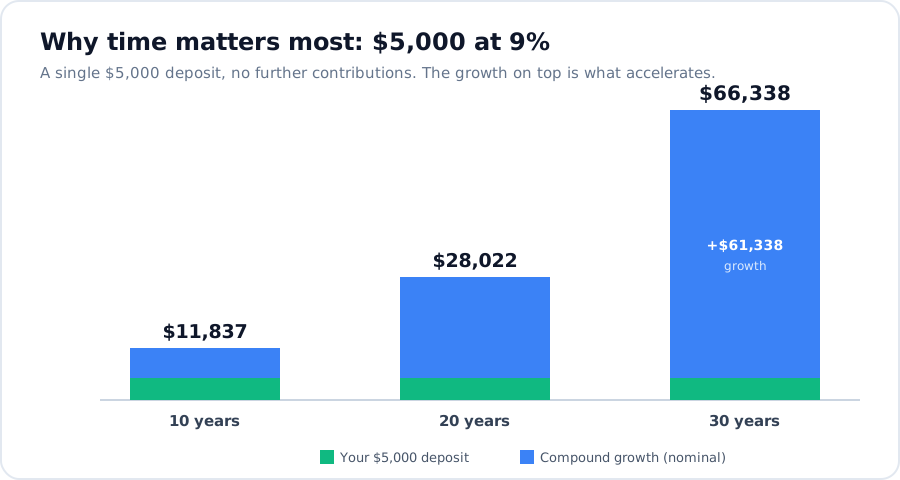
A = 5000 × (1.09)10 = 5000 × 2.3674 = $11,837
That is the whole engine. For the full walkthrough — monthly compounding, adding contributions, and how to solve for rate or time — see the compound interest formula explained. And because the 9% here is a nominal average, read real vs nominal return to plan in today's dollars.
Rate vs. Time: The Numbers That Change Everything
Here's what a single $5,000 investment grows to at different rates — no monthly additions, no withdrawals:
| Rate | 10 Years | 20 Years | 30 Years |
|---|
| 5% | $8,144 | $13,266 | $21,610 |
| 7% | $9,836 | $19,348 | $38,061 |
| 9% | $11,837 | $28,022 | $66,338 |
| 10% | $12,969 | $33,637 | $87,247 |
Verify any cell in the table above — switch rate or years to see exactly where $5,000 lands:
Check any rate & time horizon from the table
Two things dominate:
- Time beats rate. At 7%, extending from 20 to 30 years nearly doubles your outcome ($19,348 → $38,061). That decade of patience does more than jumping from 7% to 9%.
- The back half is where the money is. At 9%, years 21–30 produce $38,316 — more than the entire previous 20 years combined.
Compound vs. Simple Interest
The contrast with simple interest makes the compounding edge concrete:
| Simple Interest | Compound Interest |
|---|
| Interest earns on | Principal only | Principal + gains |
| $5,000 at 9% for 10 yrs | $9,500 | $11,837 |
| $5,000 at 9% for 20 yrs | $14,000 | $28,022 |
| $5,000 at 9% for 30 yrs | $18,500 | $66,338 |
At 30 years the compound path delivers $47,838 more — nearly 10× the starting investment — without adding a dollar. For a full breakdown of where each one wins, see simple interest vs compound interest.
Why Your Decisions Now Cost More Than You Think
One year changes every later year
At 9%, $5,000 at age 25 becomes $157,047 by age 65 (40 years). Wait until age 26 and the same $5,000 reaches only $144,080 — a $12,967 difference from one less year of compounding. Delay to age 35 and you arrive at just $66,338.
Rate differences look small, aren't
7% vs. 9% is 2 percentage points. Over 30 years on $5,000:
The gap: $28,277 — more than 5× your starting capital. This is why a 1% expense ratio on your index fund isn't a rounding error. Fees compound against you exactly as returns compound for you.
Regular contributions amplify everything
Add $100/month to your $5,000 at 9% for 10 years and you end up with $31,608 from $17,000 in total contributions. The $14,608 in compound interest is 86 cents of return for every dollar you put in.
Change the monthly amount below — every extra $50/month compounds across every future year:
Calculate with your own monthly contribution
Explore the indexed $10,000 + $1,000/month over 20 years scenario
Where to Let Compounding Work in the US
Account taxes and fees can materially reduce how much of your return stays invested.
| Account | Tax Treatment | 2026 Limit | Best For |
|---|
| Roth IRA | Tax-free gains | $7,500/yr ($8,600 if 50+) | Qualified retirement withdrawals can be tax-free |
| 401(k)/403(b) | Traditional: tax-deferred; Roth option: after-tax | $24,500/yr; catch-up limits vary by age | Employer match, when offered, is valuable |
| Brokerage | Taxable | None | After maxing tax-advantaged accounts |
| HYSA | Taxable | No contribution limit; rates vary | Cash reserves and near-term goals |
These are simplified account-level comparisons. Roth IRA eligibility and qualified withdrawal rules depend on income, age, and holding periods; workplace-plan catch-up limits also vary by age. Verify current limits and account rules with the IRS retirement-plan limits.
A common order is to contribute enough to earn an available workplace match, then compare IRA and workplace-plan tax benefits before using a taxable brokerage account. The right order depends on eligibility, plan fees, vesting rules, and access needs.
Four Mistakes That Kill Your Compounding
1. Cashing out early. Your $5,000 at year 7 has grown to $9,140. Pull it out and you give up $57,198 of potential future growth — the difference between what that $9,140 would have compounded to by year 30 ($66,338) and what you received. Taxes or penalties may also apply, depending on the account and withdrawal.
2. Waiting until you "have more money." One year of delay isn't one year of returns — it's one year compounding across every future year. Start at 26 instead of 25 and your outcome at age 65 drops from $157,047 to $144,080. That is a $12,967 difference from 12 fewer months of compounding on a $5,000 investment.
3. Ignoring fees. In a simplified comparison, $50,000 growing for 25 years at 7% reaches about $271,000; at 6% after a one-point annual fee drag, it reaches about $215,000. That roughly $56,800 gap is why expense ratios matter. Actual fund returns and fees vary.
4. Treating today's HYSA rate as a permanent return. A competitive HYSA yield (quoted as an APY, not a plain interest rate) reflects the current rate environment, not a fixed 30-year assumption. HYSAs are designed for cash reserves and near-term goals; long-term investments carry different risks and expected returns.
What to read next
Go deeper into the compound-interest cluster, then run your own numbers:
All projections assume annual compounding and no withdrawals. Past market returns do not guarantee future results. This article is educational and does not constitute financial advice.