

What is the Rule of 72?
The Rule of 72 is a mental math shortcut for estimating how long it takes to double your money at a given compound interest rate.
The formula: Divide 72 by the annual interest rate to get the approximate number of years to double your money.
Quick answer: divide 72 by the annual return percentage. At 6%, money doubles in about 12 years. At 8%, about 9 years. At 10%, about 7.2 years.
Rule of 72 chart and table: years to double by return rate
| Interest Rate | Years to Double (Rule of 72) | Actual Years |
|---|---|---|
| 1% | 72.0 years | 69.7 years |
| 2% | 36.0 years | 35.0 years |
| 3% | 24.0 years | 23.4 years |
| 4% | 18.0 years | 17.7 years |
| 5% | 14.4 years | 14.2 years |
| 6% | 12.0 years | 11.9 years |
| 7% | 10.3 years | 10.2 years |
| 8% | 9.0 years | 9.0 years |
| 9% | 8.0 years | 8.0 years |
| 10% | 7.2 years | 7.3 years |
| 12% | 6.0 years | 6.1 years |
| 15% | 4.8 years | 5.0 years |
| 20% | 3.6 years | 3.8 years |
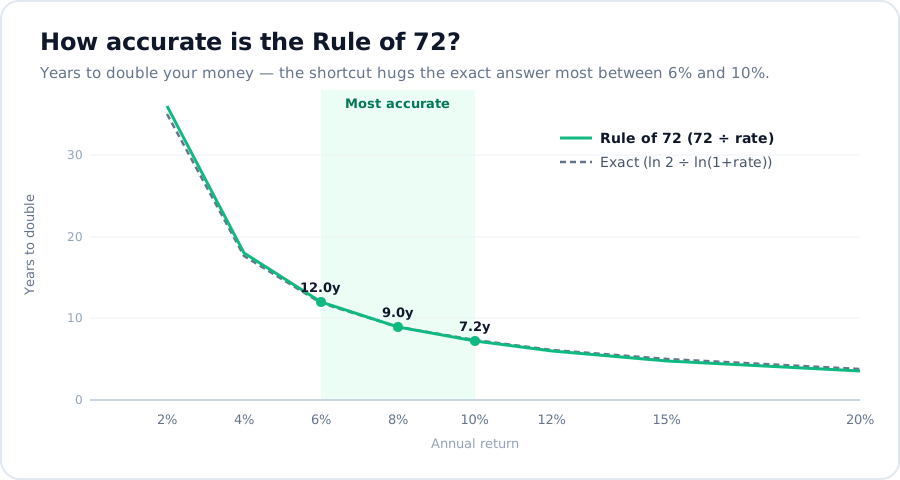
The Rule of 72 is most useful for common investing return assumptions around 6% to 10%. It becomes less precise at very low or very high rates.
Rule of 72 example: how long to double $10,000?
At 8% per year, the Rule of 72 estimates $10,000 doubles in about 9 years (72 ÷ 8 = 9) — so roughly $20,000 after one doubling cycle, before taxes, fees, and market volatility.
Why 72? The Math Behind It
For compound interest, the exact formula for doubling time is:
If you multiply 0.693 by 100 (to work in percentages, not decimals), you get 69.3 — which is the mathematically precise constant. So why 72?
72 is easier to divide mentally and has more integer factors than 69.3:
- 72 ÷ 1 = 72, 72 ÷ 2 = 36, 72 ÷ 3 = 24, 72 ÷ 4 = 18, 72 ÷ 6 = 12, 72 ÷ 8 = 9, 72 ÷ 9 = 8, 72 ÷ 12 = 6
This makes mental arithmetic simple at most practical interest rates. The slight inaccuracy (72 overestimates doubling time slightly at low rates, underestimates at very high rates) is negligible for everyday financial planning.
How to use the Rule of 72
1. Compare investment options instantly
Your bank offers a CD at 4%. A rough stock-market example might use a 10% long-term nominal return assumption.
- CD: 72 ÷ 4 = 18 years to double
- Index fund: 72 ÷ 10 = 7.2 years to double
Same money, same time — but the index fund doubles your money 2.5× as often.
2. Understand the cost of inflation
If inflation runs at 3%/year, the purchasing power of your cash halves in 72 ÷ 3 = 24 years. Cash under a mattress doesn't grow at 0% — it shrinks at the inflation rate.
3. Evaluate the impact of fees
A mutual fund with a 2% annual expense ratio is effectively charging you a 2% drag on your returns. For a fund also returning 8%:
- True return after fees: 6%
- Doubling time at 6%: 72 ÷ 6 = 12 years
- Without the fee: 72 ÷ 8 = 9 years
That 2% fee costs you 3 additional years per doubling cycle.
The Rule of 72 Applied to $5,000
Starting with $5,000 at different return rates:
| Rate | Doubles In | Value at 10 yrs | Doubles to $10k by... |
|---|---|---|---|
| 5% | ~14.4 yrs | $8,144 | Year 14.4 |
| 7% | ~10.3 yrs | $9,836 | Year 10.3 |
| 9% | ~8.0 yrs | $11,836 | Year ~8 |
| 10% | ~7.2 yrs | $12,969 | Year ~7 |
Notice that at 9%, your $5,000 doubles by year 8 — meaning you pass $10,000 well before your 10-year horizon ends. The Rule of 72 lets you see that milestone instantly without a calculator.
See the Rule of 72 in action: at 9% for 8 years, $5,000 grows to $9,963 — just under $10,000. Switch rate to 7% and years to 10 to confirm the table's $9,836:
Verify the doubling time prediction
Approximate; annual compounding and monthly contributions.
Does the Rule of 72 work with monthly contributions?
Not directly — the Rule of 72 is designed for a one-time lump sum left to compound. It does not estimate the total balance or time-to-target correctly when you add money each month, because each new contribution has a different amount of time to compound.
For contributions, use the full future-value formula or run the exact numbers in the calculator — the indexed $10,000 plus $1,000/month hub grows far faster than the doubling shortcut alone suggests.
When to Use It (and When Not To)
Good uses
- Quick mental comparisons between two investment options
- Gut-checking whether a return claim sounds realistic
- Teaching compound interest intuitively
- Estimating inflation's impact on purchasing power
Not suitable for
- Monthly compounding calculations (use the actual formula or a calculator)
- Very high interest rates (>20%) — error grows significantly
- Precise financial planning (always use a calculator for final decisions)
- Debt: the Rule of 72 applies to debt interest too, but the standard calculation gives exact figures quickly
Rule of 70 vs Rule of 72 vs Rule of 69.3
For continuous compounding, the mathematically exact constant is 69.3. You may see:
- Rule of 69: More accurate for continuous compounding
- Rule of 70: Compromise between precision and divisibility
- Rule of 72: Best for mental math at practical rates (6–12%)
All three are approximations. The Rule of 72 wins in everyday use because its divisibility makes mental arithmetic effortless.
Rule of 72 and compound growth
The Rule of 72 reframes wealth-building as a series of doublings, not a linear accumulation:
- $5,000 → $10,000 at 9% takes 8 years
- $10,000 → $20,000 at 9% takes another 8 years
- $20,000 → $40,000 at 9% takes another 8 years
Three doublings in 24 years turn $5,000 into $40,000. That's an 8× return — without adding another dollar. Each doubling cycle builds on the last, which is why time changes the result so dramatically.
Verify the three-doubling math — at 9% for 24 years the exact answer is $39,556, confirming the Rule of 72's approximation. Try 25 or 26 years to see how it compares:
Calculate three doublings at 9% for 24 years
Approximate; annual compounding and monthly contributions.
If you want a $1,000,000 retirement nest egg from a single $5,000 investment at 9%:
At 8 years per doubling: 7.6 × 8 ≈ 61 years. Invest $5,000 at age 22, retire at 83. Want to retire at 65? Add monthly contributions to close the gap — use the indexed monthly-contribution hub to compare time horizons.
Frequently asked questions
What does the Rule of 72 mean?
The Rule of 72 is a mental shortcut for how long an investment takes to double at a fixed compound rate. Divide 72 by the annual return percentage and the answer is the approximate number of years to double — for example, 72 ÷ 9 ≈ 8 years.
How do you calculate the Rule of 72?
Take the annual rate as a whole number (not a decimal) and divide it into 72. At 6% the estimate is 72 ÷ 6 = 12 years; at 8% it is 72 ÷ 8 = 9 years. No calculator required — that is the whole point of the shortcut.
Does the Rule of 72 work with monthly contributions?
Not directly. It describes a single lump sum. If you add money every month, use the full future-value math instead — see the monthly contributions section above.
What is the difference between the Rule of 69, 70, and 72?
They are the same idea with different numerators. For a quick estimate, divide 69, 70, or 72 by the rate: 69 ÷ rate is most exact for continuous compounding, 70 ÷ rate is an easy compromise, and 72 ÷ rate wins for mental math because 72 divides cleanly by so many rates. For quick mental estimates use 72; for exact planning use the compound interest formula or calculator.
How accurate is the Rule of 72?
It is most accurate for returns around 6% to 10%, where the estimate is within a few months of the exact answer. It drifts at the extremes — overestimating slightly at very low rates and underestimating at very high rates.
What to read next
This article is educational and does not constitute financial advice. All projections assume annual compounding and a fixed rate; actual investment returns vary.