

If you invest $10,000 today and add $500/month for 30 years, a standard calculator at the S&P 500's long-run average of 10% will tell you you'll end with $1,338,037. Clean. Confident. And almost certainly wrong about your specific outcome. Real markets don't return a flat 10%. They lurch — up 26% one year, down 18% the next. Monte Carlo simulation is how you see what that actually means for your money.
What a Single Rate Hides
A regular compound interest calculator assumes the market hands you the same return every year. Reality is messier. The S&P 500's annual returns range from −37% (2008) to +32% (2013) in recent memory, with a long-run average around 10% and a standard deviation of about 15%. Plugging in "10%" as if it were a fixed coupon rate gives you one number — the mean, more or less — but tells you nothing about how often you'd actually hit it.
Here's what happens when you run that same $10,000 + $500/month, 30-year plan through 20,000 randomized market paths instead of one flat assumption:
| Scenario | Final Value |
|---|---|
| Deterministic at 10% (flat rate) | $1,338,037 |
| Monte Carlo — median (50%) | $1,119,659 |
| Monte Carlo — 5th percentile | $409,488 |
| Monte Carlo — 95th percentile | $3,385,587 |
| Probability you reach $1M | 56.8% |
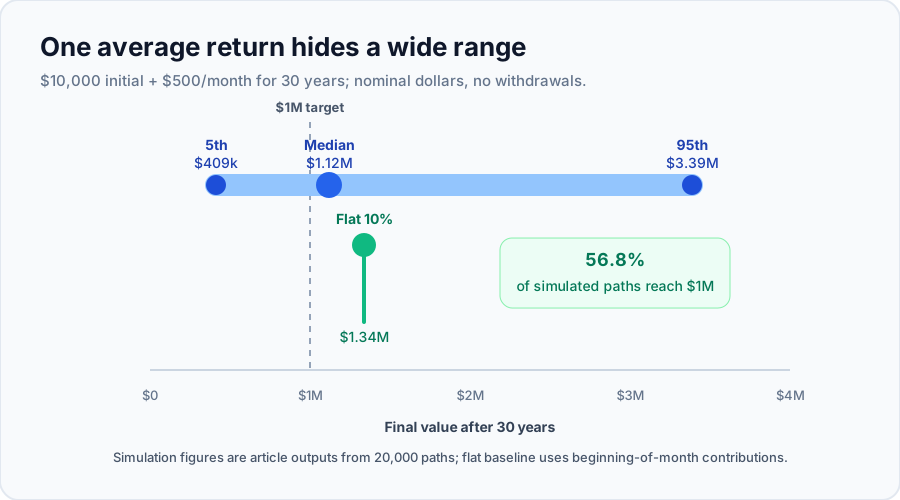
Two things jump out. First, the median Monte Carlo outcome ($1.12M) is meaningfully lower than the deterministic projection ($1.34M) — that gap is called "volatility drag," and it's a real phenomenon, not a glitch. Second, even with the S&P 500's historical mean, you have a 43% chance of falling short of $1M. The flat-rate calculator never showed you that.
What Monte Carlo Actually Does
The mental model is simple: roll the market 10,000 times, write down where you ended up each time, then look at the spread.
For each simulated path, the algorithm:
- Starts with your principal ($10,000)
- Adds your annual contribution ($6,000)
- Picks a random return for that year — drawn from a distribution centered on your expected return (μ), with spread set by volatility (σ)
- Applies that return, moves to the next year, repeats until the end of the horizon
After all paths finish, you sort the final values and read off the percentiles. The 50th percentile is the median outcome (half the paths ended below, half above). The 5th percentile is the worst-case scenario you'd accept 95% of the time. The 95th percentile is the lucky breakout.
The randomness isn't arbitrary. Annual returns are modeled as log-normal — a distribution that matches how real equity returns behave: most years cluster near the mean, but with a long right tail (occasional huge gains) and a bounded left tail (you can't lose more than 100%). Academics call this Geometric Brownian Motion. You don't need to memorize it. Just trust that the math reflects how markets actually move, not how a savings account pretends they move.
μ and σ — The Two Numbers That Matter
Every Monte Carlo run takes two inputs about the asset:
- μ (mu) — Expected annual return. The long-run average. For the S&P 500: ~10%. For investment-grade bonds: ~5%. For a high-yield savings account: ~4%.
- σ (sigma) — Volatility. The standard deviation of yearly returns. S&P 500: ~15%. Bonds: ~5%. HYSA: ~0.5%.
Different return and volatility assumptions produce very different futures. Compare three asset mixes using the same contribution plan:
| Asset | μ | σ | Median (30y) | 5th %ile | 95th %ile | P($1M) |
|---|---|---|---|---|---|---|
| Bonds-heavy | 5% | 5% | $463,219 | $338,708 | $643,717 | 0.0% |
| 60/40 mix | 8% | 10% | $811,758 | $419,314 | $1,654,108 | 31.1% |
| S&P 500 | 10% | 15% | $1,119,659 | $409,488 | $3,385,587 | 56.8% |
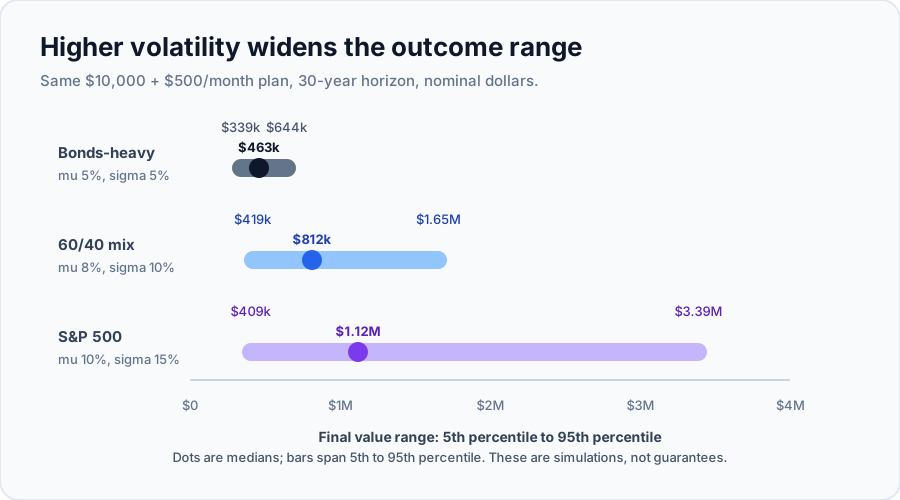
Look at the worst-case (5th percentile) column. Bonds have a much lower expected return, so their downside result is lower than the S&P 500 in this example, but not dramatically so because contributions dominate at low growth. The 60/40 portfolio's worst case is almost identical to the S&P 500's — but its best case caps at $1.65M vs $3.39M. Volatility is the price you pay for that right tail.
The mathematical formula behind a single year's return looks like this:
Where:
- rt = the return for year t
- μ = your expected annual return (as a decimal)
- σ = your annual volatility (as a decimal)
- Z = a random sample from the standard normal distribution N(0,1)
- The σ²/2 term is the "Ito correction" — it's why median outcomes are lower than the mean-only projection
You don't compute this by hand. The tool runs it 10,000+ times for you.
Why This Matters for Real Decisions
Monte Carlo changes how you should think about three questions:
How much you need to save
The deterministic projection said $500/month gets you to $1.34M. Monte Carlo says you have a 57% chance of reaching $1M and a 5% chance of finishing under $410k. If your retirement plan requires $1M, that's not a 100% confident plan — it's a coin flip. Either save more, work longer, or accept the downside risk.
How aggressive you should be
A 60/40 portfolio gives up the 95th-percentile upside ($1.65M instead of $3.39M) but holds the same 5th-percentile floor. If you're risk-averse, that trade — sacrificing extreme upside for nothing on the downside — looks worse than it does for someone who values certainty. Your stomach matters as much as your spreadsheet.
Whether to celebrate or worry mid-journey
When the market drops 30%, deterministic plans panic because they have no model for what "off-track" looks like. Monte Carlo lets you ask: is my balance still inside the 25th–75th percentile band for my plan? If yes, stay the course. If you've dropped below the 5th percentile band, then it's time to act.
How to Use This Today
If you're in the US and investing for retirement, the practical sequence is:
- Open the right account first. Roth IRA up to $7,500/year in 2026 (or $8,600 if 50+), then 401(k) up to $24,500/year ($32,500 if 50+) to capture employer match. Tax-advantaged compounding inside a Roth or 401(k) beats the same returns in a brokerage by 1–2% annualized after taxes.
- Pick an asset class first, then run Monte Carlo on it. Don't simulate "investing" abstractly — run it for the S&P 500 (μ=10%, σ=15%) or a 60/40 mix (μ=8%, σ=10%) or a bond ladder (μ=5%, σ=5%). Each has a known historical profile.
- Compare success probabilities, not single numbers. "$1.3M expected" is meaningless without "60% chance of $1M". Always check the probability of hitting your real target.
- Re-run yearly. Update with your actual balance and remaining years. The simulation is most useful as a recurring check, not a one-time projection.
Common Mistakes to Avoid
Treating the median as a promise. The median is the 50/50 line — half of paths fell short. If you're planning for retirement, plan for the 25th percentile or worse, then treat the median as upside.
Using too few simulations. Below 1,000 runs, the 5th and 95th percentiles bounce around between runs. The worth101 tool offers 1,000 / 5,000 / 10,000 — use 5,000 or 10,000 for any decision that matters.
Ignoring sequence-of-returns risk. Monte Carlo accurately models accumulation. It does not model the special danger of bad returns in the first 5 years of retirement while you're withdrawing — that's a separate problem (search "sequence of returns risk"). For pre-retirement planning, Monte Carlo is the right tool; for the withdrawal phase, you need additional analysis. See our guide to the 4% rule and sequence-of-returns risk for the withdrawal-phase view.
Forgetting what Monte Carlo doesn't include. Standard simulations ignore taxes, fees (a 1% expense ratio can erode ~25% of your terminal wealth over 30 years), inflation (use real returns if you want today's-dollars output), and regime changes (the math assumes the market will behave like its historical average — 2008 and the dot-com bust were outliers but they happened twice in 25 years).
Try It With Your Own Numbers
Don't just read the table. Plug in your own principal, monthly contribution, time horizon, and target — then see what your probability of success actually is.
Start with the flat-rate deterministic baseline below. The table's $1,338,037 baseline uses monthly compounding with beginning-of-month contributions; once you have your baseline, switch to Monte Carlo to see the full range of outcomes:
Run the flat-rate baseline before Monte Carlo
Approximate; annual compounding and monthly contributions.
Run the Monte Carlo simulator on your scenario
You'll see the fan chart of percentile bands, the histogram of final outcomes, and the success probability against your target — exactly the same outputs used to generate the tables in this article.
If you want to compare the Monte Carlo view against the standard deterministic projection, the compound interest calculator is one tab over. Or jump straight to a specific scenario like $10,000 + $500/month at 10% for 30 years to see the flat-rate version of the same plan.
What to read next
Projections are nominal dollars and assume no withdrawals. Deterministic examples use the contribution timing stated near the result; Monte Carlo examples use randomized annual return paths from the stated μ and σ assumptions. Past market returns do not guarantee future results. This article is educational and does not constitute financial advice.