

Nominal return is how fast your dollar count grows; real return is how fast your buying power grows. The difference is inflation. A 10% nominal return with 3% inflation is not a 7% real return by simple subtraction — the exact figure is about 6.8%. Over decades that gap is the difference between the number on your statement and what your money can actually buy.
| Nominal return | Inflation | Quick estimate (subtract) | Exact real return |
|---|---|---|---|
| 6% | 3% | 3% | 2.91% |
| 8% | 3% | 5% | 4.85% |
| 10% | 3% | 7% | 6.80% |
What is nominal return?
Nominal return is the percentage gain you see quoted everywhere — the headline number on a fund fact sheet or account statement. If your $10,000 grows to $11,000 in a year, that is a 10% nominal return. It says nothing about whether prices also rose during that year, so it overstates how much better off you really are.
What is real return?
Real return is the nominal return adjusted for inflation — the growth in what your money can actually buy. If your portfolio gains 10% but everyday prices rise 3%, your real progress is only about 6.8%. Real return is the honest measuring stick for long-term goals, because retirement is paid for in groceries and rent, not in account balances.
The real return formula
The precise relationship is the Fisher equation. The quick “subtract inflation” shortcut is close at low inflation, but the exact formula divides:
For a 10% nominal return and 3% inflation:
- (1 + 0.10) / (1 + 0.03) = 1.10 / 1.03 = 1.068
- 1.068 − 1 = 0.068
- Real return = 6.8%
Subtraction would have said 7%. The 0.2-point difference looks trivial, but compounded across a working life it moves six-figure outcomes.
Why “10% return” can feel like 7%
The famous “stocks return about 10%” figure is a nominal, long-run average. Since 1928, the S&P 500 has returned roughly 10% per year nominal and closer to 7% after inflation, according to NYU Stern's historical dataset, while US consumer prices have risen around 3% a year on average. A roughly 7% real return is therefore a common shorthand for inflation-adjusted long-term stock scenarios. It is a historical planning assumption, not a forecast; any single decade can land well above or below it.
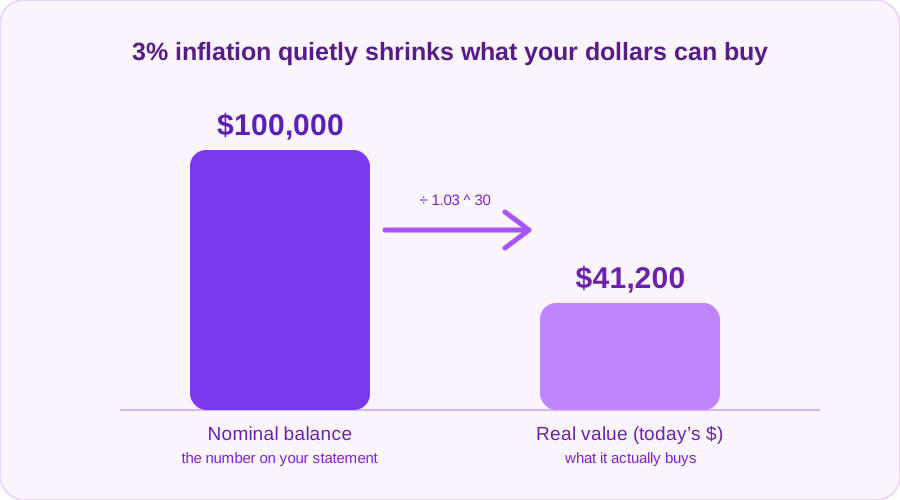
Put it in dollars: $10,000 left to grow at a 10% nominal return for 30 years becomes about $174,000 on paper — but only about $72,000 in today's purchasing power once you strip out 3% annual inflation.
Which number should you use to plan?
For any goal years away — retirement, a kid's college, financial independence — plan in real terms. One clean approach is to project with a nominal return, then discount the ending balance by your inflation assumption. The indexed 30-year compound-interest scenario includes an editable inflation adjustment for this, and the methodology page explains the 3% baseline it uses. Mixing a nominal return with today's expenses can make a long-term plan look more comfortable than its purchasing power really is.
Why FIRE planning leans on real returns
Early-retirement math runs on real returns because a 40- or 50-year horizon gives inflation a long time to compound against you. The 4% rule is built on inflation-adjusted withdrawals, and sequence-of-returns risk is really a story about real spending power in the first decade. Plan in nominal dollars and a portfolio that looks bulletproof can quietly fall short.
Common mistakes
1. Planning with a 10% return and today's expenses. That mixes a nominal return with real costs and inflates your projected lifestyle.
2. Subtracting instead of dividing. At low inflation the error is small, but the Fisher formula is the correct one — and the gap widens when inflation is high.
3. Forgetting that wages and expenses also move. Inflation cuts purchasing power, but it is also why a fixed-dollar savings goal set today may be too small by the time you reach it.
Frequently asked questions
What is the difference between real and nominal return?
Nominal return is the raw percentage gain before inflation. Real return subtracts inflation to show how much your purchasing power actually grew. A 10% nominal return with 3% inflation is about a 6.8% real return.
What is the real rate of return formula?
Real return = (1 + nominal return) / (1 + inflation) − 1. This Fisher equation is more accurate than simply subtracting inflation, especially when inflation is high.
Should I use a real or nominal return to plan retirement?
Keep returns and expenses on the same basis. You can use a real return with inflation-adjusted cash flows, or use nominal assumptions and discount the result for inflation. A roughly 7% real stock return is a historical planning assumption, not a forecast.
Is the S&P 500's return real or nominal?
The commonly cited ~10% long-run average is nominal. After subtracting historical inflation, the real return has been closer to 7% per year since 1928 — a historical average, not a guarantee of future results.
What to read next
Historical averages do not guarantee future returns, and inflation varies year to year. This article is educational and does not constitute financial advice.