

Saving for retirement is one problem; turning that pile into a steady monthly paycheck is a different one. In retirement your income comes from three buckets: Social Security, any pension, and withdrawals from your portfolio. The job of income planning is to stack them so they cover your spending reliably. If you need $5,000 a month and Social Security pays $2,200, your portfolio has to generate the other $2,800 — about $33,600 a year, which a roughly $840,000 portfolio can sustain at a 4% withdrawal rate.
Getting the mix right is what makes income feel like a paycheck instead of a guessing game. Here is how the three buckets fit together, the order most people draw their accounts, and the decisions that matter most.
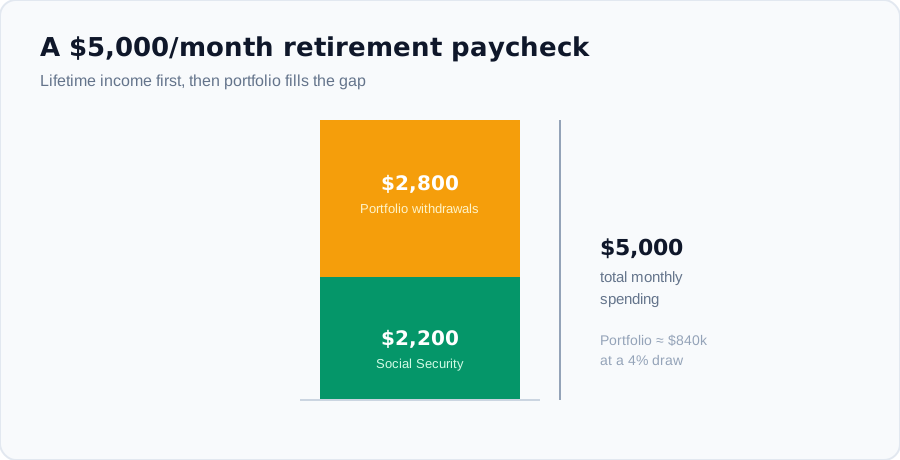
The three income buckets
1. Social Security — your income floor
Social Security is a lifetime federal benefit with annual cost-of-living adjustments, which makes it the foundation of the plan. The age you claim sets the size of the check: about 70% of your full benefit at 62, 100% at the full retirement age of 67, and roughly 124% if you delay to 70 and earn delayed retirement credits. Because it lasts for life and rises with inflation, delaying can be one of the strongest ways to strengthen an income plan.
2. Pension or annuity — if you have one
A traditional pension or an income annuity can also act as lifetime income. Added to Social Security, it raises your income floor and reduces how much the portfolio has to produce. Not everyone has one, but if you do, count it before sizing portfolio withdrawals.
3. Portfolio withdrawals — the flexible top-up
Whatever spending isn’t covered by lifetime income comes from your 401(k), IRA, and brokerage accounts. This is the flexible bucket — you can dial it up or down — but it is also the one exposed to markets, so a sustainable withdrawal rate (commonly around 4%) matters. See the 4% rule for the reasoning behind that figure.
Putting the stack together
| Source | Monthly | Annual |
|---|---|---|
| Spending need | $5,000 | $60,000 |
| Social Security | $2,200 | $26,400 |
| Portfolio must provide | $2,800 | $33,600 |
| Portfolio needed (÷ 4%) | — | ~$840,000 |
The portfolio only has to fill the gap above lifetime income. That is why two retirees with the same spending can need very different savings — the one with a bigger Social Security or pension check needs a smaller portfolio.
Which account do you draw first?
For a typical retiree, a common, tax-aware order is to spend from taxable brokerage accounts first, then tax-deferred (traditional 401(k)/IRA), and leave Roth for last when its tax treatment and your estate goals make that useful. This is a general framework, not a rule for everyone. The Worth101 retirement calculator uses a simplified taxable → Roth → tax-deferred order for its year-by-year projection, while many real tax plans use taxable → tax-deferred → Roth depending on brackets, RMDs, heirs, and Roth strategy. Both are distinct from the early-retirement Roth-conversion strategies the FIRE withdrawal-order guide covers, which solve the very different problem of reaching pre-tax money before age 59½. Once you reach your 70s, required minimum distributions from traditional accounts can force withdrawals regardless of order.
The decisions that matter most
- When to claim Social Security. Delaying raises your income floor for life, but the right age depends on health, cash needs, spouse benefits, and tax timing.
- How much to withdraw. A sustainable rate protects against running out; flexibility in down years protects it further.
- Keeping a cash buffer. One to two years of spending in cash lets you avoid selling investments after a market drop.
- Managing taxes. The order you tap accounts affects your lifetime tax bill; coordinate it with your withdrawal plan.
Frequently asked questions
How do I create a retirement paycheck?
Start with lifetime income (Social Security and any pension), then set up regular withdrawals from your portfolio to cover the remaining spending. Many retirees automate a monthly transfer so it feels like a salary.
How big a portfolio do I need for income?
Roughly 25 times the spending your portfolio must cover after Social Security and a pension. If that gap is $33,600 a year, about $840,000 supports it at a 4% rate. See how much you need to retire for the full method.
What to read next
This article is educational and not financial, tax, or investment advice. Withdrawal-order and withdrawal-rate guidance are general frameworks, not personal recommendations; your best plan depends on your accounts, taxes, and goals. Verify Social Security and tax rules with official sources before deciding.