

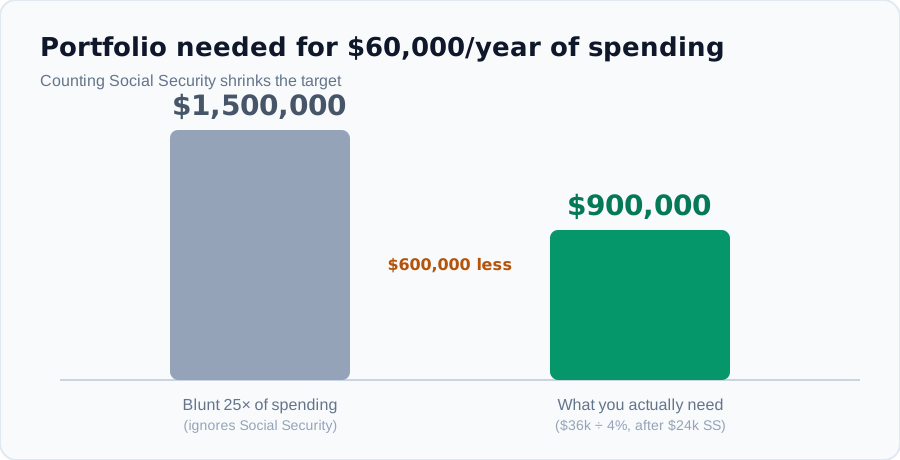
There is no single magic number — but there is a simple way to find yours. The portfolio you need to retire is roughly your annual spending minus the income you’ll get from Social Security and any pension, divided by a safe withdrawal rate of about 4%. If you expect to spend $60,000 a year and Social Security will pay about $24,000 of that, your portfolio only has to cover the other $36,000 — so you need around $900,000, not the $1.5 million a blunt “25× your spending” rule would suggest.
That gap is the whole point of this guide. Social Security is a lifetime federal benefit with annual cost-of-living adjustments, so it can dramatically shrink the pile of savings you actually need. Below is the formula, three worked examples at different spending levels, and the four things that move your number the most.
The formula: spending minus lifetime income
Start with the version everyone has heard — the 25× rule — then fix it for the income you already have coming in:
Dividing by 0.04 is the same as multiplying by 25, and it comes from the 4% rule — a planning baseline often used for withdrawals of about 4% per year, adjusted for inflation. The key change for normal retirement is the two subtractions: money that arrives every month from Social Security or a pension is spending that your savings do not have to fund.
Three worked examples
Here is the same math at three common spending levels, assuming Social Security is claimed at the full retirement age of 67 (which is the full retirement age for anyone born in 1960 or later):
| Annual spending | Social Security (per year) | Portfolio must cover | Portfolio needed (÷ 4%) |
|---|---|---|---|
| $50,000 | $18,000 | $32,000 | $800,000 |
| $60,000 | $24,000 | $36,000 | $900,000 |
| $80,000 | $30,000 | $50,000 | $1,250,000 |
Notice how much Social Security does. At $60,000 of spending, the blunt 25× rule says you need $1.5 million. Once you count a $24,000 benefit, the real target drops to $900,000 — a $600,000 difference driven entirely by income you’ve already earned. That is why a retirement number and a FIRE number are not the same: early retirees often can’t count on Social Security for decades, so their target stays closer to the full 25×.
Four things that move your number most
1. Your spending — by far the biggest lever
Every $10,000 of annual spending adds about $250,000 to the portfolio you need ($10,000 ÷ 0.04). That makes a realistic retirement budget the single most valuable input — guess your spending and the whole number is guesswork. If you want a quick pace check before you have a budget, the savings-by-age targets give you a rough milestone for your age.
2. When you claim Social Security
Claiming at 62 permanently reduces your benefit to about 70% of the full amount; waiting until 70 raises it to roughly 124% through delayed retirement credits of about 8% per year. A larger benefit means less your portfolio has to cover.
3. The withdrawal rate you assume
A 4% rate implies a 25× target; a more cautious 3.5% rate implies about 28.5×. For $36,000 of portfolio-funded spending, that is the difference between $900,000 and roughly $1,029,000. Long retirements and shaky early markets argue for the more conservative end.
4. Retiring before 65 (the healthcare gap)
Medicare generally starts at 65. Retire earlier and you must self-fund health coverage in between — often through the ACA marketplace — which can add thousands of dollars a year to your spending until Medicare kicks in. If that is your plan, the early-retirement healthcare-before-Medicare guide is worth a read.
Common mistakes
- Ignoring Social Security. Using a flat 25× of spending can overstate your target by hundreds of thousands of dollars, as the table above shows.
- Forgetting that withdrawals are taxed. Money in a traditional 401(k) or IRA is taxed as income when you withdraw it, so $900,000 of pre-tax savings spends like less. Roth balances and the standard deduction soften this, but plan for it.
- Assuming spending stays flat. Many retirees spend more in the active early years and less later, while healthcare costs rise with age. A single flat number hides that shape.
Frequently asked questions
Is the 25× rule wrong?
It is a fine starting point for the portfolio-funded part of spending, but applying it to your entire budget ignores Social Security and any pension. Subtract lifetime income first, then apply 25× to what is left.
What does the average person need?
There is no useful average, because it is driven by your spending. Two people the same age can need $700,000 and $2 million depending only on lifestyle. That is why a personalized calculation beats any benchmark.
How do I find my Social Security estimate?
Create a free account at ssa.gov/myaccount to see your projected monthly benefit at 62, full retirement age, and 70.
What to read next
This article is educational and not financial, tax, or investment advice. Examples use a steady-rate, simplified model and round figures; your real result depends on markets, taxes, and your actual spending. Verify your Social Security benefit with the SSA and re-check current rules before making decisions.