

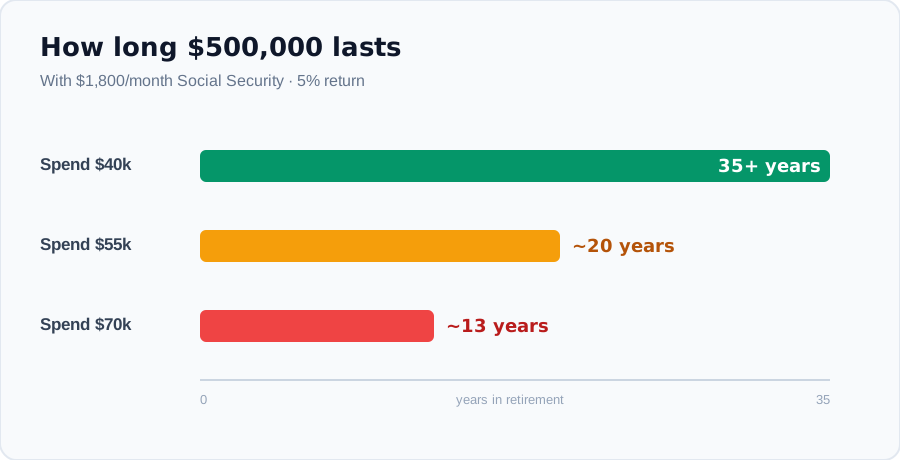
How long your money lasts depends far more on your spending and Social Security than on your balance alone. Take a 65-year-old with $500,000 and a $1,800-a-month Social Security check. If they spend $40,000 a year, the portfolio only has to cover about $18,400 after Social Security — and in this simplified steady-return example it lasts 35+ years, through age 100. Push spending to $70,000 and the same $500,000 is gone in roughly 13–15 years. Same balance, wildly different outcomes.
That is the uncomfortable truth about “will my money last”: there is no fixed answer for a balance. Below are the three levers that decide it, a comparison table, and the one risk — the order of your returns — that a simple average hides.
The three levers that decide how long money lasts
Every “how long” answer comes down to how fast you draw the portfolio down versus how fast it grows. Three things set that balance:
| Annual spending | From portfolio (after $21,600 Social Security) | $500,000 lasts about… |
|---|---|---|
| $40,000 | $18,400 | 35+ years (through 100) |
| $55,000 | $33,400 | ~20 years |
| $70,000 | $48,400 | ~13 years |
These illustrations assume a 5% return during retirement and 2.5% inflation, with Social Security of $1,800/month. They are simplified — real markets don’t return exactly 5% every year, and they ignore taxes — but they show the shape: the draw after Social Security is what burns the portfolio down.
1. Spending (the throttle)
A 4% first-year withdrawal is a common 30-year planning baseline; an 8% withdrawal roughly doubles the burn rate and leaves far less room for bad markets. This is the same idea as the 4% rule, read backwards.
2. Lifetime income (the brake)
Social Security and any pension cover part of your spending, so they directly slow the drawdown. Social Security benefits also receive annual cost-of-living adjustments. The larger your benefit — for instance by delaying your claim toward age 70 — the less your portfolio has to do.
3. Returns (the engine)
A higher return stretches the money, but most retirees shift toward a more conservative mix, so a 4–5% in-retirement assumption is often a more conservative planning assumption than the 7–10% you might use while still working and compounding.
The hidden risk: the order of returns
Two retirees can average the exact same return over 30 years and end up in completely different places if one hits a bad market in their first few years. Selling investments to fund spending while prices are down locks in losses the portfolio may not fully recover from — a problem known as sequence-of-returns risk. It is most dangerous in the first five to ten years of retirement, which is why a cash buffer and the flexibility to trim spending in down years matter so much.
How to make your money last longer
- Trim the draw, not just the balance. Cutting spending by $5,000 a year does more for longevity than chasing an extra 1% of return.
- Compare Social Security claiming ages. A bigger lifetime check can reduce how much your portfolio has to fund, especially if longevity is the main risk.
- Stay flexible. Spending a little less in bad market years dramatically reduces the chance of running out.
- Keep a cash cushion. One to two years of expenses in cash lets you avoid selling investments at the worst time.
Frequently asked questions
Will I run out of money in retirement?
Only if your withdrawals consistently outpace your portfolio’s growth. Because Social Security keeps paying for life, the real risk is depleting the portfolio portion — not your total income — so a modest, flexible draw is usually durable.
How much can I safely withdraw?
A common planning starting point is about 4% of the portfolio in year one, adjusted for inflation after that. Longer retirements or a cautious outlook argue for 3.5% or less. See the discussion of whether the 4% rule is still safe.
What to read next
This article is educational and not financial, tax, or investment advice. The examples use a steady-rate, simplified model and ignore taxes and year-to-year market variation; your real timeline depends on markets, spending, and the order of your returns.